Additive Manufacturing Forecast 2025: 5 Tips for Success



Over the last few weeks, AMFG have released articles forecasting AM in 2025.
Throughout this miniseries, one central question has anchored the discussion: what type of year will it be for AM?
Drawing from statistics, news items, and opinions from industry leaders, we predict that 2025 will be a year of cautious optimism. The industry is set to begin to make up ground after the trials and tribulations kindled by high interest rates post-pandemic and the loss of faith in AM as a disruptive technology.
2024 was a challenging year, yet there was still hope for AM given renewed potential in the technology by various industries.
This trend is set to continue into 2025, spurred by increased interest from various sectors, including healthcare and aerospace and defence, and broader adoption of AI and software to drive down cost per part.
Market conditions are more favourable than previous years thanks to gradual growth and disinflation. Market consolidation could foster a united approach to encouraging AM adoption, and reshoring policies spell opportunity for 3D printing.
So there’s good reason to be hopeful about the coming year for AM. Yet these advancements cannot be secured without careful strategies and planning.
Here are 5 steps to ensure success in AM in 2025.
1. Make sure you meet regulations

As we’ve seen in the technology and applications forecast, healthcare, aerospace and defence denote big areas of opportunity in 2025. The unique capabilities of the technology include the personalisability and customisability for orthotics, prosthetics, anatomical models, surgical guides, implants, and PPE, and the ability to completely centre defence production in the home country– and this is attracting companies in these sectors.
But both industries bear stringent regulations that must be met. Medical device implementation in the EU, UK, and USA are governed by regulatory bodies that include the European Medical Device Regulation and standards governed by the FDA in the US. Security and visibility are essential for AM companies to keep up to date with compliance standards in order to secure contracts in 2025.
The regulations include:
- ITAR- regulates the ITAR regulates the manufacturing, export, and transfer of defense-related items on the U.S. Munitions List (USML). It ensures that sensitive technologies and data don’t fall into unauthorized hands.
- ISO13485- an internationally recognised quality management system standard for medical devices.
- AS9100- an international standard for aerospace management systems widely adopted for the aerospace sector.
Companies looking to achieve success in this burgeoning industry will consider MES solutions that help to ensure these standards are met. AMFG guarantees full ITAR compliance and allows manufacturers to bolster security by leveraging Cyber Essentials Plus and ISO certifications for both enterprise and defence-focused AM operations.
Likewise, AMFG allows companies to consistently attain ISO13485 and AS9100 compliance, by implementing real-time tracking of quality assurance tasks within AM service bureaus.
Since 2020, AMFG have collaborated with Ricoh, with the implementation granting critical insights into Ricoh 3D’s medical part production, with the traceability enabling them to meet exacting ISO13485 standards, vital for their medical industry customers. Book a demo to find out how to ensure you meet regulatory requirements in 2025. Book a demo
2. Prepare for onshoring opportunities

The US have recently implemented policies to reshore manufacturing and decrease dependence on foreign products and supply chain steps located in other countries. The new President announced tariffs in early February that would impact China, and possibly Mexico and Canada, in a general bid to revitalise American manufacturing.
AM is well positioned to capitalise on this opportunity. A pivot towards onshoring marries naturally with distributed manufacturing, the cornerstone of AM. Dependence on overseas steps in the supply chain diminishes, and Just-In-Time (JIT) manufacturing can truly be employed, decreasing the risk of supply chain collapse.
Additive OEMs and service bureaus can use this chance to further AM adoption in 2025. Digital inventories can encourage production in local markets, reduce costs, and diminish risks to the supply chain.
But digital inventories need as much care and attention as physical ones, and manufacturers must be prepared. AMFG allows manufacturers to manage digital inventory, streamline shipping processes, and directly connect with preferred suppliers and subcontractors and enable on-demand, distributed manufacturing. HP and AMFG collaborate to solve a lack of connectivity across the AM workflow, meaning HP Jet Fusion users can track production status and receive critical alerts and information in real time.
3. Transparency is key
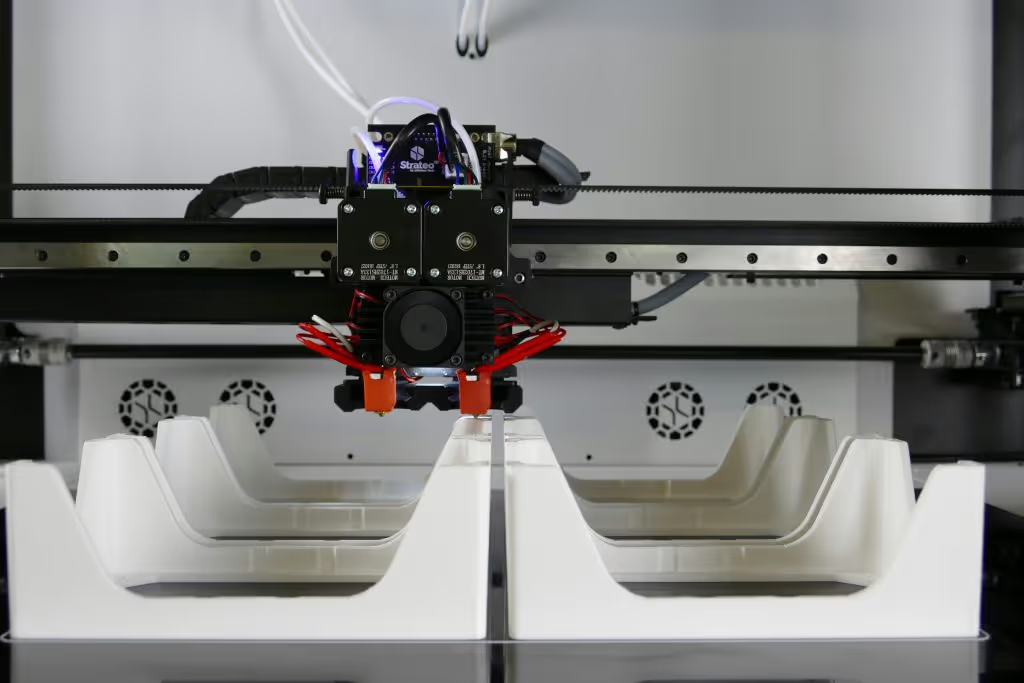
The potential possessed by AM cannot be denied. Yet, as we explored in the first article in this miniseries, 2021/22 presented some major snags, and manufacturers have been working to build back confidence ever since.
It is therefore crucial that manufacturers exhibit a degree of realism in regards to applications and performance, and that they do the necessary homework and produce a practicable programme for 2025. Given that the market has substantially shifted away from selling technology and towards selling solutions, a large part of this will consist of listening to customers and providing data-backed, transparent solutions.
AM is inherently predisposed towards agile manufacturing, so companies should be prepared to listen and respond quickly to customer needs. Quotation has historically impeded immediate response to client’s demands, so companies should consider MES software that speeds up the quotation process.
Since 2023, Portuguese company Varishapes have used AMFG’s Instant Quote Tool, which has permitted them the ability to offer customers hassle-free and rapid quotations, transforming a process which previously took days to a matter of mere minutes.
For companies like Varishapes, who ensure short lead times and tailor-made solutions, a system which prioritises adaptability and transparency is key. Success in 2025 will be defined by preparation– make sure your business is ready.
4. Embrace technology
2025 will see manufacturers take a step towards significantly scaling up their operations.
We are firmly in the midst of Industry 4.0, and in this coming year, companies will continue to leverage AI and machine learning solutions to scale production. Software is being employed to rethink and redesign production lines, and simulation is beginning to usurp on the role habitually held by physical prototyping.
Success in 2025, as we begin to make the transition from Industry 4.0 to 5.0, will be defined in technological parameters, and the extent to which machines are used to complete menial tasks, leaving time and resources for human creativity. AI will be leveraged in various solutions designed to reduce the need for human labour and increase productivity.
We’ve already seen companies turning to MES solutions to achieve this. In 2024, AMFG partnered with Toolkit3D to facilitate seamless workflows within healthcare and allow customers to scale in digital manufacturing.
5. Scale production

If 2024 laid the foundations conducive to stabilisation, then 2025 is the year for AM companies to build on this. Manufacturers can bolster confidence in the potential harboured by the technology by applying their solutions to industrial applications that have a real-world impact.
Scalability is now number one on the checklist. Industrial AM is leaving the ‘trough of disillusionment’ and is embarking on the ‘slope of enlightenment’ towards serious, widespread adoption.
The question is no longer if or when companies can scale to serial additive production, but how. Organisations have realised that scaling and expanding AM requires more than simply investing in AM machines and materials alone. Rather, scalable processes need a high level of control and transparency over machines, teams, and AM production operations, which is only achievable with the right digital infrastructure in place.
It makes day-to-day business processes more efficient, by enabling rapid prototyping and coordinating tasks between people. And it also helps to synchronise data between systems, making the integration of AM into a digital manufacturing environment much simpler. With additive MES, you can build a solid production management strategy and successfully scale serial AM in 2025.
Read the other articles in the miniseries:
- Additive Manufacturing in 2024: A Summary
- Additive Manufacturing Forecast 2025: Technology and Applications
- Additive Manufacturing Forecast 2025: Market
About AMFG
AMFG is an award winning MES designed to empower production workflows, from order placement to shipment, with seamless integration and precision automation.
With over 500 successful implementations in 35 countries and across a range of industries, we specialize in enabling companies to successfully integrate our software for AM and CNC production, into their wider manufacturing processes and scale their AM operations.
For more information, please contact us here: Book a demo


.avif)
.svg)