Digital Twins and 3D Printing: Revolutionising Manufacturing



We are in the midst of Industry 4.0. Every year, new innovations and integrations facilitate a step towards a holistic technological approach towards manufacturing, and progress will only speed up from here on in.
Among these transformative technological advancements in recent years is the integration of digital twins with additive manufacturing (AM).
A digital twin is a virtual replica of a physical system, product, or process that allows real-time simulation, monitoring, and analysis. From the output of the model, scientists can make predictions about the behaviour of the actual entity, and make or change decisions in the real world.
In the world of AM, digital twins enable manufacturers to enhance product quality, optimise production workflows, and reduce costs. Usage is gaining in popularity; the digital twin market was already valued at $6.9 billion in 2022 and is forecasted to boom to $73.5 billion by 2027.
In this article, we explore how digital twins are revolutionising additive manufacturing and shaping the future of modern production systems.
What are digital twins?
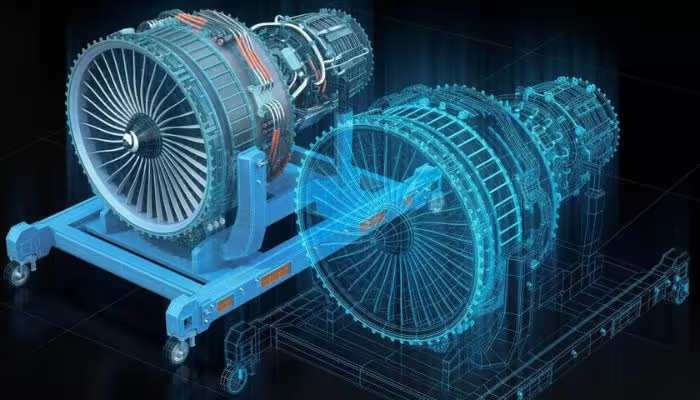
Image courtesy of Konica Minolta
Digital twins have their roots in the 1960s, formulated as a way to create a living model of the Apollo mission to help evaluate potential failure through a physical model of the vehicle with digital components. The concept has evolved now, to a computer model that can be used to identify patterns of behaviour for the item in the real world.
Yet digital twins are more than mere models– they employ algorithms and mathematical workings to predict behaviour of the parts, such as those produced by 3D printing processes. The breadth and depth of the representations offered by twin technology is unrivalled.
A digital twin in AM is a dynamic, real-time digital counterpart of the physical 3D printing process. It captures data from sensors embedded in machines, integrates simulation models, and applies artificial intelligence (AI) and machine learning (ML) to predict outcomes, detect defects, and optimise parameters. By mirroring the physical environment, digital twins enable manufacturers to anticipate problems before they occur and fine-tune processes for maximum efficiency.
A digital twin starts as a 3D model, produced through CAD, generative design, or 3D scanning, the latter picking up traction due to its bullseye accuracy when creating a model of the specific part.
As mentioned above, there are different forms that digital twins can take, and this extends to AM. The models can be broadly divided into four categories: process digital twins; equipment digital twins; facility digital twins; and product digital twins. The first three account for the entire printing process, from printers to factory floors, and product digital twins enable manufacturers to optimise, design, and test a part after predicting performance– a truly revolutionary development for AM.
The benefits of digital twins for AM
AM and digital twins have only been combined in recent years, yet the partnership seems like a match made in heaven. 3D printing is inherently digital, and rather than revamping current processes to integrate digital twins, the models can be treated as just another tool– albeit an incredibly helpful one.
While AM offers significant advantages over traditional manufacturing methods, including design flexibility and material efficiency, it also presents challenges related to quality control, process stability, and material behavior. This is where digital twins come into play.
Process Optimisation and Predictive Modeling
Digital twins allow manufacturers to simulate and analyse various printing conditions, materials, and design geometries before actual production begins. By running simulations, engineers can determine the best parameters for factors like temperature, layer adhesion, and printing speed, ensuring higher-quality outputs.
Predictive modeling also helps in identifying potential issues such as warping, residual stress, or layer misalignment, minimising material waste and rework. This is particularly useful for processes in industrial applications, such as LPBF metal AM, as it could drastically improve consistency.
Real-Time Monitoring and Data-Driven Decision Making
Integrating twin technology with AM enables real-time monitoring of the manufacturing process. Sensors embedded in the 3D printer collect data on parameters such as temperature, pressure, humidity, and material properties. This data is then analysed by the digital twin to detect anomalies, provide alerts, and recommend adjustments. Manufacturers can make informed decisions to optimise production and ensure consistency across batches.
Likewise, the values of cost and material reduction that AM holds dear can still be retained. Digital twins permit users to directly assess parameters through a continual stream of data due to the feedback. This real-time monitoring means that these parameters can be optimised without having to resort to physical testing, which wastes time, money, and material.
Quality Assurance and Defect Prevention
One of the significant challenges in AM is ensuring repeatability and consistency. The industry has moved on from its early days of rapid prototyping, but quality control is still a worry. Therefore, a tool like digital twins allows manufacturers to cut back on extensive testing.
Digital twins facilitate closed-loop feedback systems where any deviation from the expected outcome is detected immediately. If an issue arises, the digital twin can compare the actual print with the intended design and suggest corrective actions. This minimises post-processing requirements and reduces the risk of producing defective parts, especially in industries like aerospace and healthcare, where precision is critical.
Industry Applications of Digital Twins in Additive Manufacturing
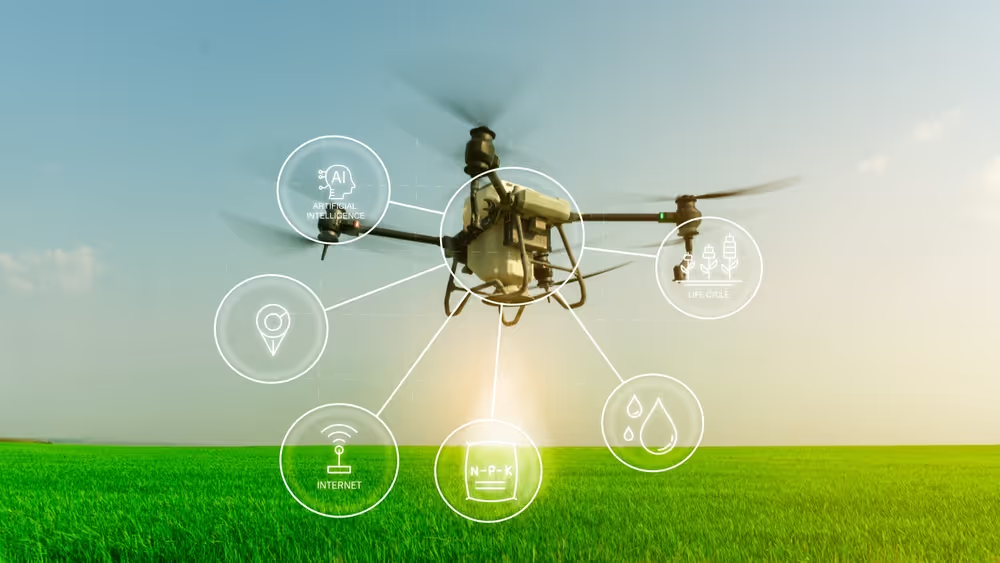
Aerospace and Defense
The aerospace and defense industries rely heavily on AM for producing lightweight, high-performance components. Digital twins help optimise the design and manufacturing of aircraft parts, ensuring structural integrity and compliance with stringent regulatory standards. By enabling real-time monitoring and defect detection, twin technology enhances the reliability of critical components used in aircraft and space exploration missions.
Healthcare and Medical Devices
In the healthcare sector, digital twins are transforming the production of patient-specific implants, prosthetics, and medical devices. By creating virtual models of patient anatomy, surgeons can simulate procedures and customise medical implants to improve patient outcomes. Digital twins also assist in ensuring biocompatibility and regulatory compliance in medical manufacturing.
Automotive and Industrial Manufacturing
Automotive manufacturers are increasingly adopting AM for prototyping and producing lightweight components. Digital twins streamline the development process by allowing engineers to test different designs digitally before printing. This reduces the time required for physical prototyping and accelerates innovation in vehicle design and production.
As an example of twin technology in use, we can turn to the Turing Institute's digital twin they produced of the world’s first 3D printed bridge. With around 100 sensors on the bridge, they can measure the bridge’s load, how it vibrates, bends, and tilts according to food traffic, temperature and humidity, and how these factors affect the composition of the walkway. 3D printing is a new way of building, and engineers are symboiotically benefitting from twin technology to identify how the AM product performs.
Final thoughts
Digital twins are redefining additive manufacturing. Twin technology symbolises a fundamental change in the way we design, test, and optimise parts, and shouldn’t be ignored.
From optimising printing parameters and ensuring quality control to reducing downtime and promoting sustainability, digital twins unlock new levels of efficiency and innovation, offering the chance to revolutionise factory floors across the world.
As technology continues to evolve, the synergy between digital twins and additive manufacturing will drive the future of smart manufacturing and deep technology, enabling industries to produce higher-quality products with greater precision and lower environmental impact.
There are still some challenges; for one, cybersecurity concerns must be addressed to protect sensitive manufacturing data from cyber threats.
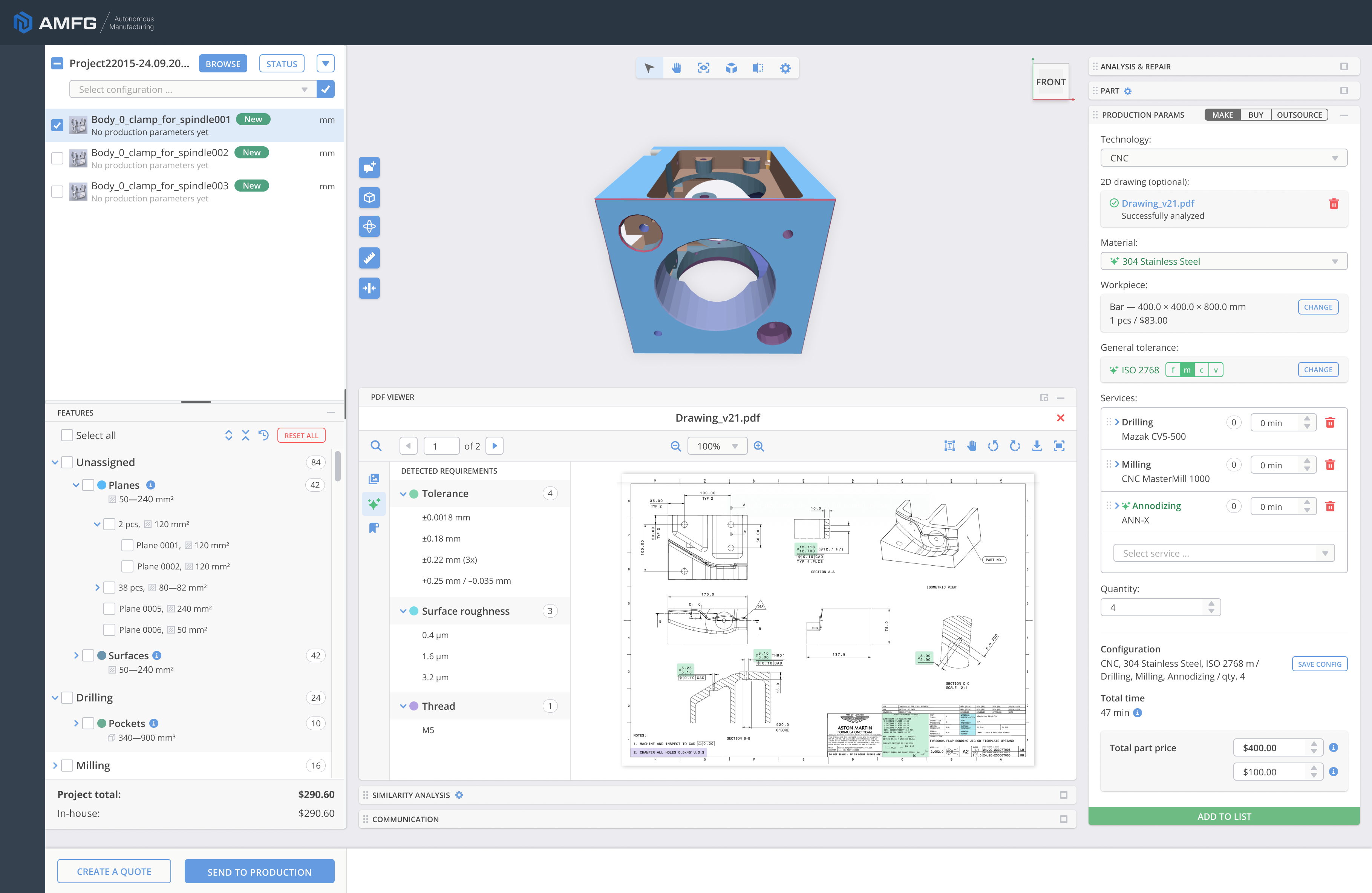
Embracing this technology is not just an advantage—it is a necessity for manufacturers aiming to stay competitive in the modern industrial landscape. AMFG is an award-winning MES solution for additive manufacturing that empowers production workflows, from order placement to shipment, with seamless integration and precision automation.
Combining tools like AMFG’s MES and digital twins is the way forward for additive manufacturing. Book a demo to discover how to prepare your company for the future:


.avif)
.svg)