Latest Developments in Additive Manufacturing: February 2025



There are few industries in which monthly stories could range from haute fashion and tea-based bioprinting pens, to concrete wall standards, to protection for astronauts– yet AM manages it.
This month, AMFG takes a look at the headlines in AM in February, focusing on 5 of the biggest:
Gucci launches a partially 3D-printed shoe

Gucci Cub3d. Image courtesy of Gucci
Gucci have produced a one-off, not-for-sale shoe that combines SLS 3D printed elements with its custom Demetra material. The Gucci Cub3d’s additively manufactured midsole features a lattice structure inspired by the polyhedron. Utilising 3D printing was not merely an aesthetic decision; the SLS technology facilitates a lighter, cushioning midsole.
With the Cub3d, the Italian fashion pioneers have married technological and innovation with renewable principles. In the sneaker’s upper construction, mesh is combined with Demetra, a new material from Gucci composed of 77% plant-based raw materials and responsibly managed sources. Gucci’s iconic Red ‘Ancora’ decorates the Cub3d, matching the Via Montenapoleone in which the footwear will be showcased in mid-April.
The House are no strangers to interacting with 3D printing– Jared Leto famously appeared at the 2019 Met Gala clutching an $11,000 3D printed replica of his own head as part of a Gucci outfit, while Beyoncé launched her whisky brand in 2024 appearing in a Gucci dress and holding a custom 3D-printed crystallised bag.
Although the Cub3d will be reserved for the feet of collectors (the limited edition is composed of only 20 pieces), Gucci’s opening foray into the world of 3D printing is promising for the industry. Brands including adidas, ASICS, and Reebok (February also saw Nike achieving a patent for a new footwear 3D printing process) have all released shoes with 3D printed elements, so it’s worth monitoring if high fashion opts for adopting AM too.
Tea-time for bioprinting
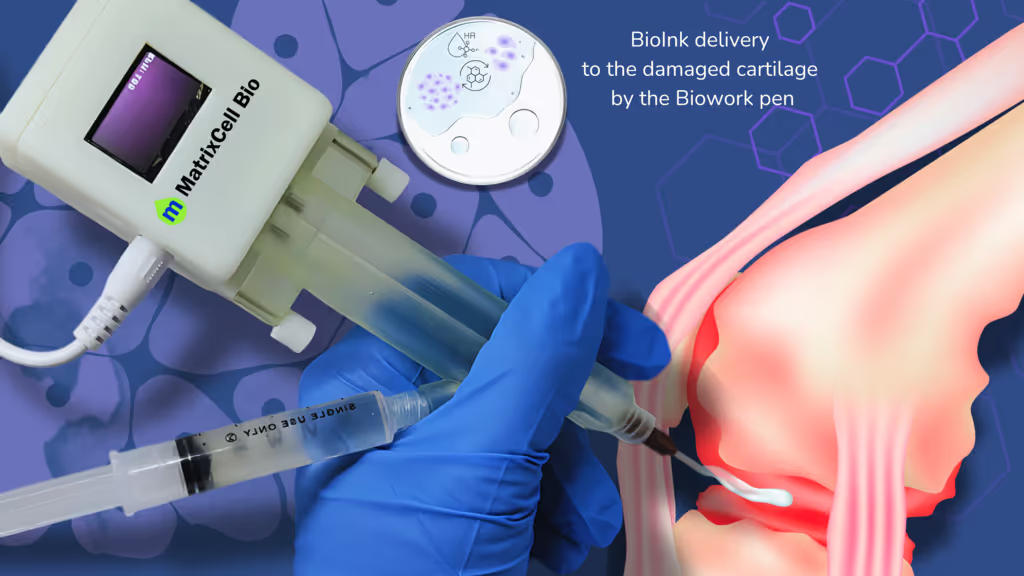
The Biowork pen delivering bioink. Image courtesy of MatrixCell Bio
A team of researchers at Seoul National University of Science and Technology has developed a bioink using nanocellulose derived from Kombucha SCOBY (Symbiotic Culture of Bacteria and Yeast) as the scaffold lead.
The nanocellulose from SCOBY can be partially hydrolyzed, reinforced with chitosan and kaolin, and printed onto irregular wounds after being loaded onto the hand-held ‘Biowork’ biopen.
This biopen will then permit the precise application of bioink to damaged defected areas, facilitating the path towards personalised in vivo tissue repair.
Kombucha SCOBY produces cellulose during tea fermentation, thus producing nanocellulose that is biodegradable and cell-compatible. The default entangled structure can be difficult to extrude, so acetic acid is used to loosen the fibres before restoring structural stability with the addition of chitosan and kaolin.
Bioprinting has typically involved complex, time-consuming processes in which tissue scaffolds are carefully cultivated in labs before implementation. Yet this discovery would allow doctors to go straight from bioink to treatment, revolutionising the state of play in bioprinting.
3D printed hydrogels help protect astronauts from radiation

Illustration of space radiation. Image courtesy of ESA
Space is dangerous- in just one day beyond the protection provided by our atmosphere and magnetic field, astronauts are exposed to the equivalent radiation received on Earth in a year.
For these missions, which may one day include missions to Mars, protection from radiation is of paramount importance. Any shielding must be lightweight, effective, and adaptable to different environments.
Researchers at Ghent University are devising a solution which involves shaping 3D printed hydrogels into custom radiation shields. The research, conducted in collaboration with the European Space Agency (ESA), aims to solve complications borne from using water as a radiation shield by incorporating it into suberabsorbent polymers that can then be printed into stable structures.
Water is relatively dense and contains a lot of hydrogen atoms to slow down incoming radiation particles, but bulky containers could limit movement and leak if the container is punctured.
Unlike free-flowing water, 3D printed hydrogel structures retain water in a stable form, meaning they’re both easier to integrate into spacesuits and spacecraft and can hold water without leaking.
Speaking about the project, researcher Lenny Van Daele said ‘the beauty of this project is that we are working with a well-known technology. Hydrogels are found in many things we use every day, from contact lenses to diapers and sanitary products’.
Launch of revolutionary 5-in-1 3D printer for biomanufacturing
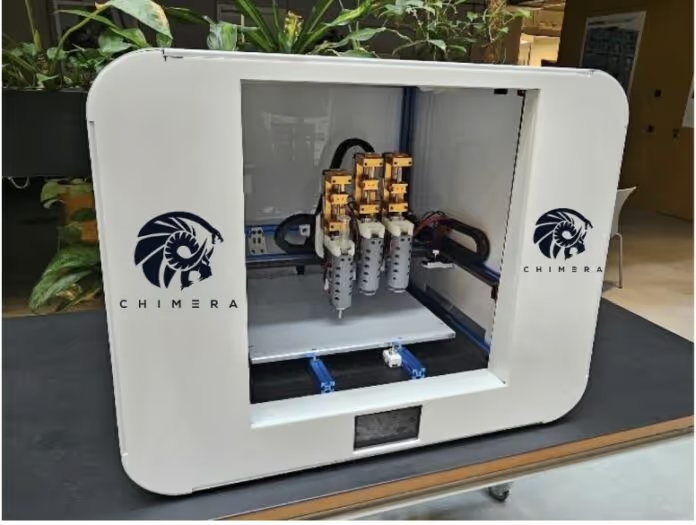
Image courtesy of Ourobionics

.avif)
.svg)