Latest Developments in Additive Manufacturing: March 2025



Spring is here, and it has brought with it a host of interesting developments in the world of AM.
From robotic hands and 3D printers in space, to an entirely additively manufactured train station, AMFG runs down five of the biggest developments in AM in March.
The world's first 3D printed train station
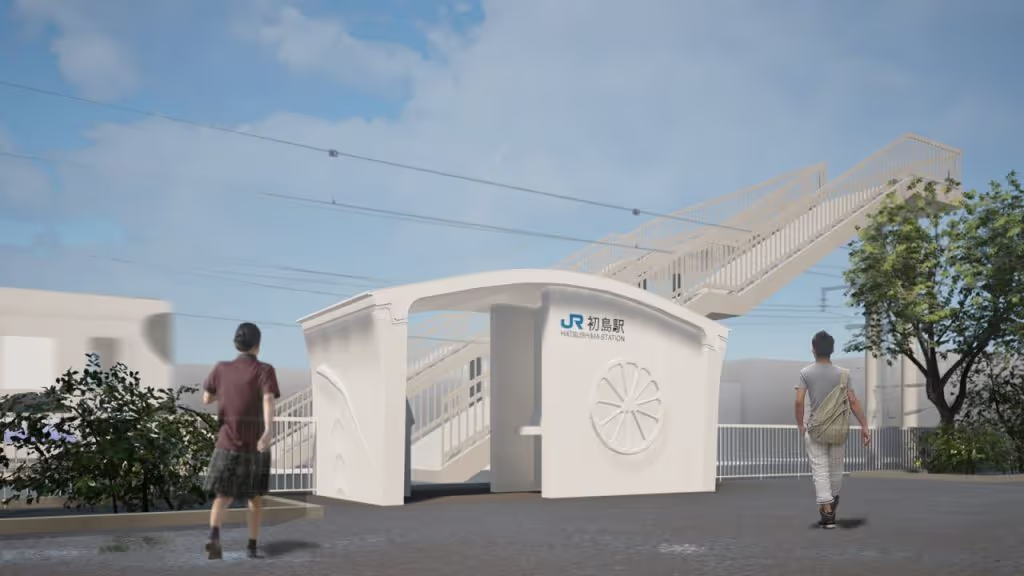
Image courtesy of West Japan Railway Group.
At the end of March, engineers in Japan 3D printed a train station in about 3 hours.
Yes, you read correctly– West Japan Railway Company, one of the main groups responsible for running bullet trains, built a classroom-sized railway station to replace an existing wooden iteration on the Kisei-Arita line in Wakayama Prefecture.
The innovation combines Japanese expertise in the construction of earthquake-proof buildings with modern construction technology, producing new buildings using robot extrusion.
The individual parts of the station building were manufactured and then assembled into a complete building on site with the use of a crane. The formwork, used to mold concrete sections, was 3D printed using mortar, which were then filled with concrete and steel reinforcement to create the four parts of the building and its foundations, which were then transported and assembled.
Construction occurred between the last evening train and the first in the morning, and reportedly only took two and a half hours. The duration of the build was (rather obviously) drastically shortened compared to traditional construction methods, and the Japan Times estimated that the cost was half of that needed when using reinforced concrete.
Additive construction featured heavily in this month’s AM news; the US DoD unveiled new, 3D printed barracks at Fort Bliss, and ICON announced their intention to additively manufacture a dozen two-story residential homes in Texas.
Hybrid robotic hand able to replicate human touch
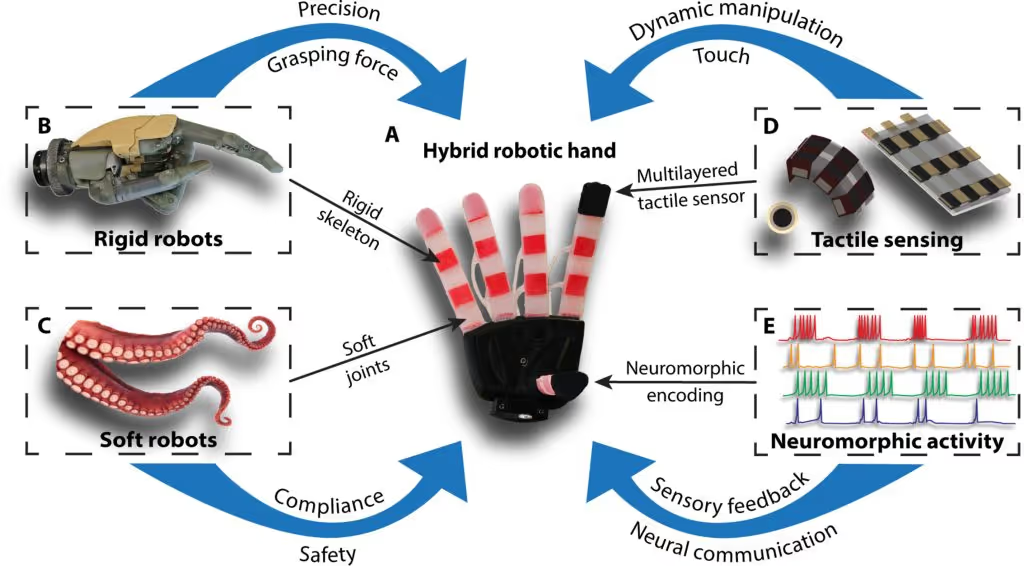
Hybrid robotic hand with neuromorphic tactile sensing. Image via JHU
Engineers at Johns Hopkins University have developed a breakthrough prosthetic hand able to mimic human touch. The hand, whose research was funded in part by the US DoD, is able to deftly handle everyday objects, from plush toys and water bottles to other humans, carefully adjusting its grip to avoid damaging or mishandling.
Historically, robot hands have been excessively rigid or soft to replicate the touch of a human. The hybrid robotic hand, however, combines the flexibility of soft robotics and the strength of traditional rigid robotics, permitting it to both pick up a fragile plastic cup and securely hold a water bottle.
The hybrid robotic fingers use three independently actuated soft joints made from Dragon Skin 10 silicone, which are in turn supported by 3D printed polylactic acid rigid skeletal structures. During lab tests, the hybrid fingers showed over three times the grasping force of fully soft robotics alternatives, and accurately differentiated between 26 diverse textures, achieving an average accuracy of 98.38%.
The engineers heading up the discovery described how the goal was to create a prosthetic hand that functions and feels like a lost arm, drastically improving everyday experiences for those who have lost an upper limb and allowing them to hold their loved ones without fear of hurting them.
And it’s not just humans who are benefitting from 3D printed prosthetics this month! Six-year old pit bull mix Tryla, who has been waiting for a new home for two years, has had a legprinted for her by the captain of Southampton High School’s robotics team, Sarah Barros.

Sarah Barros and Tryla. Image courtesy of 3DPrint.com
Record-breaking restaurant
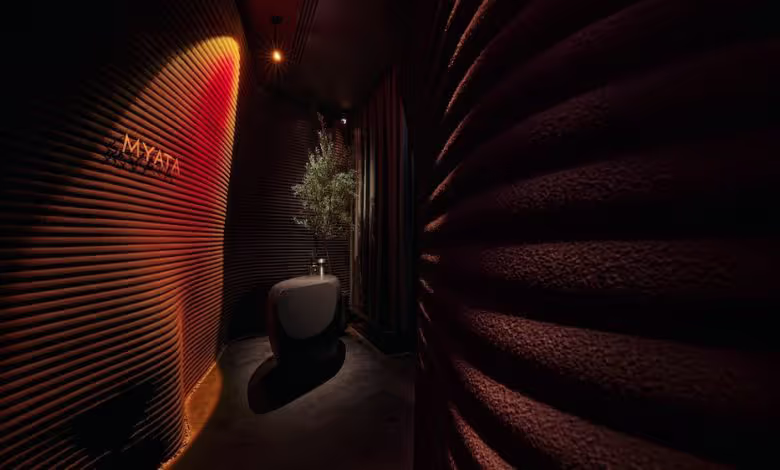
A restaurant in Dubai has broken the Guinness World Record for the world’s largest 3D printed structure by volume. In collaboration with Proto21 3D Printing LLC, MYATA Platinum produced 23 large 3D printed structures that fill the restaurant, which serve as interior and exterior façades, counters, planters, and caves.
The design is inspired by canyon landscapes, with each element manually modelled in Blender in order to achieve distinctive sedimentary patterns. This manual approach was key to executing the design vision, as Proto21 wanted to represent nature and its erosive processes, “the world’s most brilliant architect”.
92% of the pieces are completely unique, a feat unachievable via traditional manufacturing methods. The record-breaking volume notched up by MYATA reaches 13.75 cubic metres, covering 1,190m2, comprising 10,500 3D printed parts that total 10.2 tonnes of material. FDM, SLA, and LFAM were used over three months of nonstop printing.
This innovation echoes a 2016 Emirati directive entitled the ‘Dubai 3D Printing Strategy’, which aims to position the UAE as a global leader in AM by 2030, prioritising advancements in industrial and sustainable tech solutions.
3D printing has the capacity to create complex, seamless structures beyond traditional construction methods, and these groundbreaking developments that push these boundaries are becoming ever more commonplace.
Bambu Lab launches a "supercharged toy ecosystem" with reusable, programmable electronics
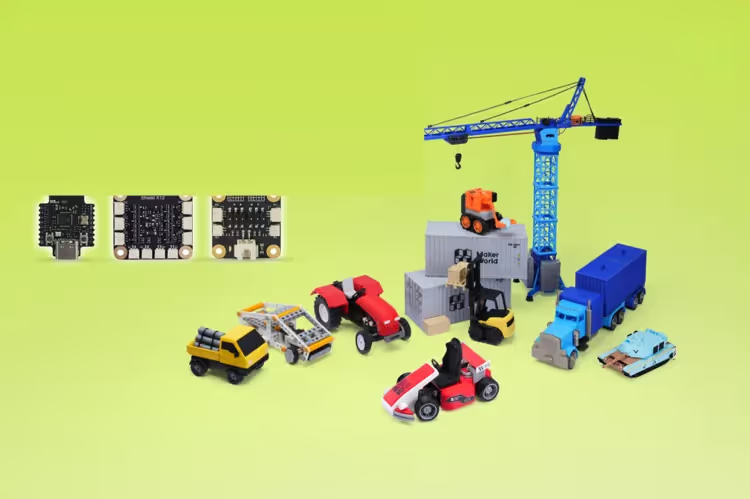
Image courtesy of Bambu Lab
Instead of trawling tiresomely through toy stores, imagine being able to print toys at home– this is what Bambu Lab are planning through CyberBrick. The Chinese company has announced a Kickstarter campaign for a “supercharged toy ecosystem” which combines reusable and programmable electronics components with 3D-printable models for a range of possible toys.
Users are able to buy either a do-it-yourself kit for those who already possess a 3D printer at home, or alternatively they can purchase complete sets with printed parts included.
The models for the (currently three) designs of the toys and joysticks can be found in CyberBrick’s library, in which users themselves can also upload their designs and receive financial compensation for their creativity– these designs so far include a lunar rover, a walking table, and a replica Tesla Cybertruck.
Once users have the printed toys, these are connected to a battery and lights with wires to make it interactive and electric. The toy can be configured to the CyberBrick app, but makers also have the opportunity to use MicroPython and gain some experience in coding. After this, kids can face off against each other or participate in co-op games, even having the ability to control multiple creations from a single remote control.
With CyberBrick, Bambu Lab strives to educate the next generation on 3D printing and improve technological literacy in regards to programming. Additionally, they describe the project as an “eco-friendly and budget-friendly” way to minimise waste produced in the current methods of toy manufacturing.
Photocentric announce update in a 3D printer for space
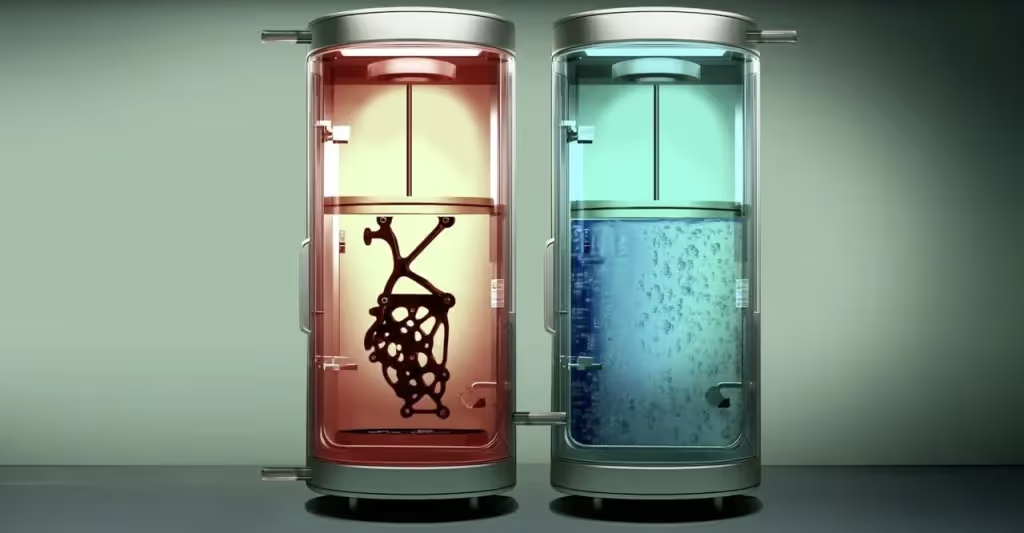
CosmicMaker, a resin 3D printer for space. Image courtesy of Photocentric
Photocentric have announced the achievement of a substantial milestone in the development of CosmicMaker, a fully autonomous manufacturing platform for space applications.
The machine, which is able to manufacture components directly in orbit, has proved it is able to print parts in a wide range of materials in any orientation and perform robustly in a wide range of positive and negative g-force, and full vacuum environments (which indicates zero gravity suitability). It has also been shown, in the lab, to be the lightest, most compact, most reliable, lowest-energy, and most productive 3D printer design for space applications.
The machine is unique in that it is built to operate in microgravity, turning resin into solid parts using light– a more efficient solution in speed and energy compared to FDM. Moving forward, the next step of the process will be testing the printer during parabolic flights, which mimic how the machine would perform in real, space-like conditions, before eventually sending the printer to the ISS.
Photocentric is working with the European Space Agency to accelerate in-space manufacturing, as sending equipment and spare parts to space is incredibly costly and time-consuming. 3D printing is an exciting tool that could solve these problems, as the CosmicMaker demonstrates.
Final thoughts
It’s been an exciting month for additive manufacturing, with breakthroughs in various industries heralding the arrival of important new applications for the technology.
In particular, the proliferation of developments in aerospace and construction signal approaching opportunities for AM companies to capitalise on high interest.
Making sure your business is ready to take advantage is essential.
AM is being taken seriously, make sure your company is prepared.
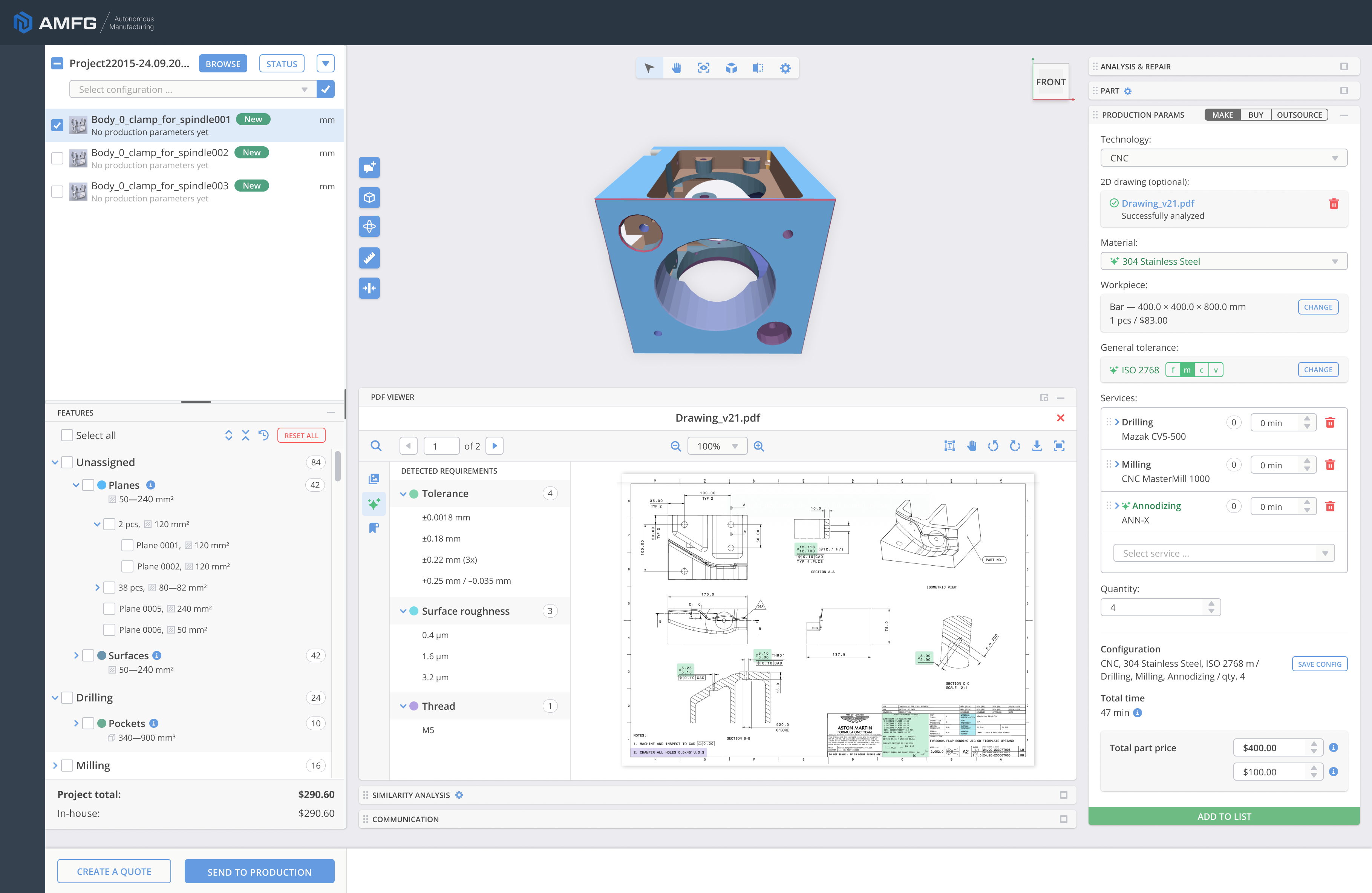
AMFG is an award winning MES designed to empower production workflows, from order placement to shipment, with seamless integration and precision automation.
With over 500 successful implementations in 35 countries and across a range of industries, we specialize in enabling companies to successfully integrate our software for AM and CNC production, into their wider manufacturing processes and scale their AM operations.
For more information, please contact us here:


.avif)
.svg)