Why Are There So Few Women in Manufacturing?


We all know that the manufacturing industry is male dominated. In fact, the 2025 Global Gender Gap Report found that women make up less than 35% of the manufacturing industry, and less than 25% of women hold top level management positions. In an industry constantly worried about an increasing skills gap, why is half the global population so underrepresented?
It Starts Young
Picture this: you enter a high school classroom, and everyone is bald except for you. Your teacher is bald, the person you sit next to is bald, the people in your textbook are bald. You might start to think - can I do this if I have hair?
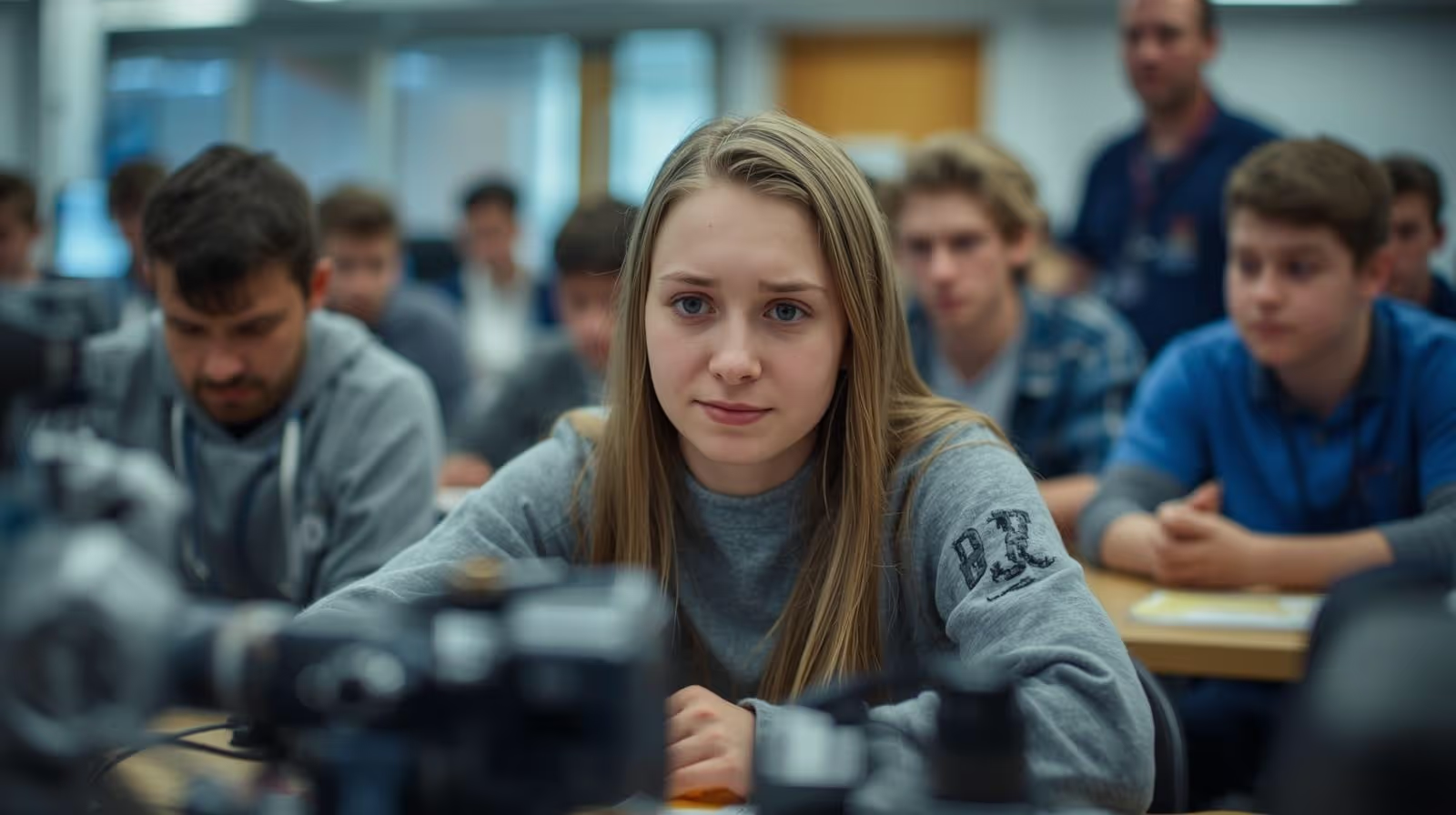
That’s how young girls feel when they enter a classroom full of boys. In 2022 less than 4% of American girls took Engineering / Science Technologies in school, while a meagre 5.7% took Engineering. Imagine being in a room where only 5% of people are like you. Would you stay? Or would you join your friends in the class next door?
In the UK, less than 20% of engineering and technology students and apprentices are girls. No wonder the university classes are so male dominated.
Women in STEM? Where?
While classes in traditional sciences and mathematics are far more equal than they used to be, engineering and technical sciences still lag far behind.
In 2024, 20.4% of U.S. graduates in engineering, manufacturing, and construction were women.
In China, while more women are studying at university, they tend to take humanities and arts subjects while STEM subjects remain male dominated.
India, which has record numbers of women enrolling in STEM subjects at university, faces a similar problem with women dropping out of their courses before graduating, leading to a male dominated manufacturing workforce.
Having a role model is often a key reason why women choose to continue studying while in a male dominated environment. But when so few women make it through school and university, it leads to a lack of female teachers, role models, and parents who can inspire girls to pursue a career path in manufacturing.
She made it. Now what?
Of the 35% that make it into the industry, women still regularly experience high levels of sexism and gender-based violence. The murder of 20 year old Amber Czech just last year, a welder killed by a man simply because he “didn’t like her”, prompted an outpouring of stories on social media. Women in the trades and manufacturing experience sexism, harassment, and violence regularly enough that Amber’s murder is seen as something that could’ve happened to any of the women working on a shop floor today.
Speaking out about workplace sexism is the first step towards real progress, and often takes huge courage from the women involved. However, the unfortunate flip side is that young girls thinking of a career in manufacturing or the trades are unlikely to read these stories and think “that sounds lovely!”
Genuine improvement in workplace safety and culture is the only way forward. Until more men, and those in senior leadership positions, start speaking out and putting proper procedures in place to improve the industry and culture, generations of women will continue to turn away from the door marked “Manufacturing”, and the industry will lose brilliant, talented workers.
It’s well paid though. Right?
Manufacturing can be a rewarding, challenging, and lucrative career. However, women in manufacturing face a significant gender pay gap.
In 2020, American women working in manufacturing earned 82 cents for every dollar made by a man.
In the UK, women in manufacturing earn 15.9% less than their male colleagues, while in India women earn only about 44% of a man’s salary.
Meanwhile in Germany’s manufacturing industry, men take home 19% more than women.
While the earning potential may be higher than many other industries, the gender pay gap is still very much alive and well in manufacturing.
So what do we do?
While this article may have depressed you so far, all hope is not lost. Women of all ages and nationalities are actively working to make the manufacturing industry more accessible, welcoming, and equal.
So let’s take a look at some of the women making the manufacturing industry a better place.
Allison Roberts Grealis began working with the Precision Metalforming Association (PMA) in 2001, and through her work she met many female metalworkers in small and medium sized shops who were running shops or in key management positions. She started investigating the resources that were available to support them, and was shocked to find that there was no national resource that provided training or networking. With several other women from PMA, Grealis created what is now known as WiM, and has dedicated decades to supporting and encouraging women in manufacturing.
With more than 32,000 members across over 50 states and 65 countries, the WiM institute focuses on increasing the number of women in the workforce, and supporting them throughout their careers. With workshops, career fairs, mentor-ship programmes and networking events, WiM provides a sense of community and connection.
Dr. Jennifer Castañeda-Navarrete
An economist by training, Dr Castañeda-Navarrete is the Principal Policy Analyst at the University of Cambridge’s Institute for Manufacturing, and a founding member of the Women in Manufacturing UK branch. As part of her work, Dr Castañeda-Navarrete advises policy makers in governments and the United Nations, and is a strong advocate for women in manufacturing.
In the UK, advanced manufacturing has a 35-by-35 target, with policy makers and industry professionals aiming to increase the amount of women in the workforce to 35% by 2035. Dr Castañeda-Navarrete’s work with the IfM and WiM (UK) has made her a driving force for gender equality in the industry, with her insight and research resulting in huge advances for women in the industry.
Chief Executive Officer and Managing Director of Welspun Living Limited, Dipali Goenka was ranked by Forbes as the 16th most powerful woman in Asia in 2016. When she first moved into an executive role at Welspun in 2003, Goenka faced huge challenges, with many in the industry discounting her opinion and abilities based on nothing but her gender. But since taking over, Goenka has more than proven her capability, improving products and profits to grow Welspun Living Limited into world leading home textile manufacturer.
Goenka has started a range of initiatives at Welspun to encourage and support female workers, athletes, and young girls. During her time at Welspun, she has increased the number of female workers from 7% to 30%, with a long-term goal of 50%. Her Women of Welspun initiative helps those female employees navigate workplace challenges and facilitate their career progression, while the WelShiksha programme focuses on providing education to young girls and those who are disadvantaged. Goenka’s work also extends internationally, and she works as a brand ambassador for WEConnect International, a certification body for women-owned businesses in the textile industry.
President of the Japanese Trade Union Confederation (JTUC-RENGO), Japan's largest and most influential Trade Union Confederation in Japan, Yoshino is a lifelong activist for women in manufacturing. In 1984, Yoshino began working at JUKI, a sewing machine manufacturing company. While there, she volunteered to join JUKI’s union labour committee, which heralded the start of four decades of activism on behalf of women’s rights.
Yoshino’s persistence and persuasive skills resulted in massive social change. In 1990, she successfully fought for maternity pay to be provided for female employees at JUKI, two years before it became legally mandated. A member of The Women’s Committee of Rengo Tokyo, Yoshino was part of extensive research which helped to uncover a range of sexist gender biases in the workplace. This research resulted in a legal amendment named the “1997 revision” which prohibited discrimination against women and required employers to put measures in place to prevent sexual harassment in the workplace.
Her appointment to the presidency of Rengo highlights a shift in Japanese society, and she has used her influence to continue campaigning for women’s rights in the manufacturing industry. Her success and determination has made her an inspiration to women and girls working in manufacturing and machine shops, proving that manufacturing has a place for them, and that they can create real, positive change in the industry.
Conclusion
While the manufacturing industry is still male dominated, women around the world have been campaigning and working for decades to improve opportunities and working conditions for women, on the shop floor and in the boardroom. As we push forwards towards an industry where 50% of the workforce are women, we should remember and celebrate the activists, researchers, and CEO’s that work tirelessly to help our industry become even greater.
About AMFG
AMFG works with high-mix, low volume manufacturers across the globe, streamlining their operations with our cutting-edge software platform. Our scalable tools automate all stages of manufacturing operations, providing automatic quoting and order management. Using our software, our clients can adapt to complex demand with efficiency and precision, securing their place at the forefront of the manufacturing industry.
For more information, please visit www.amfg.ai or contact: press@amfg.ai



.svg)