5 Reasons Why Traceability is Crucial for Additive Manufacturing


Traceability is one of the key concerns facing additive manufacturing. With regulations, reporting and quality control requirements coming into play – particularly for industries like aerospace and medical – any lack of traceability across the AM ecosystem and supply chain must be tackled.
3D printing has emerged as a viable manufacturing technology in the past decade, with companies experiencing great success by providing high-value, and even high-volume, services.
Their trick? Ensuring traceability across the manufacturing process.
Running an ‘efficient’ system without traceability is like running a marathon with old, uncomfortable trainers– it will take longer than necessary, cause endless frustration, and leave you pained and wishing you’d forked out for better in the first place.
Buy the good shoes. Make sure your manufacturing processes are traceable. Here are 5 reasons why ensuring traceability is key for additive manufacturing.
5 reasons why traceability is important for AM
Ensures part compliance
Traceability is especially important when producing parts for industries like aerospace, defense, or medicine technology. Quality standards here require quality checks and documentation for each single part; for example, this is being seen in the additive construction industry, with adoption increasing in relation to regulatory compliance.
Securing contracts in these markets is dependent on quality control and operational efficiency. Finding a software solution that ensures ITAR, data protection, and ISO 27001 compliance is a must-do for AM companies.
Improved quality management
End-to-end traceability establishes more effective quality management processes through data analytics and business intelligence tools. Being able to track exactly what has happened to your 3D part – and when – along the product life cycle adds a new level of process quality for additive manufacturing, as companies can easily review key data and optimise processes when errors or faults arise.
One of the key benefits of traceability is that it allows manufacturers to track each part throughout its entire production chain lifecycle – spanning data preparation, production, post-processing, and quality assurance followed by logistics, usage phase up to recycling. This comprehensive tracking is especially important in AM, as the material properties and dimensional accuracy of a component are determined during the manufacturing process.
Furthermore, data can be used to identify bottlenecks and resolve issues, providing a comprehensive business picture.
Strengthens integrity of supply chain
Production can be a fragmented process, dependent on different steps in the supply chain, which are located across the world and are contingent on geopolitical and market factors.
A greater level of visibility throughout the process will enhance transparency, making it vastly easier for manufacturers to identify pain points. If a particular supplier or subcontractor is unable to complete an order, or wider issues like tariffs are having an adverse impact, a traceable system can highlight these potential issues and ensure that they’re addressed before a lapse in the supply chain.
Optimises digital inventory management
Physical inventory is the weak point in any supply chain. AM permits the creation of digital inventory and thus a digital warehouse, a revolutionary concept for Industry 4.0.
Decentralised production can be laid as a foundation for a newly constructed conception of how inventory works, but this is only achievable if all aspects of the inventory can be clearly seen and accessed.
Some MES can save production parameters and part specifications to ensure the same part is produced every time, ensuring repeatability for serial AM and standard components like tooling and spare parts. This is particularly useful for reordering processes, which are quite common for HMLV parts.
Facilitates spare parts tracking
On the topic of digital inventories, full traceability allows manufacturers to keep an eye on spare parts. Where time was once wasted on part tracking and information retrieval, traceable systems like AMFG ensure that companies can navigate both historical and real-time data.
Traceability doesn’t require a continuous human presence. Automation of administrative processes and spare parts control grants a level of confidence that allows manufacturers to apportion their time according to maximal efficiency.
Traceability in AM: 3 examples
Digital product passports
As mentioned, certain industries require exact product traceability. In order to ensure traceability for quality control, it’s often important to be able to track down a part into a specific build job and even down to a specific part location within that build.
That’s where digital product passports come in. They serve as a comprehensive digital record for each component, listing essential information such as material specifications, manufacturing processes and processing parameters, quality control data, part individual maintenance history, and so on.
This information can be stored securely and digitally, and can be accessed throughout the product’s lifestyle through a code embedded in the part.
3D printed parts are perfect for passports, as the codes can be directly embedded, removing the need for (potentially erroneous) labelling, and the product history can be subsequently be accessed on a single, accessible platform.
This practical implementation of twin technology improves product quality, customer satisfaction, and operational efficiency.
File versioning
As companies integrate AM into their manufacturing processes, AM departments will inevitably be processing thousands, if not tens of thousands, of STL files.
Thus, the ability to not only save, but also to track new versions of your STL files immediately provides greater transparency for AM departments.
File versioning systems are designed to fill the traceability gap in the pre-production process by allowing you to automatically store new file versions as files are automatically analysed, repaired and converted before they are sent to production.
In the likely event that the STL files undergo several iterations, team members can easily revisit all versions of the file in question. And with the large amount of files that AM departments will typically need to process, file versioning provides huge time-saving benefits, as you no longer need to manually rename files or maintain duplicates.
Manufacturing Execution Systems (MES)
As we have explored, to solve the issue of traceability in additive manufacturing, the connection between hardware and software is crucial, with software driving the push towards full traceability through the use of analytics, data reporting and, ultimately, machine learning.
The broad answer to the absence of traceability for the majority of manufacturers is software technology.
Automation facilitates part compliance, improves quality management and supply chain integrity, and enables spare part management and an efficient digital inventory.
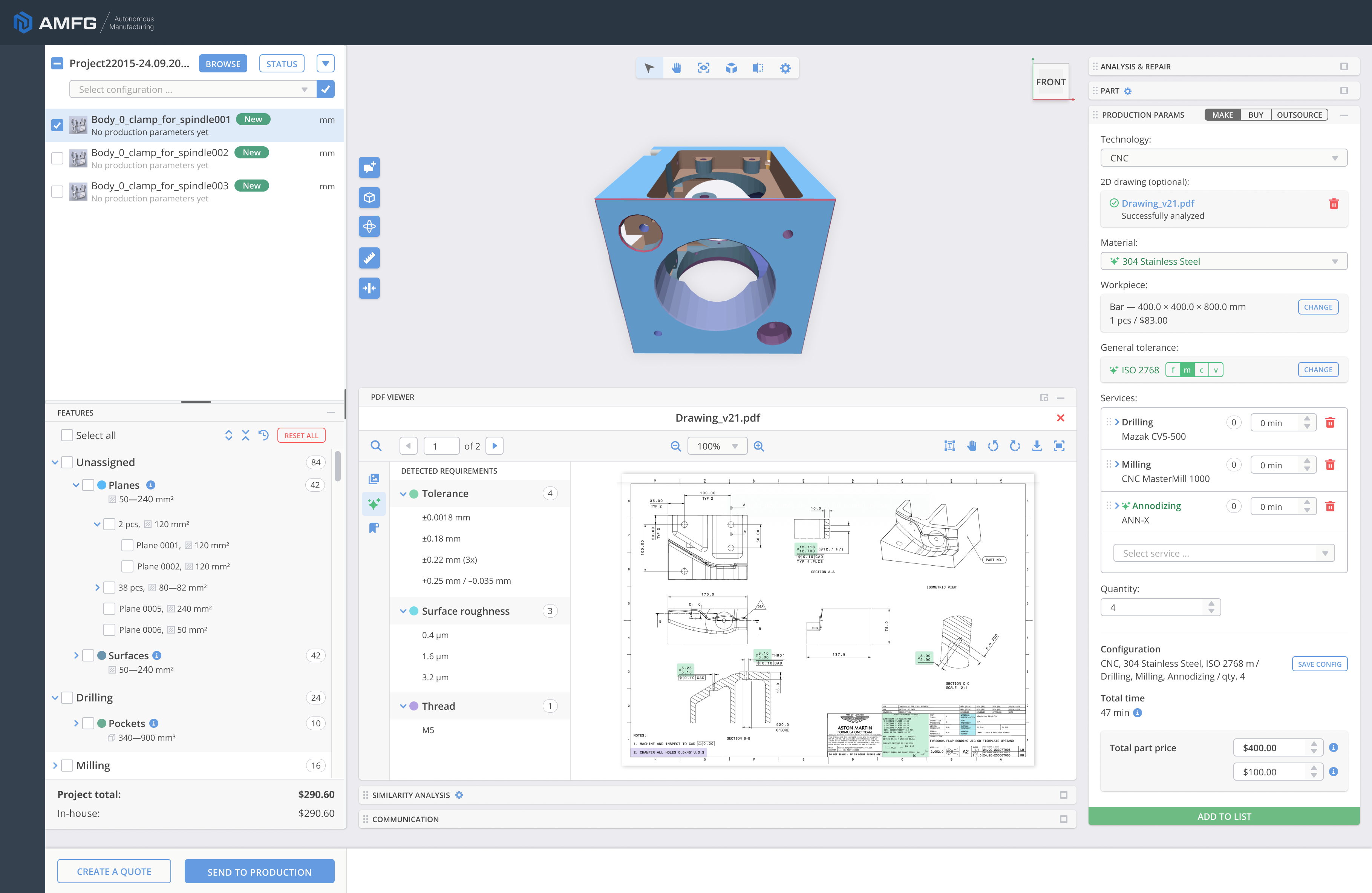
An MES like AMFG helps manufacturers streamline their operations with our cutting-edge software platform. By automating quoting, order intake, and production workflows, we enable high-value manufacturers to adapt to complex demand with efficiency and precision, securing their place at the forefront of the manufacturing industry.
Want to learn more? Speak to one of our team here: Book a demo


.svg)