Latest Developments in Additive Manufacturing: January 2025


The start of 2025 has brought a vast range of developments in additive manufacturing, with exciting advancements in various applications and big stories across the industry.
From the highs of revolutionary progress in microgravity and medical application, to the lows of business closures and controversial firmware updates, January was stacked with AM headlines.
Here are five of the biggest:
Successful clinical trials for resorbable breast implants
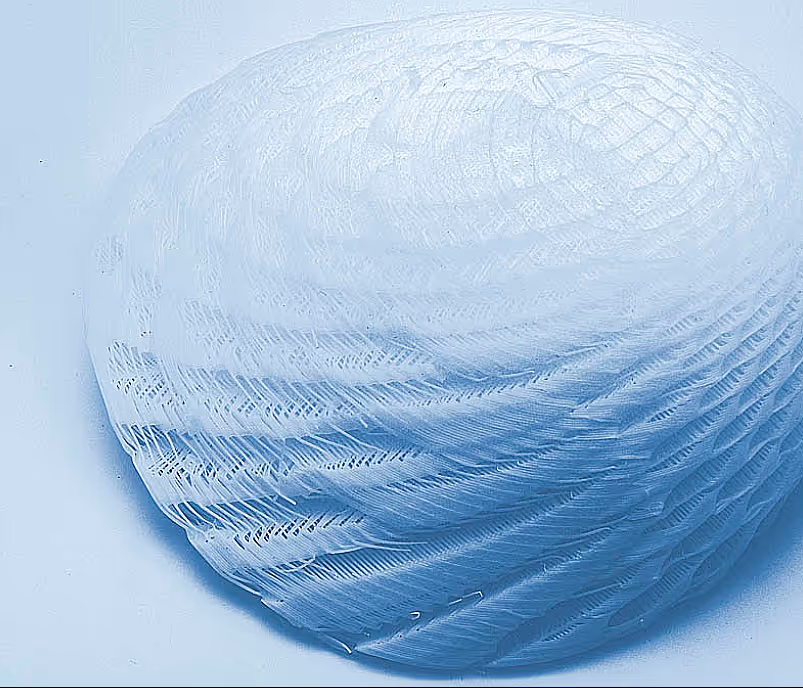
3D printed resorbable breast implant. Image via BellaSeno.
January saw an exciting development in 3D printing application in healthcare with BellaSeno. The German medtech company, which focuses on 3D printed resorbable breast implants for augmentation and lumpectomy, successfully completed two Australian clinical trials.
The results represent the first-ever use of polycaprolactone (PCL) scaffolds, after trials that began in 2022 and consisted of 19 breast scaffold patients and 7 patients suffering from pectus excavatum (a deformity in which the breastbone is sunken into the chest). The outcome led to a fully resorbed implant and natural tissue, showing the possibility of replacing silicone implants in breast augmentation with safer alternatives that offer a better quality of life.
In both trials, patients reported an absence of pain and an unawareness of the scaffold in situ after twelve months. Discussing the future, Mohit Chhaya, CEO of BellaSeno, remarked on the ‘very strong clinical data set to initiate a pivotal study … in the US and Europe’, along with plans to expand to primary breast augmentation and lumpectomy procedures and providing a final two-year follow-up in 2026.
Success in 'Vomit Comet' promising for AM use in microgravity
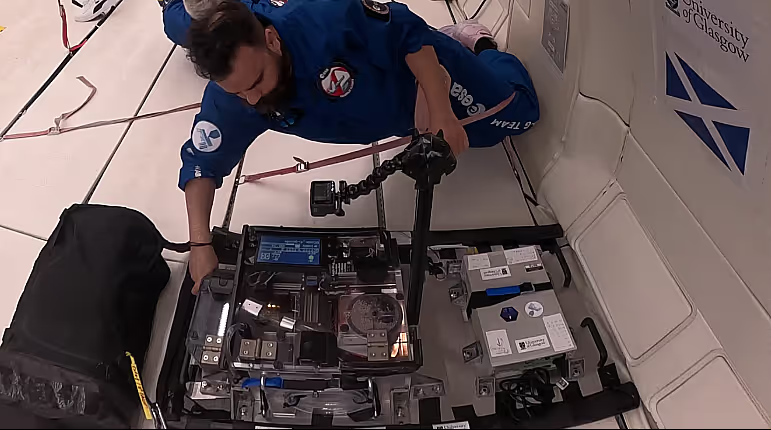
A researcher evaluating 3D printing system in a microgravity simulation aboard a parabolic flight. Photo via University of Glasgow.
Researchers from the University of Glasgow’s James Watt School of Engineering were successful in testing a 3D printing system designed to work in the microgravity of space.
The demonstration took place on the European Space Agency’s parabolic flight campaign, lovingly nicknamed the ‘Vomit Comet’. 90 moments of 22-second intervals of microgravity were used to evaluate the system, which uses a granular feedstock material in place of conventional filaments. The material flows reliably from the printer’s tank to the nozzle, even in the microgravity and vacuum conditions of space.
The event is a remarkable development in 3D application in aerospace; instead of sending items into space, risking destruction and damage when going into the Earth’s orbit, AM fabricators could be placed in space to build structures on demand. 3D printing in space has never been conducted in space outside the pressurised modules of the ISS, yet this demonstration indicates a system that could function perfectly in microgravity. This approach could revolutionise the design and functionality of in-space equipment, with gear that remains in space for its entire existence, never reentering orbit or launching from Earth.
The next step is an attempt to secure funding for an in-space demonstration of the technology.
Food 3D printing company closes their doors

3D printed sugar Holly Jolly Glitter Skulls. Image courtesy of Currant 3D and Sugar Lab
The start of the year unfortunately spelled the end for Currant 3D and Sugar Lab, two AM culinary companies who consistently pushed boundaries over the past decade.
During their years in operation, they were responsible for unique and innovative creations including 3D printed glitter drops in the form of SpaceX helmets and Dragon capsules, lime-flavoured Holly Jolly Glitter Skulls as cocktail decorations, and a 3D printed honeycomb for a Las Vegas restaurant filled with honey goat cheese, apple, ginger, and lemon.
Sugar Lab, who operated as a brand under Currant 3D, aimed to make 3D printed food manufacturing scalable and accessible, partnering with major brands and helping caterers develop bespoke products for events.
However, on January 22nd, the company announced its closure. Besides the blow to the field at large, the departure represents a worrying trend in companies from niche markets going bust. Whether it be from high costs putting off customers, economic challenges in 2024, or the solution being excessively obscure to scale up sustainably, the exit of Currant 3D and Sugar Lab raises worries about innovation in smaller AM markets.
Bambu Lab in hot water
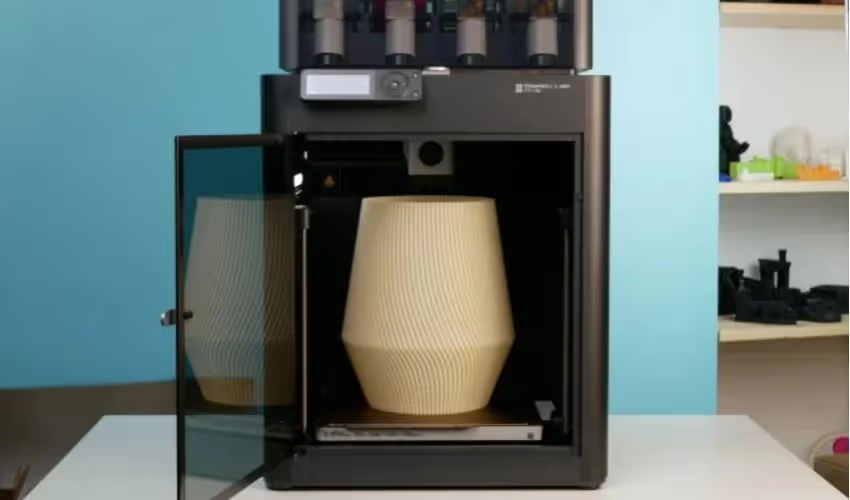
Image courtesy of Bambu Labs
In mid-January, Bambu Lab announced a firmware update which sparked a furore in the 3D printing user community. In an attempt to address critical security issues, the Chinese company introduced an update which meant users had to use a cloud application to configure their devices. Some perceived the reliance on a cloud as an attack on the principles of control over tools, an axiom by which the maker community lives.
To counter threats posed by unauthorised requests to servers and targeted cyberattacks, Bambu Lab implemented authorisation and authentication mechanisms for several key printer functions, including linking and disassociating printers with user accounts and launching print jobs via cloud or LAN mode.
Users saw these changes as a betrayal of principles of openness and sharing that have characterised 3D printing from its inception, and a worrying move towards personal data collection and a closed ecosystem that excludes interoperability between hardware and interaction with third-party slicers. In response, Bambu Lab attempted to assuage doubts by clarifying some points of concern and introducing a ‘Developer Mode’ that maintains local access to your printer without any new authentication.
But it’s unclear whether this response has effectively calmed the storm, and whether Bambu Lab have done lasting damage to their public perception.
America Makes invests in the future
the logo of America Makes. Image via America Makes
America Makes, ‘a national accelerator’ and the United States’ leading collaborative partner in additive manufacturing, announced the winners of the $6.6 million project call IMPACT 2.0 (Improvements in Manufacturing Productivity via Additive Capabilities and Techno-Economic Analysis).
After investing $2.1 million in other AM projects a week previous, America Makes dished out funding with a focus on improving lead times, productivity, and yields in casting and forging. These processes are particularly relevant to the aerospace and defence industries, where lighter, stronger, and faster-produced parts are in increasing demand.
Part A of the initiative allocates $5.1 million across various topics, including the enhancement of methods for adding functional surfaces and complex geometric features to forgings.
The Rapid Casting Demonstration Challenge comprises Part B, with a funding allocation of $1.5 million to evaluate integrated strategies in real world scenarios.
Many companies were successful in acquiring funding from the initiative, an encouraging sign for US manufacturing.
Final thoughts
January 2025 served as a microcosm of the state of the play of AM going into the New Year. As we have explored in our miniseries forecasting 2025, challenging market conditions have placed pressure on smaller AM companies, as was the case with Currant 3D and Sugar Lab. Bambu Lab’s lambasted update evidenced worsening perception of 3D printing companies and greater tensions with China on the issue of data and security.
However, the investment made by America Makes for improvement in various processes across applications was a bright light for AM, and the benefit of application-specific approach was highlighted by the clinical trial success of BellaSeno.
Likewise, the University of Glasgow’s innovation in 3D systems in microgravity provided reason for great interest in the technology’s application in the aerospace sector.
These groundbreaking achievements not only mark a significant moment but also set the stage for ongoing innovation and exploration in the field of AM throughout the upcoming year.
About AMFG
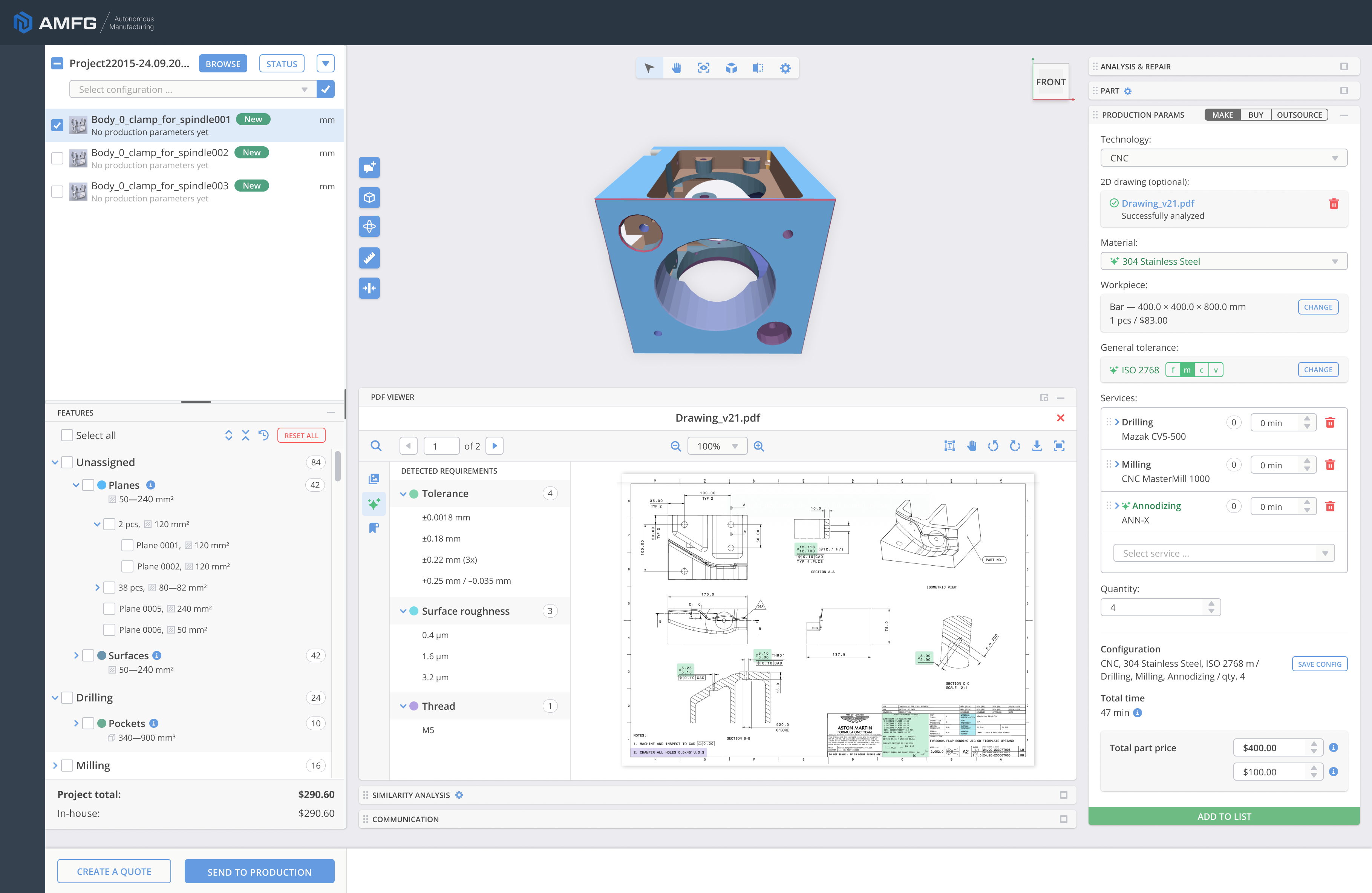
AMFG is an award winning MES designed to empower production workflows, from order placement to shipment, with seamless integration and precision automation.
With over 500 successful implementations in 35 countries and across a range of industries, we specialize in enabling companies to successfully integrate our software for AM and CNC production, into their wider manufacturing processes and scale their AM operations.
For more information, please contact us here: Book a demo


.avif)
.svg)