Latest Developments in Additive Manufacturing: May 2025



As we approach the halfway point of the calendar year, AMFG are taking a look back at the monthly developments in the world of additive manufacturing.
From a 3D printed microneedles patch, to sports equipment and gecko grippers, read on to discover more about the innovations and applications that defined AM in May 2025.
No need for needles
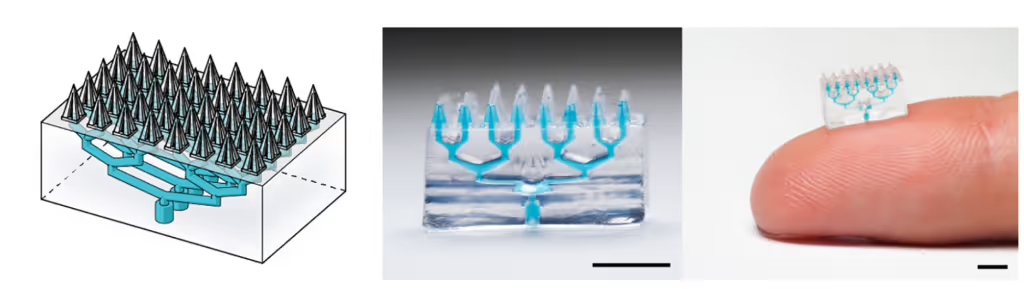
Microfluidic enabled microneedle patch. Image courtesy of PNAP
Needles aren’t always the most pleasant– thankfully 3D printing technology is facilitating a way around this.
May harboured an exciting development for PinPrint, a startup developing 3D printed microneedles patches that deliver drugs and vaccines through the skin. The company, spearheaded by Joseph DeSimone (cofounder of Carbon) received backing from Continuity Biosciences, a Floridian drug delivery company seeking to deliver treatments non-invasively.
Currently, PinPrint is focused on therapeutic delivery, but this investment will facilitate an expansion into aesthetic and cosmetic applications. The 3D-printed patches utilise a lattice-like structure to deliver drugs and vaccines painlessly through the skin, avoiding ‘over-curing’ – a common issue in resin-based printing where light spreads and distorts small features.
PinPrint’s method precisely controls light exposure, producing highly accurate microneedles with sharp tips crucial for effective skin penetration. This allows for improved drug delivery and patient comfort.
Continuity Biosciencies’ investment aims to expand the application of this tech to aesthetic cosmetic treatments, such as anti-ageing and skin rejuvenation. This collaboration underscores the growing interest in microneedle systems for various medical and cosmetic applications, highlighting their potential to revolutionise drug delivery methods.
Football fabrication
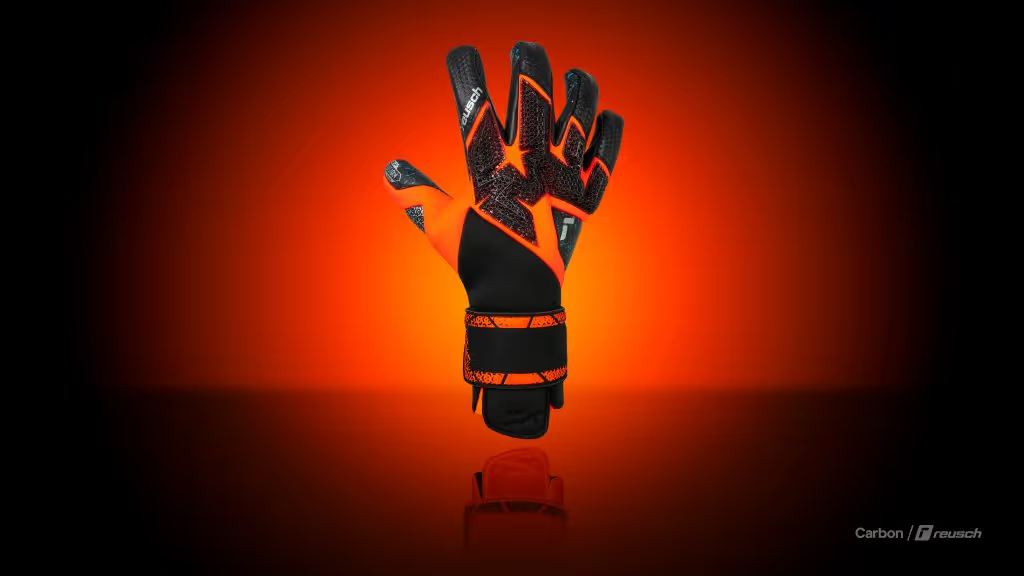
Attrakt Fusion Carbon 3D. Image courtesy of Reusch
AM and F1 is a well-reported relationship, but AM and football?
Reusch has partnered with 3D printing company Carbon to launch the Attrakt Fusion Carbon 3D, the world's first goalkeeper glove featuring a 3D-printed punch zone.
Utilising Carbon's Digital Light Synthesis technology, the glove incorporates a lattice structure in the backhand area designed to enhance energy rebound, flexibility, and tear resistance.
This innovative design offers superior performance compared to traditional rubber or latex materials. The glove also features Reusch’s Fusion Grip Latex for optimal grip in all weather conditions, the Evolution Negative Cut for a snug fit, and the AdaptiveFlex Closure System for wrist stability and freedom of movement.
The integration of 3D printing allows for rapid prototyping and customisation, enabling the creation of high-performance sports equipment tailored to athletes' needs. Priced around $200, this limited-edition glove represents a significant advancement in sports gear manufacturing, combining cutting-edge technology with functional design to meet the demands of modern goalkeeping.
Moving from football to the American cousin of the sport, a line of custom-fit helmets using 3D printed lattice structures have been released. VCIS and Carbon collaborated on the ZERO2 MATRIX, a modular helmet platform that integrates Carbon’s latest impact-damping elastomer with VICIS’ in-house lattice geometry, creating a top-ranked helmet for quarterbacks.
A six-armed LFAM machine
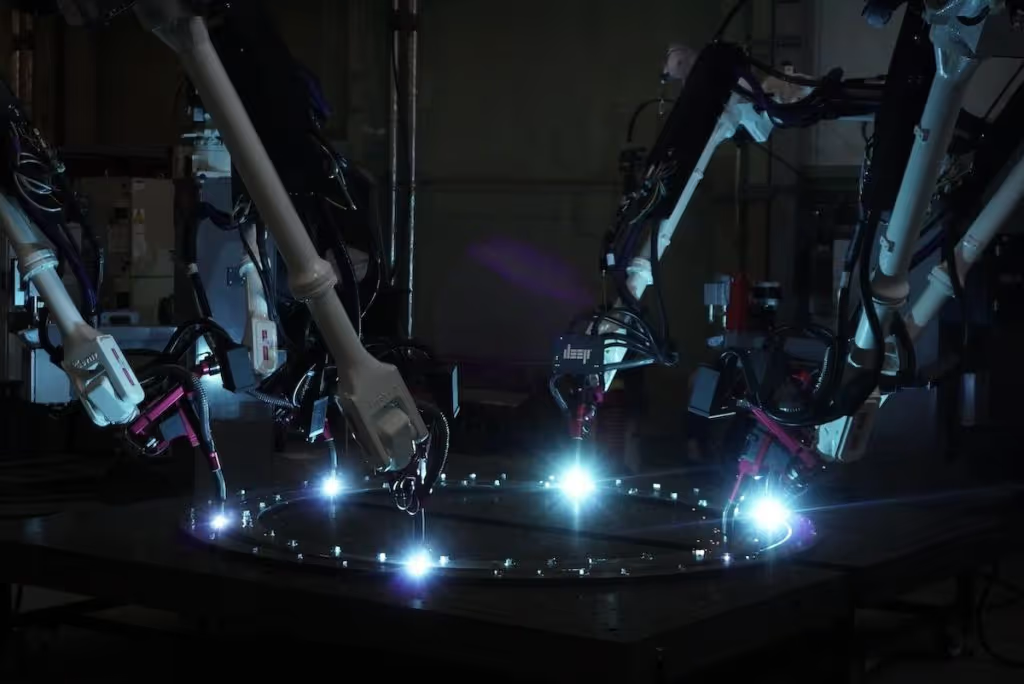
Image courtesy of DEEP Manufacturing
DEEP Manufacturing Limited, a UK-based company specialising in precision manufacturing solutions including subsea equipment, has announced a six-armed, robotic HexBot system for ultra large-scale WAAM.
Each robotic arm can operate independently to build metal parts up to 3.2 meters in height and 3 meters in diameter. When all six arms work in unison, the system can produce components up to 6.2 meters in diameter, offering unprecedented customisation, scale, and speed in metal part production.
DEEP Manufacturing, a division of DEEP, initially developed HexBot to support the production of next-generation underwater pressure vessels for subsea human habitats. Recognising its broader applications, the company has expanded its WAAM offerings to external clients across offshore, maritime, energy, and aviation sectors.
The company initially invested in WAAM in order to support its internal manufacturing needs, and it recognised the technology’s potential for complex, large-scale structural parts for offshore wind platforms, subsea energy infrastructure, and shipbuilding applications.
With these industries on the rise, an innovation like the HexBot, and secured DNV approval for using WAAM to produce steel pressure vessels for human occupancy, it is certain that the system will revolutionise metal part production.
Gecko grippers revolutionise overcuring

Researchers at Hanyang University have transformed a common 3D printing flaw into a novel method for fabricating gecko-inspired soft grippers.
Overcuring is typically an error in digital light processing (DLP) 3D printing, in which unintended areas harden due to excess light exposure. Although it is usually classed as a printing defect, this was strategically harnessed to create anisotropic microstructures that mimic the adhesive setae on gecko feet.
By precisely controlling light exposure and print orientation, the team induced tilted microstructures from simple digital models. These structures, processed through a double-casting technique, exhibited directional adhesion akin to gecko setae, allowing strong attachment in one direction and easy detachment in another.
The resulting soft grippers demonstrated the ability to handle delicate objects, such as silicon wafers, without causing damage. This approach not only simplifies the fabrication process by eliminating complex hierarchical designs but also opens new avenues in soft robotics, biomedical devices, and precision manufacturing.
The study underscores the potential of reinterpreting manufacturing defects as innovative design tools, expanding the capabilities of next-generation 3D printing technologies.
A self-walking soft robot
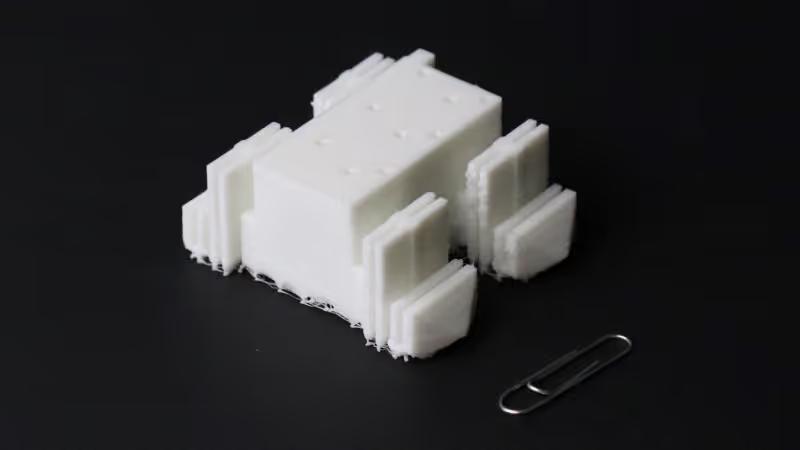
Image courtesy of the University of Edinburgh.
In a story equal parts cute and innovative, scientists at the University of Edinburgh have 3D printed a tiny soft robot able to walk straight off the machine that made it.
Built entirely from one ultra-flexible plastic and powered by simple air pressure, the soft robot is able to print itself, stand up, and then take its first steps without assembly or electronics.
The robot was fabricated with the Flex Printer, a desktop system that can be built for under £400 using off-the-shelf parts. The soft robotic product it birthed runs, rather than complex wiring, sensors, and motors, on air. After it is printed, it only requires an air supply, which, under pressure, permits its soft legs to move and walk.
According to 3Dprint.com, this is the first time that a device made using space-saving, upside-down, desktop 3D printing has come to life without the need for assembly or electronics; a true milestone for soft robotics and 3D printing as a whole.
What are the implications? Well, although prices to make these are high, they could open a lot of doors in the future. The team at the University of Edinburgh hope that this development will democratise soft robotics, hopefully enabling a future generation of scientists to make waves.
In medicine, soft robots could navigate inside the human body, they could be printed and deployed in orbit, and they may offer a safer, non-electrical alternative in hazardous environments.
About AMFG
Our mission is to help manufacturers streamline their operations with our cutting-edge software platform. By automating quoting, order intake, and production workflows, we enable high-value manufacturers to adapt to complex demand with efficiency and precision, securing their place at the forefront of the manufacturing industry.
Want to learn more? Click here to chat to one of our team: Book a demo



.svg)