Thinking to Start a Machine Shop? Here’s What You Need to Know.


Thinking to Start a Machine Shop? Here’s What You Need to Know.
With roughly 3/4ths of US manufacturing firms employing less than 20 people, starting your own machine shop is a common dream for most machinists. But being a great machine shop owner is entirely different from being a great machinist.
When excellent craftsmanship and quality parts are the baseline expectations, your success as a shop owner depends on how you master the business, financial and operational realities behind the work. To start a shop that lasts, machinists need to start thinking like a business owner, considering market fit, managing cash flow and optimizing non value added time. This means identifying your customers before you buy equipment, securing your space and aggressively focusing on running lean to non value added costs and maximizing the profitability of every hour your shop is running.
The Pre Launch Strategy: Identify your Customer First
Before you start browsing machinery catalogues, a strategic job shop owner should understand what needs remain unmet in the market. Start by identifying the booming manufacturing industries in your region, especially with the focus on reshoring to build supply chain resilience which can become a key benefit you provide your customers. Leverage your network and speak to local manufacturers to identify their current pain points.
What your customers need will dictate what your machinery and tooling shopping list as you get a clearer idea of what materials you would be working with.
- Medical device manufacturers: Small, intricate titanium or implant grade stainless steel components so that the machinery you would need would be a high precision mill or Swiss lathe.
- Aerospace industries: Require tight tolerances and complex geometries, resulting in needing 5 axis CNC mills or specialized grinding and finishing equipment.
The Physical Foundation: Assessing the Facility’s Infrastructure
Once you have a clearer idea of your customer base, you must evaluate your potential facility.
Understanding the local laws to comply with safety and facility code requirements will be important to decide on your first facility and it can vary by state such as:
- Machine and Worker Safety (OSHA):
- Electrical and Facility Infrastructure (NEC / NFPA)
- Coolant and Waste Management (EPA / Local Water Regulations)
- Fire Hazards (NFPA 484)
However these can vary by the type of shop you aim to run.
Ultimately, most manufacturing facilities would need to address Utilities, Structure and Safety.
Utilities:
Machines run on two key things: 3-phase power and compressed air. If you are starting in a residential garage, you are limited to single phase power which cuts down your machine selection and production throughput. Upgrading utility lines or rotary phase converters can quickly add up to your initial investment. Additionally, a reliable clean air compressor system is non-negotiable to handle tool changes, pneumatics and chip clearing.
Structure:
Heavy machinery requires thick, reinforced concrete foundations that can handle vibration and maintain high tolerances. Furthermore, machining processes generate dust, mist, or fumes and proper ventilation is critical to keep the air quality safe while maintaining control over climate stability.
Safety:
The safety of your facilities must also be considered in case of emergencies. There needs to be a clear emergency exit, automated sprinklers and fire extinguishers in place and setting up dedicated chemical and waste storage.
The Financial Foundation: The Reality Cheque
Starting a machine shop requires a lot of initial liquid capital to cover just the essentials of tooling and fixturing as well as employee salaries.
After understanding the initial upfront investment required, consider going to the small business administration to secure capital. A critical point to keep in mind is that despite securing the loan, it does not mean you receive a lump sum. The SBA loan has a withdrawal limit and they only allow an additional draw once a month.
Considering new vs. used equipment can be one approach to plan your financial strategy. While new machines provide peace of mind through warranties, training and the expectation of the machines running smoothly and reliably, it can be expensive. On the other hand, used machines save upfront capital but increase risk of wear and breaking down earlier.
The need for capital still remains even after you secure all your machinery. New shops frequently hit a working capital bottleneck. Even after your shop is operational and you land your first client, machine shops face the challenge of paying for raw materials and tooling up front without being paid from large original equipment manufacturers (OEMs) particularly in industries like aerospace, defense and automotive until 60 days or even 90 days out. Despite being highly profitable, if there isn’t enough capital to cover you while you wait to be paid, your shop can fail before you start.
In order to survive the gap in capital, there are a few strategies you can implement.
- Negotiating supplier terms: Try to get your materials supplier to agree to a Net-30 agreement which can shorten the amount of time your own capital is tied up in a project.
- Enforce start up deposits: When starting with a new customer, as a part of onboarding you can establish a policy to cover a percentage of their raw materials before you order.
The Post Launch Optimization: Running Lean by Modernizing
In an industry plagued by delivery delays, streamlining your shop floor operations directly accelerates lead times and protects your bottom line. For machine shops to operate more efficiently, the tech stack should be integrated into your processes so your data moves from quote to shop floor seamlessly. Non value added time such as hours spent typing data or looking for paper travellers on a messy desk can slowly erode profitability. To run lean, the right technology stack can interconnect all the different processes from the initial email to manufacturing parts.

Sales → Quoting → Job Management → Shop floor
Phase 1: The RFQ Bottleneck
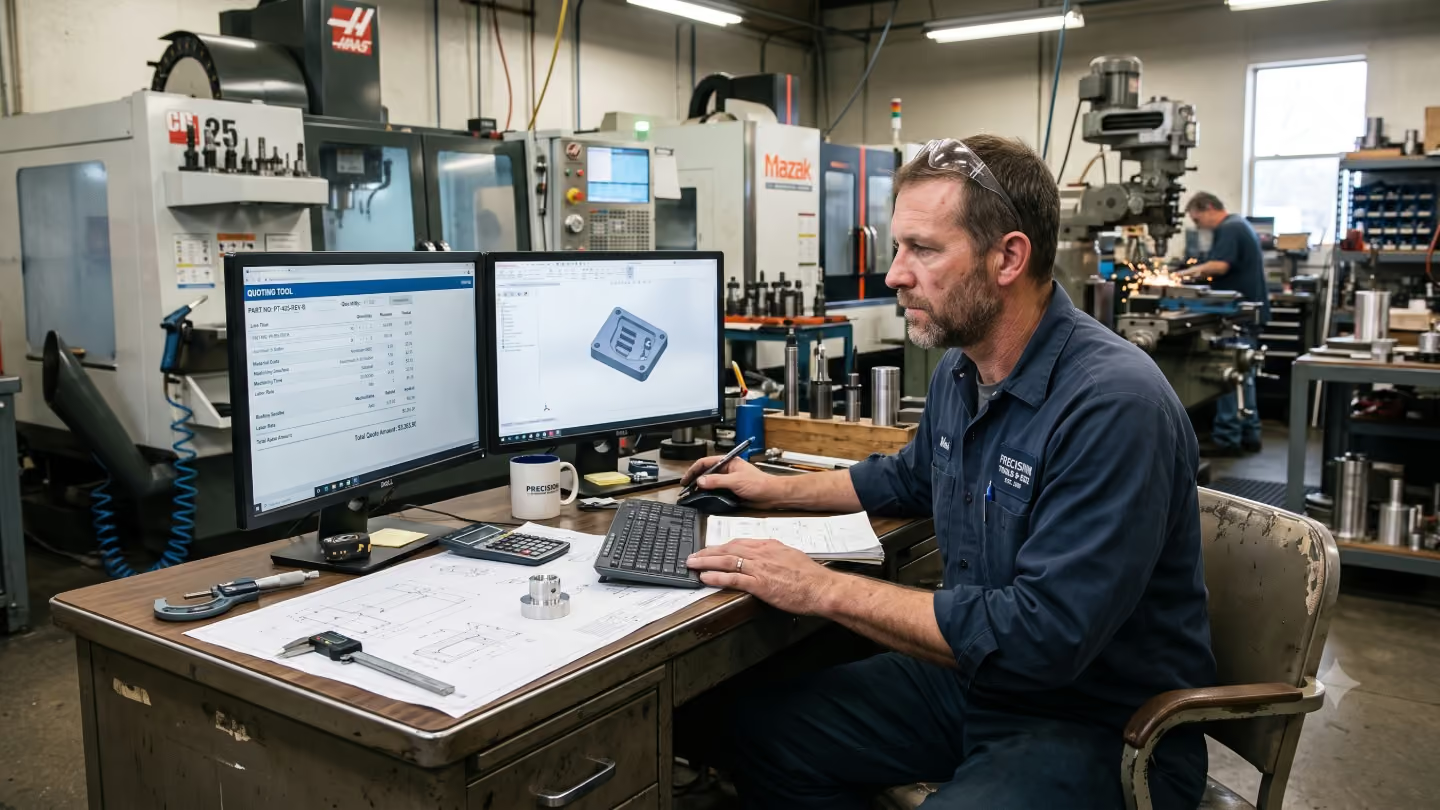
The financial health of your shop is dictated during the Request for Quote. The bottleneck usually starts before a project kicks off and hits the machines. When an RFQ lands in your email, it is buried among 2D PDF or 3D CAD designs.The opportunity is exciting, but once you get into manually quoting, you or your sales team has to dig through the files to pull out specifications to understand whether it fits your shop’s capabilities.
Manually quoting a job by counting each feature, factoring in tolerances and GD&Ts and chasing CAM programmers to get the time estimates, can take hours, if not days depending on the complexity. The manual approach also increases chances of input errors which can also directly impact your profitability. Misquoted work can cost you the job resulting in unpaid labor as CAM programmers are tied up in creating rough estimates instead of production programmes for existing jobs. But being too cautious can also cost you the job, as speed is one of the key factors in winning work.
The Efficiency Win: Quoting and Estimating Software
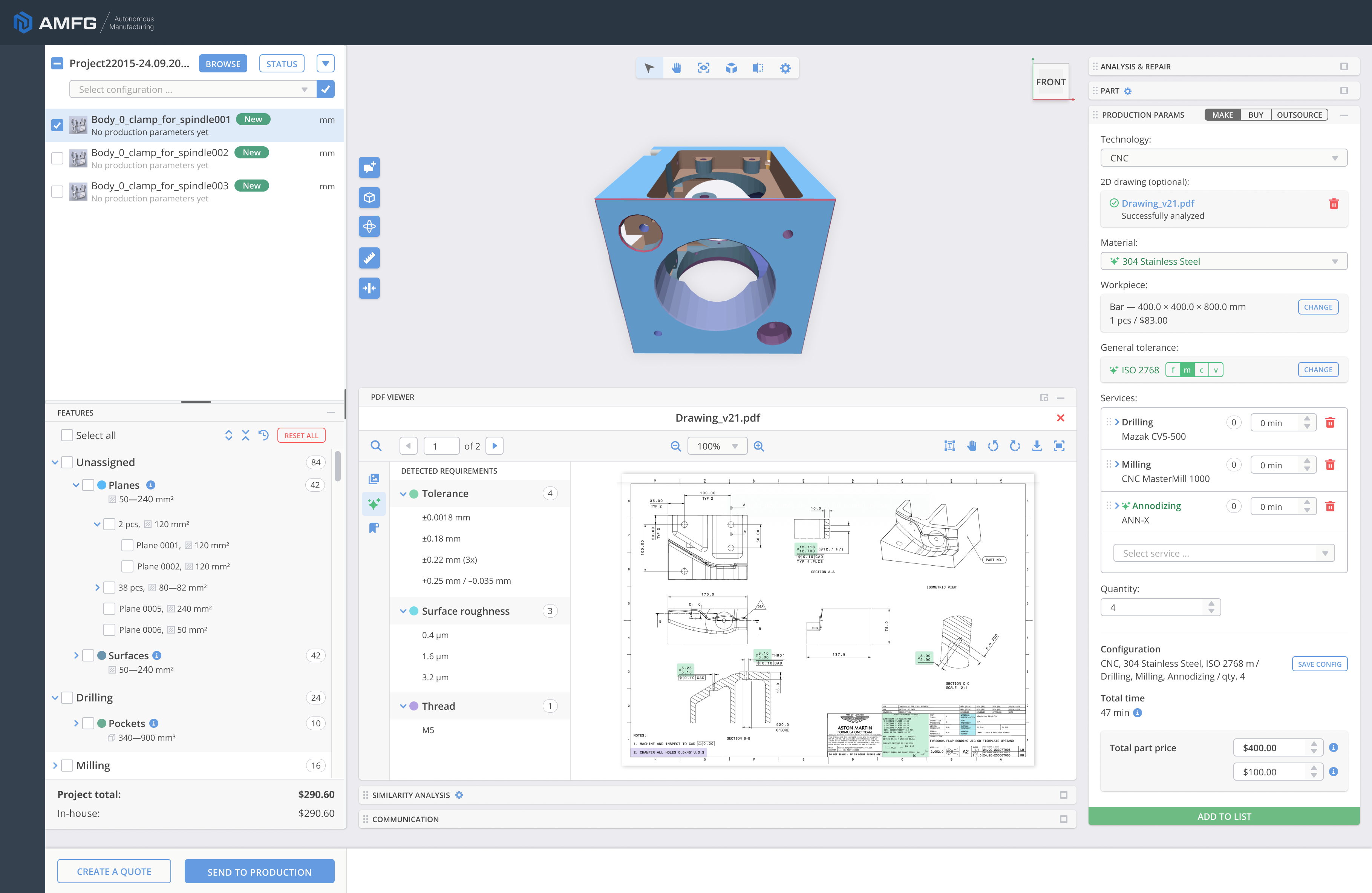
With 46% of manufacturers citing Estimating and Quoting solutions as their #1 software need, implementing software like AMFG to automate your quoting and estimating results in fast, accurate and reliable quotes. AMFG can integrate directly with your email to pull out RFQs with 2D and 3D drawings to detect features, assess tolerances, surface roughness requirements and GD&T and auto selects tools to calculate time estimates. Paired with customizable settings to adjust your shop’s costing logic, AMFG helps create accurate and reliable estimates while speeding up RFQ turnaround to improve your win rates and your customer experience. Speed wins work and automating this process can free up your skilled programmers’ time to focus on production rather than estimating and quoting.
Phase 2: The Scheduling Chaos
Once an RFQ is won, it needs to be treated like a project you will be tracking its progress on. However, tracking jobs that need to be done without a centralized system can feel like a constant scramble. The mental load of keeping track of the scheduling you jotted down on a piece of paper, quality specs sitting on an excel sheet and memory to track current inventory status and which revisions you’ve made can keep you tense and reactive, feeling as though you’ve forgotten something.
The Single Source of Truth: Enterprise Resource Planning (ERP)
ERPs tailored for machine shops like JobBOSS or ProShop eliminates data silos, unifying this information. They convert won quotes into live jobs, schedules production, manages material inventory and tracks quality compliance all in one place for project management.
AMFG can be bolted on to seamlessly integrate with an ERP so that a quote is automatically loaded into the system once the job is won.
Phase 3: The Messy Shop Floor
An ERP handles organizing the overarching business processes, but you still need to translate the project requirements into actionable steps to execute the production of the parts on the floor. You lack visibility, unsure of which machine is actually running, how long it's running for, what tools need to be used and which machines are available. This kills efficiency and quality control.
You’re left wandering around to look for where you might have left your paper travelers and guessing how efficient your processes are. Traceability is also tough keeping track of the project process as well as the quality control. Mid run inspections might not have been properly recorded and when an audit for a bad batch comes in, or your job went over budget, the messy processes can make things much harder than they need to be.
Control Over the Shop Floor: Manufacturing Execution Systems (MES)
MES works hand in hand with the ERP to bridge the scheduling software and the actual machines. It keeps track of machine usage to measure capacity and provide visibility into the progress of a job. It also replaces paper travellers with digital tablets so machinists know exactly which tools to use and enforces consistent mid-run quality control. By eliminating hidden time killers like searching for paperwork, missing tools and unexpected machine downtime, MES can help maximize shop floor efficiency.
Many ERP systems now have built in MES capabilities to cater to smaller shops, like JobBOSS or ProShop ERP to maximize the value from your software.
Shifting to a Business Mindset
The harsh truth of modern manufacturing is that craftsmanship is no longer enough to guarantee the survival of your shop. Excellent products at good prices can help establish your brand and build your reputation. However, transitioning from a skilled machinist to a successful shop owner requires to view the machine shop as a business to prevent it from failing in the first few years. From planning your consumer base to securing funding and preparing to optimize your processes for efficiency, the business fundamentals provide the blueprint for a long lasting shop.

.svg)