5 Exciting Innovations in 3D Printers
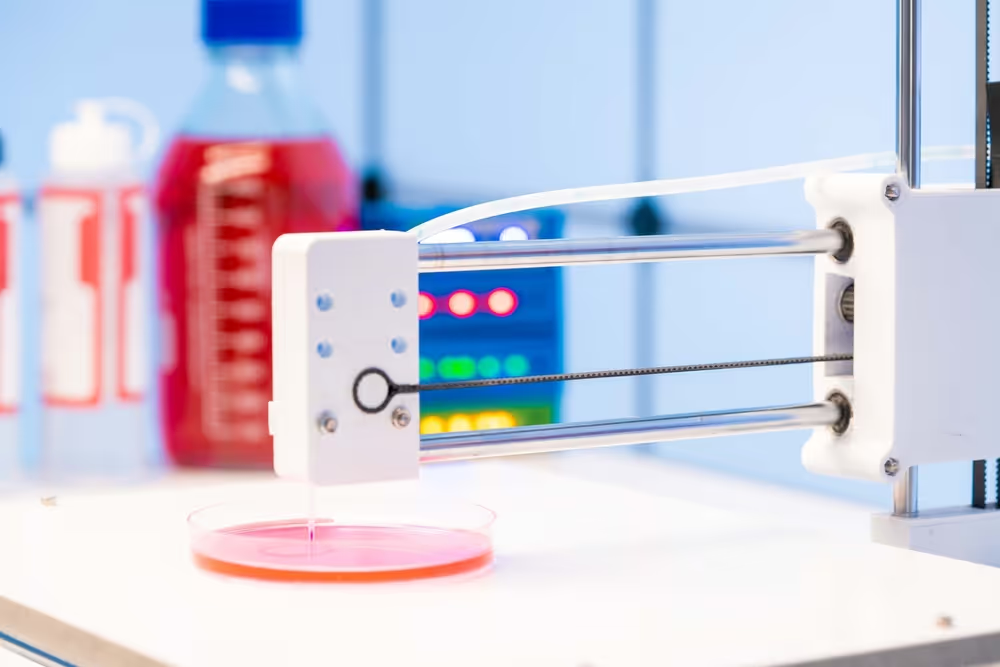


Additive manufacturing is an industry perennially in flux, with new technologies constantly arising and altering what we consider possible in various applications.
Here are 5 innovations spanning bioprinting, 5-axis printing, liquid metal AM, and large format hybrid printers which are encouraging for the adoption of AM.
Liquid metal 3D printing
Over the past couple of years, a handful of startups and researchers have made strides in the world of rapid printing, leveraging liquid metal as a material for a potentially revolutionary development in part production.
In early 2024, MIT researchers developed rapid printing with liquid metal, an AM technique at least 10 times faster than a comparable process. With the technology, large-scale parts like table legs and chair frames can be produced in a matter of mere minutes. The process involves depositing molten aluminium along a predefined path into a bed of tiny glass beads, with the aluminium subsequently hardening rapidly into a 3D structure.
Despite the material efficiency and benefits in speed, final parts lack the high resolution boasted by alternative methods of production. Parts produced with LMP would be better suited to applications in architecture, construction, and industrial design, as parts in these industries do not require extremely fine details.
Boston startup Fluent Metal have also developed a similar approach to AM, using liquid metal drops in lieu of powder with an eye to make high-quality metal parts more accessible and affordable.
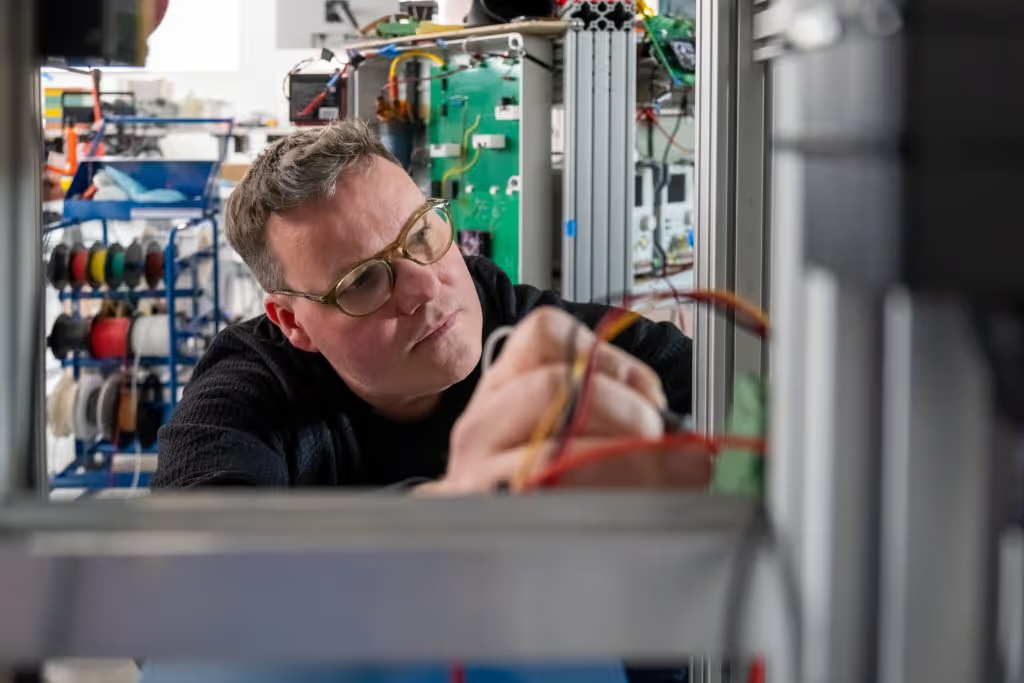
Fluent Metal Co-Founder Peter Schmitt working on a prototype of the metal 3D printer. Image courtesy of Fluent Metal/Andy Ryan.
Co-founder Peter Schmitt aims to combat the limitations and high costs associated with powder-based metal printing, democratising metal AM by eliminating the need for expensive clean rooms and explosion-proof facilities. The process involves heating a thin metal wire to create a droplet of molten metal in milliseconds, then ejected in precise droplets to form the desired part.
Liquid metal rapid printing offers a truly unique solution, providing a more affordable and user-friendly solution in extremely quick times.
Bioprinting systems
3D bioprinting is the future. The technology mixes bioinks with living cells to 3D print natural, tissue-like three-dimensional structures, and developments come thick and fast in the sector. Here are two of them:
In March 2025, biomedical engineers at the University of Melbourne developed a 3D bioprinting system capable of creating structures that closely replicate the diverse tissues of the human body, including soft brain tissue, and harder cartilage and bone.
This technology, which uses vibrating bubbles to 3D print cellular structures in a matter of seconds, gives cancer researchers the ability to mimic specific organs and tissues. Researchers can predict drug responses and develop new treatments independently of animal testing and the ethical dilemmas implicated with this practice.
Similarly, last month saw the Eindhoven University of Technology (TU/e) announce their progress in adapting xolography, a novel light-based 3D printing technique, to the printing of living cells.
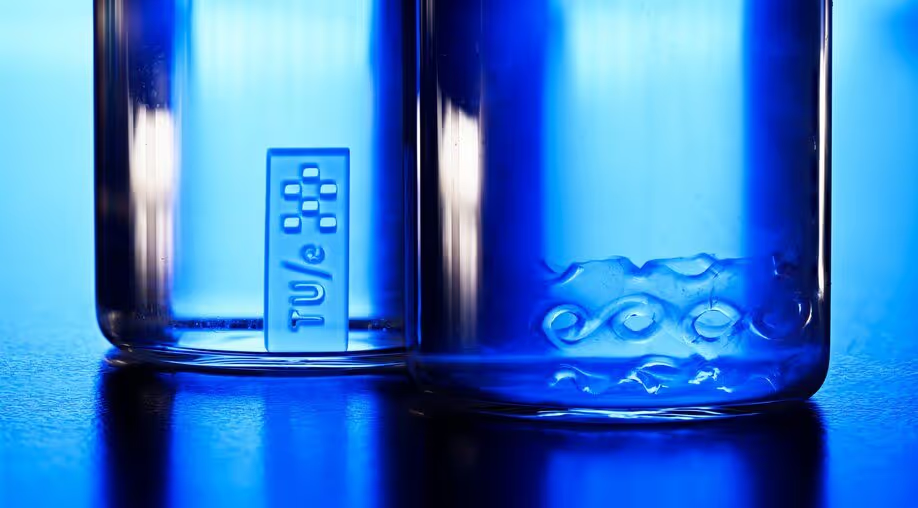
The TU/e xolography system. Image courtesy of TU/e
Researchers were successful in printing structures as small as 20 microns (the size of a human cell), a development which suggests the possibility of printing complex biological tissues, such as kidneys and muscles. Xolography solidifies entire volumes simultaneously by projecting a sequence of images onto a light-reactive fluid, enabling faster, higher-resolution printing.
Although this development is merely experimental for now, the possibilities that this discovery bears are highly promising for the future of medical research.
Hybrid 3D printers for large format AM

Rapid Fusion CTO Martin Jewell testing Medusa. Image courtesy of Rapid Fusion/ 3dprint.com
AM is often complementary to more traditional manufacturing methods like machining or injection molding.
But there are some machines able to combine multiple manufacturing processes to increase possibilities and design parts with ever-increasing complexity.
Hybrid 3D printers have been an invaluable tool since the 1990s, but innovation in this technology is constantly expanding. One segment of the market of particular interest is large format AM.
In February, Rapid Fusion announced the first UK-built large-format hybrid printer, an innovation designed to incentivise reshoring efforts against the backdrop of supply chain issues.
Following a £1.2m grant from Innovate UK, destined for the development, testing, design, and production of the printer, Rapid Fusion have produced a gantry-style machine that combines a pellet extruder, filament and CNC machining tools. The printer, named Medusa, provides a single-source solution for large moulds and tooling typically leveraged by companies in the aerospace and defence, automotive, marine, and construction industries.
Medusa is able to:
- Operate at speeds reaching 1,200mm per second (3 times quicker and twice as accurate as conventional machines)
- Reduce training and maintenance costs by 30%
- Run more efficiently thanks to AI-driven enhancements (such as predictive maintenance, thermal modelling, and computer vision)
Rapid Fusion’s project (and the backing behind it) is a positive indication that LFAM is experiencing exponential growth. Medusa is a factory-ready industrial 3D printer produced entirely in the UK, with superior speeds to international competitors– set to impact production performance and representing a catalyst for reshoring.
5-in-1 printer
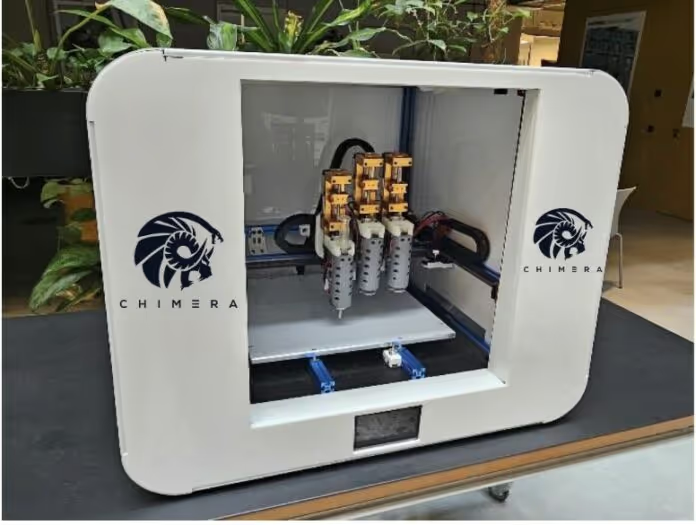
Image courtesy of Ourobionics
Dutch company Ourobionics BV recently unveiled CHIMERA, an advanced bio-fabrication and biomanufacturing platform that integrates 5 advanced technologies into a single machine.
Researchers can work with 5 biofabrication technologies in 1:
- 3D Bio-ElectroSpraying
- 3D Cell-ElectroSpinning
- 3D Bio-ElectroJetting
- 3D Melt/Cell ElectroWriting
- Standard 3D Extrusion BioPrinting[spacer height="20px"]
Separate devices are no longer needed– all these capabilities are now available in a single machine. Combining these technologies allows the creation of complex, multi-dimensional tissue structures with unrivalled precision and efficiency. This platform represents a transformative tool in biofabrication; CHIMERA possesses:
- Ability to unlock 98% cell viability
- Nanoscale resolution of 50nm
- 30X faster speeds than extrusion (1cm3 in 1min)
- Capability to work with a greater range of high viscous biomaterials with multiple streams
- Proof that cellular, metabolic, and pluripotent characteristics don't get damaged, as they can in extrusion
- Potential to used for cell encapsulation or gene encapsulation
This innovation signals positive steps forward for tissue engineering, regenerative medicine, cell-based manufacturing, and advanced biomaterial development.
Open-source 5-axis FFF desktop 3D printer
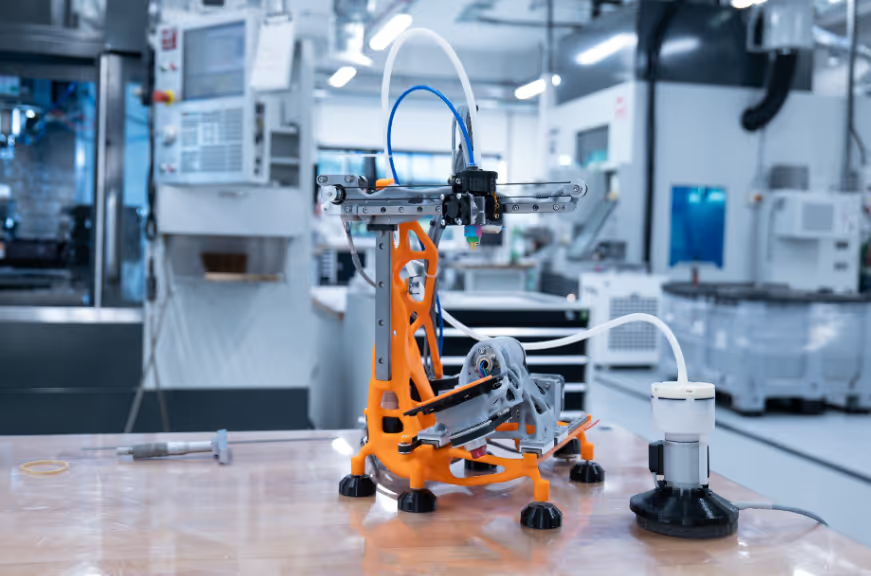
Generative Machine’s 5-axis FFF 3D printer’s beta version. Image courtesy of Autodesk
Robotics engineering startup Generative Machine has taken an exciting step toward the possibility of self-designing products and machines.
The British company is developing a new open-source 5-axis FFF/FDM desktop 3D printing platform by using Autodesk’s Fusion 360 software. The suite utilises AI and cloud computing to quick;y generate a broad range of design alternatives based on various parameters including material, manufacturing methods, and performance requirements.
Conventional FFF 3D printers use 3 axes, struggling with overhangs and complex geometries. However, the tilting build platform in the 5-axis printer offers a greater flexibility in part orientation, thus ensuring the reduction of material waste, refinement of surface quality, and the ability to produce intricate designs, the likes of which would usually necessitate industrial equipment.
‘Imagine just defining the required build volume, updating the parametric base configuration, and automatically ‘regenerating’ an optimized machine to these new dimensions – it’s not difficult to see the concept of ‘self-designing’ products and machines begin to emerge, and we can do it all in Fusion’, said Ric Real, co-founder of Generative Machine.
Innovations like these are allowing an increasingly higher proportion of desktop users the ability to access advanced 3D printing techniques, meaning manufacturers can overcome obstacles previously considered insurmountable.
Final thoughts
These innovations have the potential to shake up our perception of 3D printing's capabilities. Applications could range from revolutionary advancements in the medical field, to unprecedented improvements in industrial production.
Manufacturers should be prepared for the increasing adoption of AM given these developments.
AMFG is an award winning MES designed to empower production workflows, from order placement to shipment, with seamless integration and precision automation.
With over 500 successful implementations in 35 countries and across a range of industries, we specialize in enabling companies to successfully integrate our software for AM and CNC production, into their wider manufacturing processes and scale their AM operations.
For more information, please contact us here: Book a demo


.avif)
.svg)