Additive Manufacturing Forecast 2025: Market



In the first of this miniseries forecasting 2025 in AM, we cast our minds back to 2024, diagnosing it as a year of stability and restoration of trust in AM after a rocky couple of years. The technology and adoption to applications provided promising signs for 2025, but the market threw up some hiccups that prohibited comprehensive positive recovery.
In this penultimate article of the series, we’ll be analysing AM market dynamics in 2025. We contend that the gradual improvement in the global economy bodes well for investment into 3D printing, although ‘cautious optimism’ will be the predominant sentiment after a difficult few years.
China will continue to establish themselves in the global market, but policy decisions centred around reshoring could be beneficial for AM and help level the playing field.In our analysis of 2024, we introduced Gartner’s Hype Cycle as an illustration of the state of the AM industry as an emerging technology. We predicted that AM has left the ‘trough of disillusionment’ and is starting to be adopted at a sustainable rate, which we saw manifest in the success of the technology applied on an industrial level.
But what about the market? What type of year will 2025 be for AM?
Where are we now?
North America continues to be the largest geographical market, with a market portion that exceeded 30% in 2022. The US is the single-largest market, making up 22% of the global total.
North American and European (particularly British and German) additive OEMs, service bureaus, and manufacturers are still dominant in 2025.
Last year, despite global disinflation, high interest rates and restrained capital expenditure presented a challenge to greater investment in AM. China asserted their presence with the success of companies like Bambu Lab, and market consolidation and key player exits shook up the AM landscape.
Macroeconomic factors

In regards to the economy at large, the IMF has predicted ‘growth on divergent paths amid elevated policy uncertainty’, with global growth projected at 3.3% both in 2025 and 2026, below the historical (2000-2019) average of 3.7%. The US is expected to offset downward revisions in other major economies, and global headline inflation is expected to experience a decline to 4.2% in 2025 and 3.5% in 2026.
With new governments in the US and the UK, and upcoming elections in key European countries, change is afoot.
So, what does this mean for additive manufacturing?With the reduction of inflation and slow growth, the market may finally settle to a happy medium between the incredible hype garnered around the technology before the pandemic, and the hit that adoption took after interest rates soared during COVID.
In light of this, François Minec, Global Head of Polymers 3D Printing at HP, labelled the sentiment going into the new year as ‘cautious optimism’. The technology is progressing through the use of software and automation, and the desire from applications is present, but expectations must still be managed. Investment is expected to pick up again, but CAPEX decisions will still be affected by the global economy.
In this miniseries so far, we have referred to Gartner’s Hype Cycle as an illustration of AM’s progress from a nascent invention showing signs of great potential to a technology that suffered a lack of growth and decline in public opinion. Although challenging, more stable macroeconomic conditions will encourage a more tempered engagement with AM at large. In 2025, AM can begin to leave the ‘trough of disillusionment’ and travel up the ‘slope of enlightenment’ towards adoption.
Poor macroeconomic conditions in Europe impacted end-user decisions to invest in AM in 2024. Key countries, like Germany, were hesitant to adopt AM. Manufacturers have had to be creative in the face of sustainability regulations, and Europe continues to drive innovation in the field.
Market consolidation
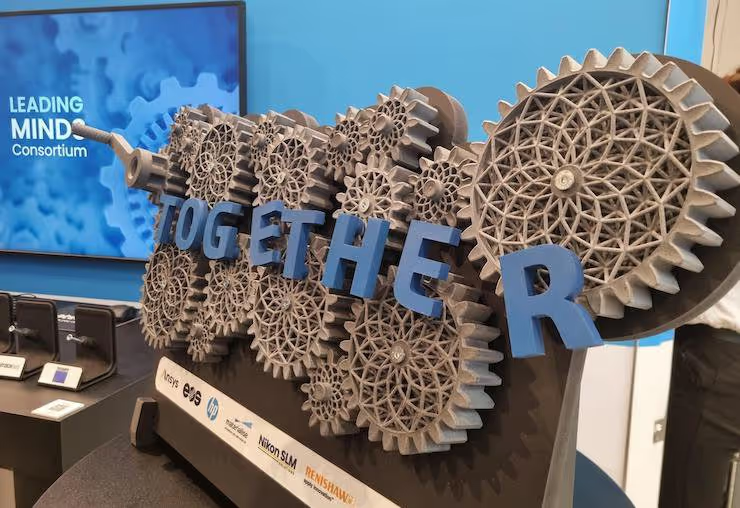
Leading Minds consortium presentation. Image courtesy of TCT
In 2024, several major companies were bought out, such as the acquisition of Desktop Metal and Markforged by Nano Dimension. Some manufacturers left the market entirely, whilst others were compelled to delist from Nasdaq and the NYSE.
This consolidation is expected to run over into 2025, with a handful of dominant manufacturers coming to the fore. As we will explore below, there will be increased globalisation in equipment utilisation and the service industry alike, so there may be more acquisitions and mergers between OEMs as they strive to stay competitive.
There are worries that market consolidation will stifle the emergence of technologies within a newly maturing industry. Phil DeSimone, CEO of Carbon, reported how the AM ecosystem could be cut in half, and that innovation could be challenged if resources are spread too thin across many acquired technologies.
Yet there are plenty of positives to market consolidation; established companies with the capacity to bring strong returns on investment will refine 3D printing's public image.
Furthermore, fostering collaboration between companies encourages widespread adoption and scalability.
At the end of 2024, representatives from Ansys, EOS, HP, Materialise, Nikon SLM, Renishaw, Stratasys, and TRUMPF announced the Leading Minds consortium. This group aims to develop a ‘common language framework’ for AM, work cooperatively to present an outward-facing image of the industry, and joining forces to address sticking points that limit customer success. Despite business rivalries- EOS and HP are direct competitors on their polymer AM solutions- Leading Minds are united in their efforts to further AM adoption.
Improving accessibility and scalability are the two points of focus for the collective, prioritising the shift from why manufacturers should adopt AM to how they should adopt AM. People in AM are aware of the benefits, but misconceptions and lack of understanding caused by a ‘very confused AM nomenclature’ hinder companies taking on AM. A more unified approach toward furthering AM as a technology could reap benefits for the industry and combat some of the PR-damage caused by market exits in 2024.
Investment

After an often-challenging year for the AM market, the start of 2025 bore promising tidings with a substantial investment in market leader Stratasys from Fortissimo. The private equity fund specialises in technology and industrials, and the $120 million investment (equivalent to about 14% of the company’s issued and outstanding ordinary shares) represents a significant commitment, a hopeful sign for 2025.
In a press statement, Stratasys declared how they hoped their investors would support ‘the continued execution of Stratasys’ strategy to drive growth and further strengthen the Company’s balance sheet as it seeks to capture inorganic value-creation opportunities in the additive manufacturing industry’.
At the beginning of February, American financial services firm Cantor Fitzgerald issued an optimistic outlook for AM partly based on the performance of key lead players. For example, Materialise has displayed resilience with a 35% gain and has been trading over its 52-week high, a promising signal for the mood surrounding AM in 2025.
AM in China

Although the US and Europe have historically been (and remain) market leaders, Chinese companies have blossomed into significant competitors.
China has emerged as powerhouses in the global AM market, and is set to reach $7.9 billion by 2030, growing at 27.5% annually– compared to North America’s 22.4%. Chinese manufacturer Eplus3D achieved delivery of over 100 super-meter metal 3D printers worldwide and Bright Laser Technologies (BLT) secured a 60% revenue spike in 2024 and a position among the top global AM revenue earners.
China, at an early point, realised the potential borne by AM, and the subsequent investment into 3D printing has meant that production costs are extremely low, and adoption is extremely high. A principal objection to more extensive adoption of AM has been worries about cost, and Chinese manufacturers are making waves with rapid growth and cost-cutting innovations, making additive manufacturing more accessible worldwide.
Exports make up about 90% of sales for China’s 3D printer manufacturers, showing how far-reaching their influence in the AM world is becoming. We turn to Bambu Lab as a case study of this.
Bambu Lab
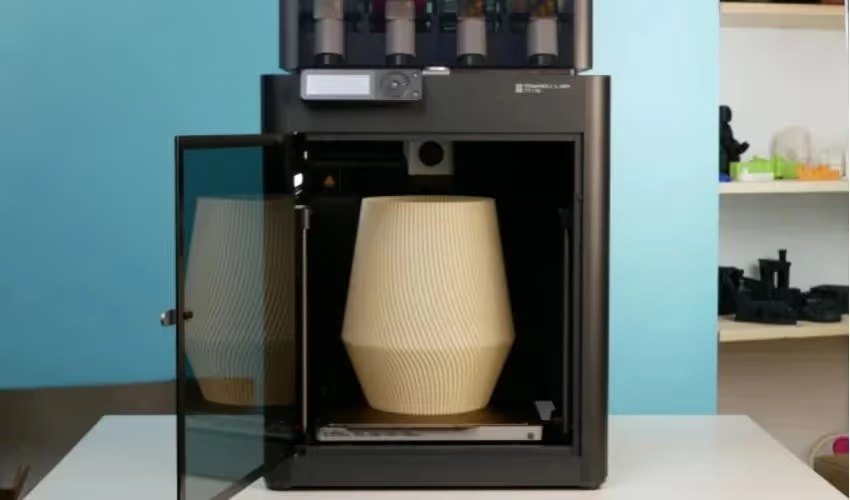
Image courtesy of Bambu Labs
Even moving away from industrial-level printers, Chinese companies have established themselves in the personal-use market. Bambu Lab provides good, quick printers at reasonable prices and have continued on an upwards trajectory that only started in 2020 and saw shipments increase by 3000% in 2023 and by 336% in 2024 Q2.
Bambu Lab’s success could be read in many ways. On the one hand, their success is an auspicious win for a small, new company who have burst through in a saturated market. Their first product, the Bambu Lab X1, was launched on Kickstarter in 2022 and represented one of the most successful printer crowdfunding campaigns ever.
Likewise, their software is democratising 3D printing for hobbyists and private users. The utilisation of the cloud allows people to access designs and processes from devices like Chromebooks and even phones, an indication that more and more people will continue to adopt AM technology and products in their everyday lives.
However, concerns regarding data security and privacy– reinforced by a controversial firmware update in January 2025– have damaged public perception of the brand. Irrespective of these hiccups, Bambu Lab and other Chinese companies will continue to assert themselves in the industrial and personal-user markets and place pressure on Western manufacturers and companies.
Reshoring

Image courtesy of Getty
In light of this, the US have implemented policies to reshore manufacturing and decrease dependence on foreign products and supply chain steps located in other countries.
The CHIPS Act from 2022 authorised $280 billion in new funding to boost domestic research and manufacturing of semiconductors in the US, with a view to strengthen American supply chain resilience and resist being overtaken by China.
Likewise, as we discussed in a recent article, Donald Trump proposed tariffs on imports from China, Canada, Mexico, and other trading partners, presenting great potential for AM.
High tariffs mean products can’t be made overseas and imported with ease; thus facilities and technologies that can be used in the US will have to be prioritised; AM is one of those technologies set to benefit.
The US is at risk of finding themselves playing catch-up with China on production rates and costs. Yet these policies may allow American OEMs an opportunity to reshore and secure up their supply chain whilst competing with China in the market.
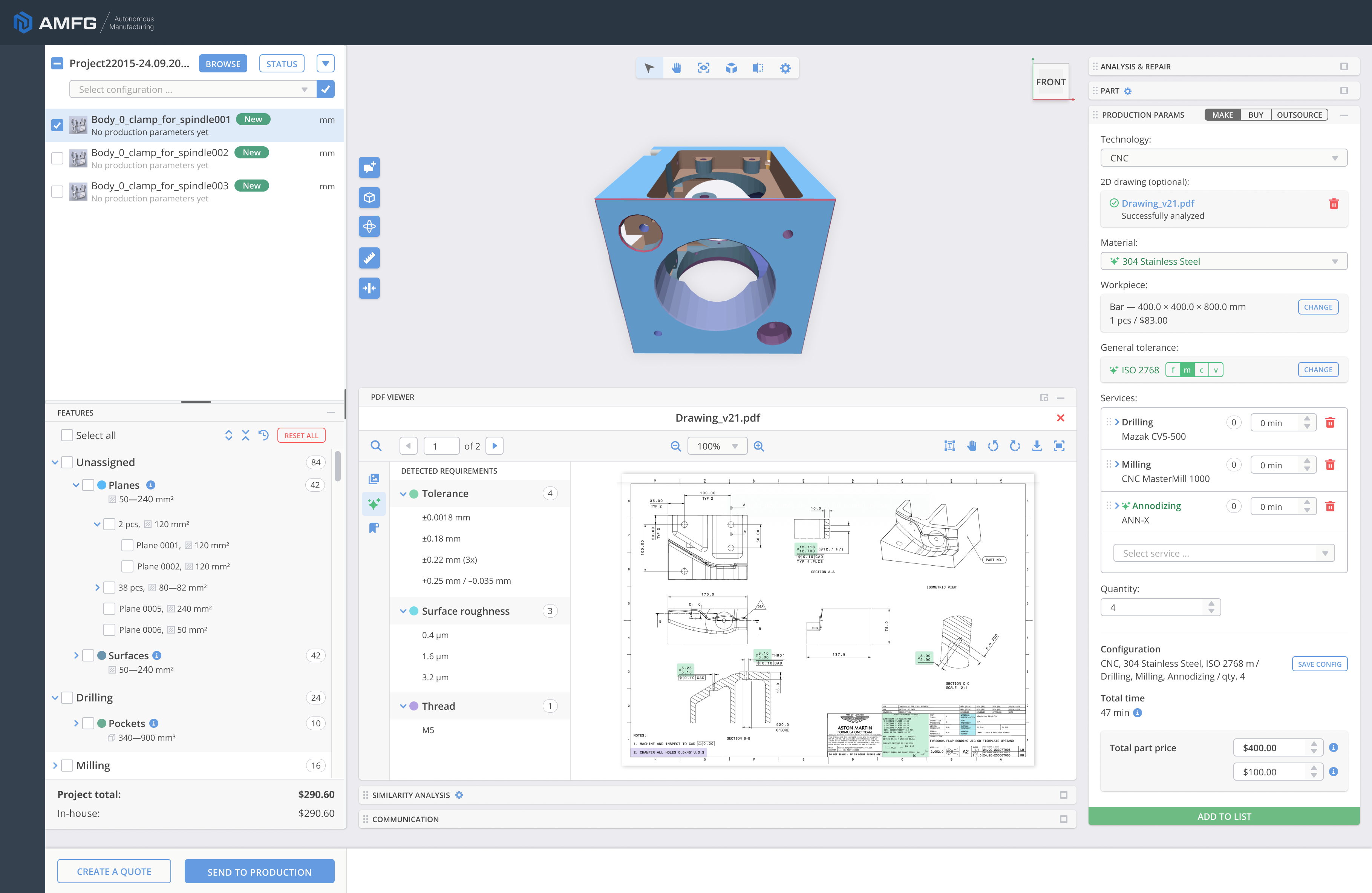
AM is able to address issues with supply chains and provide an alternative to traditional manufacturing that doesn’t rely on foreign suppliers and contractors. The technology can enable on-demand, localised production, with digital inventories replacing physical warehouses. Therefore, the move towards reshoring of production and regionalised manufacturing hubs could spell an exciting next 12 months for AM, with the trend t0ward regionalised manufacturing hubs gaining momentum.Additive OEMs and service bureaus should capitalise on the potential benefits of these new policies, and ensure that they prepare digital inventories and supply chain efficiency. AMFG allows manufacturers like Ricoh, Decathlon, and HP to manage digital inventory, streamline shipping processes, and directly connect with preferred suppliers and subcontractors and enable on-demand, distributed manufacturing– click here to find out more: Book a demo
Final thoughts
What type of year will 2025 be for AM?
At least in regards to the market, a year of cautious optimism.
As shown by early investments and collectives like the Leading Minds consortium, there is an effort to restore confidence in AM– and it seems to be working.
The technology is established, and what were once cutting-edge inventions are now being earnestly applied to various industries.
China’s rise threatens the US and Europe’s dominion over AM market share, but companies in these countries won’t lose out if they take advantage of reshoring policies and make sure they’re truly prepared for 3D printing to make a serious impact on manufacturing.
In the next and final article in this miniseries, we will summarise the predictions we have made about the AM technology, applications, and market trends set to define 2025. We will offer our verdict on whether a good year lies in store for AM in 2025, and offer advice on how to fully capitalise on the opportunities presented.
Contact us by clicking the button below to receive the final part or speak to an expert about how to succeed in additive manufacturing in 2025.
Read the other articles in the miniseries:
- Additive Manufacturing in 2024: A Summary
- Additive Manufacturing Forecast 2025: Technology and Applications
About AMFG
AMFG is an award winning MES designed to empower production workflows, from order placement to shipment, with seamless integration and precision automation.
With over 500 successful implementations in 35 countries and across a range of industries, we specialize in enabling companies to successfully integrate our software for AM and CNC production, into their wider manufacturing processes and scale their AM operations.
For more information, please contact us here: Book a demo


.avif)
.svg)