Additive Manufacturing in 2024: A Summary
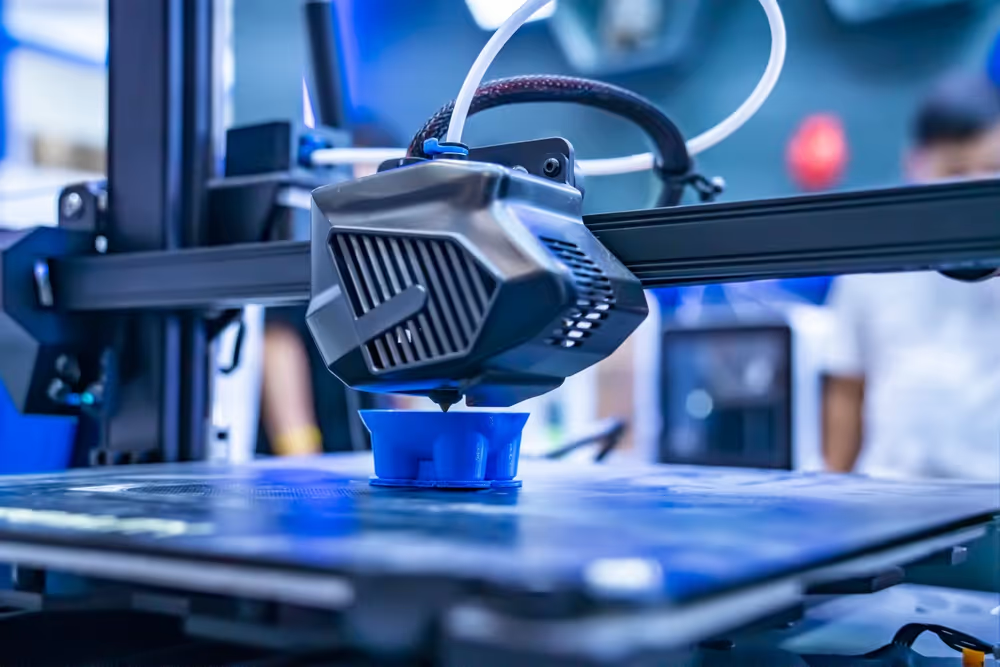


Additive manufacturing has grown up. From the early days of prototyping usage to production of end-use parts, the industry has been touted as having great potential in global manufacturing. The global additive manufacturing market size was valued at $19.97 billion in 2023 and is expected to reach $143.3 billion by 2033.
But AM has somewhat buckled under the weight of such pressure, and despite substantial investments from global corporations and heavy funding into numerous start-ups, the industry has experienced teething problems in the last five years which continued into 2024.
In this article, we look at the positives and the negatives from the last year. In the face of challenging market conditions in 2024, renewed interest from certain industries and several success stories provide an indication that in 2025, AM can stabilise and advance again.This is the first in a miniseries looking forward to 2025, in which AMFG will closely examine technology, innovation, and market factors that will affect how AM performs in the new year.
The AM landscape
Following the pre-pandemic flurry of printer purchases, and a mid-Covid spike in AM industry as governments tried to generate solutions to the crisis, interest rates soared and larger companies who had bought 3D printers started to question why they had done so.
As a result, AM experienced a crisis of image. Companies and investors have begun to doubt the hype, concerned about the last few years and clinging to misconceptions that, despite material and environmental efficiency scaled for end-use, 3D prototyping is merely an expensive pre-manufacturing process.2024, then, was a year to begin rebuilding trust in a technology leaving Gartner’s ‘trough of disillusionment’ experienced by all new technologies. After the dramatic rise and subsequent careening fall of 3D printing, last year signalled the rebuilding of confidence and the beginning of a gradual, sustainable growth to a general adoption over time.
Nevertheless, there were significant challenges. Despite a high demand from users, machine saturation meant that manufacturers struggled. Shipments of mid-range ($20,000–$100,000) and professional ($2,500–$20,000) saw a 10% and 28% decline, respectively, and industrial printers dropped by 15%. Shipments of high-end machines declined for a fourth consecutive quarter, falling 25% compared to 2023.
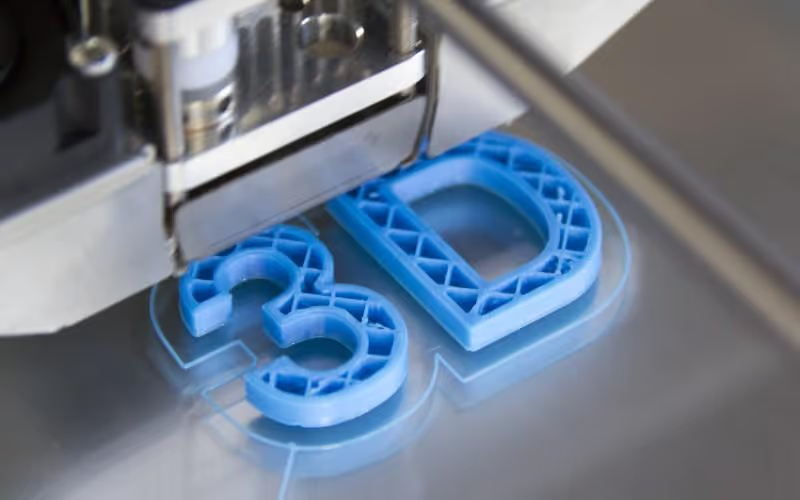
A look back at 2024- technology and applications
Positive: Continued adoption of AM technologies based on capacity of materials
Manufacturers gained ground in various industries due to the technology’s capabilities, such as high-performance polymers being used for their high resistance to heat and stress. Likewise, steel and titanium were widely utilised in industrial applications through electron beam melting, intelligent layering, and layer metal deposition. AI and automation began to be implemented with a view to autonomise production and speed up shop floor processes.
Stable: Selling solutions remained an important trend, reinforcing AM’s position in manufacturing
2024 continued the trending transition from selling technology to selling solutions to manufacturing problems. Application developments with high-value clients once conducted away from the public eye have reduced in frequency, and manufacturers have stepped out to market their services.
Companies like EOS and HP, with both of whom AMFG works to improve connectivity across the AM workflow, have pivoted from selling equipment towards offering expertise and bringing groundbreaking products to fruition.
Positive: High interest in aerospace, defence, and healthcare
Following the pattern of the past few years, aerospace and defence caught the interest of several manufacturers and greatly sustained the AM market, yet high production costs continued to limit widespread adoption. North America was important for AM once again; the continent is forecast by Technavio to contribute 42% to AM’s global economy in a forecast period extending to 2029. Healthcare parts were in high demand, with metal AM revolutionising the production of customised dental implants and restorations. 3D Systems signed a five-year, $250 million contract to supply clear dental aligners, the largest in its history.

2024 reinforced AM’s presence in several applications, with various success stories towards the latter end of the year. For example, in September, SLM Solutions introduced a new metal powder designed to improve mechanical durability and reliability of parts used in oil and gas, aerospace, and defence. According to Additive Manufacturing Research (AM Research), AM services grew by 14% in Q3 2024, demonstrating that, despite a tough year, AM’s growth in applied industry is an encouraging sign.
A look back at 2024- market
Negative: Challenging macroeconomic conditions
Despite the continuation of global disinflation, high interest rates and restrained capital expenditure remained a sticking point for those looking to invest in AM. Industrial shipments of printers fell, despite an increasing demand from China, with decreased sales for industrial equipment in Q3 2024. Poor macroeconomic conditions in Europe discouraged end-users from investing in advanced manufacturing technology as a whole.
Positive: Decreasing interest rates
However, the mood leaving the year was not one of despair, but rather cautious optimism: discussion of decreasing interest rates prompted customers to delay their purchases to get a better deal, perhaps prompting a positive 2025.
Negative: Delistings, insolvencies, and bankruptcies damaged AM’s image
The AM player market experienced a significant degree of upheaval. Velo3D’s stock and securities were delisted after the company fell below the NYSE’s continued listing standard, and Voxeljet voluntarily delisted from Nasdaq in March.
Forward AM and Zortrax went into insolvency, and notable companies like Sintratec, KIMYA, and BASF also exited from the market. Shapeways, formerly a major name, filed for bankruptcy in the middle of the year, being acquired and eventually revived by Manuevo BV.
These market changes signal the end of 3D printing’s heyday in the international stock market and raise questions for investors going forward.

Uncertain: Market consolidation set to continue in 2024
Major companies were bought out, with Nano Dimension acquiring competitors Desktop Metal and Markforged after months of market manoeuvring, the former in an all-cash deal.
The move was an assertive declaration of authority and an indication of impending market consolidation with only a few key players in future years. But legal proceedings and controversial firings made both acquisitions contentious and ultimately damaged public perception. It is not yet known whether consolidation will be beneficial; whether it will separate the wheat from the chaff and highlight key movers, or stifle innovation by spreading resources too thin across acquired technologies. We'll explore this in more detail in our miniseries.
Positive: Bambu Lab showed resilience amidst a challenging market
Despite this, 2024 saw the continued rise of Bambu Lab, with companies turning to the Chinese company for cheaper, easier-to-run entry-level printers. The Shenzen-based printer manufacturer founded in 2020 has experienced a meteoric rise, which continued in 2024; in Q2, Bambu Lab achieved a 336% growth in shipments. Their growth represented a highlight in a tough year for AM.
The forecast: Groundwork laid for a stabilising year ahead
Despite a challenging year in 2024, there is still hope and interest in the potential that the technology harbours. AM is starting to assert itself in nearly every manufacturing-centric industry, with more end-use parts and advancement into full-scale production. The hiccups in 2024 are expected to subside, a result of the year’s economic environment and key player exits from the market, and growth is expected to return after a series of chaotic years. Even if 2025 is not a critical inflection point, the year certainly represents a chance to continue restoring confidence in the industry.
In the rest of this miniseries, AMFG will peer into our crystal ball, providing a thorough forecast of technology and applications in the second installation, and market in the third, assessing whether this forecast is likely to occur in the fourth.
Contact us by clicking the button below to receive the next two parts or speak to an expert about how to succeed in additive manufacturing in 2025. Book a demo


.avif)
.svg)