Expert Interview: Yanesh Naidoo on The Legacy of Industry 4.0


From the shop floor to becoming an owner of Jendamark Automation, Yanesh Naidoo has had a long career in automotive manufacturing.
Named African tech company of the year in 2023, Jendamark is a global leader in designing and manufacturing automotive assembly lines, having built over 3000 automotive assembly systems worldwide.
Yanesh Naidoo is the company’s Innovation Director where he heads up Jendamark’s digital services division. As an expert in Industry 4.0, we were thrilled to sit down with Yanesh and get his insight on manufacturing technologies.
Here Yanesh discusses whether Industry 4.0 has lived up to its promises, the transformative role of AI and why we’re wrong about our approach to the skills shortage.
How did you get into manufacturing?
It's the typical story of a kid breaking things. I wouldn’t say that I was creative, but I was certainly interested in how things worked and making things. I loved cars and always wanted to be in the automotive engineering space.
I managed to get into the University of Cape Town to study mechatronics engineering, which was a very new kind of topic back then.
I got my first job at VW in the planning area where we were planning new equipment for production lines - that was 20-plus years ago. I quickly realised that I was more interested in the deeper engineering side of the machines, and I wanted to be more involved with machine design.
At the time, Jendamark was a supplier to VW and when there was a position for a sales engineer role, I applied for it and managed to get that job.
This year, I will have been with Jendamark for 20 years. Throughout my career, I’ve had many different roles from sales engineer, to head of sales and now I’m an owner of the company. I've also managed the design office and controls department and I'm now on the digital innovation side, building a digital business off the back of our automation business.
Ultimately, what Jendamark does is design and build production lines that assemble automotive components.
So that's how I ended up where I am today.

Image courtesy of Jendamark
You must have seen a lot of changes in the industry since you joined over 20 years ago. How has manufacturing evolved in that time?
To be honest with you, I think it's evolved on the surface but at the end of the day, manufacturing components have remained pretty much the same.
Some digital elements have been incorporated i.e. tracking and traceability. But I've worked in the automotive industry for a long time and digitisation, tracking and tracing have been around for 15 to 20 years in the automotive space. It's had to be - every single bolt in your car has to be traced back and logged.
The whole digital revolution hasn't materialised as much as what the hype says. I think there’s still huge potential and it's still being realised, but to be honest with you, I think it hasn't materialised as we expected.
Industry 4.0 is now 10 or 11 years old, right? Has it had that revolutionary impact? I’m not sure.
Why do you think Industry 4.0 hasn't delivered on this revolutionary promise?
I think it's twofold. The main challenge is that manufacturing has been sold a bunch of new tech that doesn't necessarily solve a problem and because there's all this new fancy stuff, we try to find problems so we can use the technology.
That's the challenge I have with consultants, they love to create hype around new tech and say that if you're not adopting this new, fancy thing, you're falling behind. Whereas, the right approach should be a deep understanding of manufacturing challenges.
I think most consultants don't know what safety shoes feel like, they've never had enough experience on the ground on the shop floor, or on a live production line to really have a deep appreciation for the problems.
The right approach has to be value-driven. As the saying goes, “You can skin a cat in many ways”. It's a horrible thing, but that's the truth. The problems in manufacturing haven't changed in the last 20 years. The way we solve problems can be different, but if you come from a technology perspective and you don't actually understand the problem, you won’t achieve anything.
That's one side of the problem, and I think the other side of the problem is that manufacturing has been done in the same way for hundreds of years.
Most manufacturing cultures are retrospective, we do things based on problems that happened yesterday, so they don’t happen again tomorrow. By using data correctly, we have an opportunity to prevent these problems from happening tomorrow.
Conceptually, that’s very easy to understand, but manufacturing people don’t look at a chart and think about preventing tomorrow’s problems. They look at a chart to explain yesterday’s problems and so we're in a very retrospective mindset.
As with any change, the mindset is the hardest thing to change.
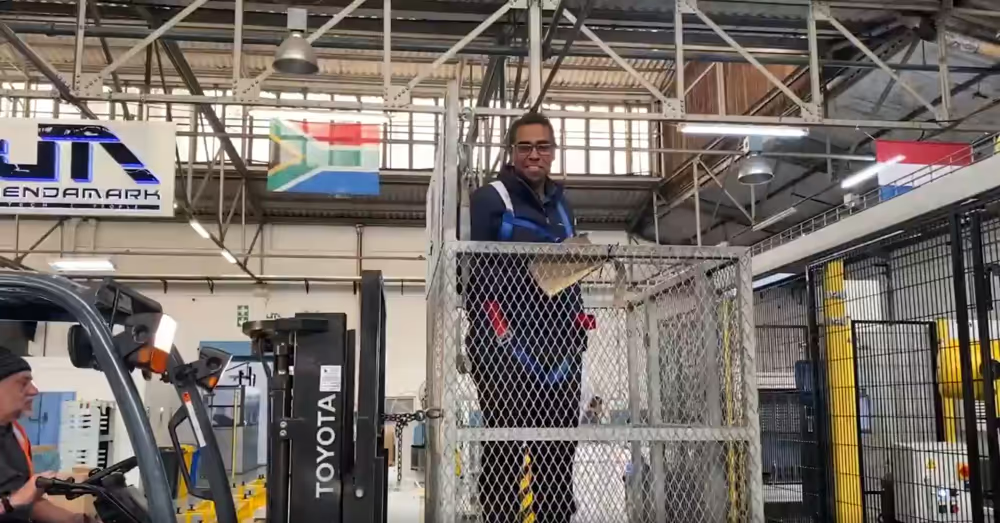
Image courtesy of Jendamark
You mentioned that manufacturing has had the same problems for 20 years or so, what are they?
The problem around skills is huge and I don't think you need massive investment in technology to solve that I think it comes down to mindset.
Another issue is the availability of information. One of the biggest challenges in factories is that you have disparate departments. You have manufacturing quality, sales, etc. and they work off different datasets. Combining that data into a common truth for the company will align those much more effectively.
You find repeated breakdowns and downtime on certain machines. We keep having to deal with that and not actually solving the root of the problem. That doesn't require huge technology changes, it requires a mindset change.
Communication is also a huge problem between people, i.e. how people put their bias in the description of an issue. It's a massive thing, and the story changes as it goes up the food chain because people add their biases to that.
Could you give an example of that?
We had a breakdown on one of our production lines in the US, and we have a support guy in this particular plant.
When the line stops, all hell breaks loose. There’s a big panic, everyone gets upset, swear words are flying… that's the nature of a factory floor. One of the machines broke and then it started to escalate because our customers were starting to lose a lot of money.
As it went up the food chain, people weren’t satisfied with the answers they were getting from Jendamark on how to solve the problem. By the time it got to the CEO of our customer, and that CEO phoned our CEO, they were talking about the wrong production line.
When our CEO started telling us internally to go and fix ABCD, he was completely wrong.
There was a miscommunication along the way and it's like a broken telephone, it's human nature, we add our biases to that and that's the reality of what happens on the shop floor.
Is there a way that technology can fix that?
Having clear visibility is key. If the CEO had had a dashboard and could see that line 7 was down or got a message on his phone, it would have aligned everyone's understanding of which machine was down.
There is an opportunity for data to be shared across all levels of an organisation that represents the truth and not people's opinions.
It’s important to have that objectivity, data can't be misinterpreted in the same way.
Yes, if we had had access to that as a supplier, we would have reacted much more quickly.
That's when technology can help, but it's about understanding the problem first and then applying the right technology on top of that.
Of course, it’s better to make sure that the technology fixes the problem than vice versa. Having said that, are there any industry 4.0 technologies that you’re excited about?
I think all of them are exciting but we need to think of Industry 4.0 as tools in a toolbox whether that’s collaborative robots, 3D printing, digitisation, computer vision, AI, etc.
These are all fancy tech but we need to know that they’re tools in a toolbox. You need to send the engineer to go and solve a particular problem, understand the problem and then pick the right tools accordingly. Not going to look for a problem where they can use a cobot.
A cobot is a good example because that technology was really hyped but now a lot of cobots have been decommissioned. They're great products when used correctly but a lot of CEOs said to their engineers, “We must use cobots, put cobots in everywhere.”
Interestingly, a cobot slows the process down because it's got to be safe, it’s got to be programmed in a certain way. A human is often faster than a cobot, and a human working with a cobot is even slower.
If I want to make my productivity faster, a cobot might be part of the solution, but it may not be. The mindset can’t be, “There's a cobot, let's use it, I don't care where - I want to use it.”

Image courtesy of Jendamark
I see, using it for the sake of it isn't as effective as using it to solve a specific problem that only a cobot can solve. Do you see that attitude in the way that we talk about AI at the moment? Is it the same thing?
No, AI is different, it’s a foundational and transformative technology. But again, I think it comes down to the mindset in the organization to use it correctly.
Whether it be computer vision, large language models or conversational AI, I think it’s going to change the game because it can do what humans can do but cheaper, like inspecting a product.
I've got a water bottle here, there are certain things that a conventional camera can't do, but a camera and AI can probably check certain things on this bottle the same as a human.
At the end of the day, it can cost less and may potentially be more reliable, but it takes time.
We’ve spoken about Industry 4.0 but what’s your take on Industry 5.0?
Again, consultants trying to create more hype around something that means nothing.
People have misconstrued Industry 4.0 as well. People think that advanced manufacturing and very automated production lines are Industry 4.0, but are they really?
For me, the definition of Industry 4.0 is using data to improve your productivity.
Industry 3.0 was about automation and just because you automate the line doesn't mean it’s industry 4.0 because you need to use data proactively as opposed to reactively.
Industry 5.0? I think it's all bullsh*t.
At the end of the day, it comes down to the same thing, understand the problem you're trying to solve and use different tools, AI being one of them.
So we spoke about the skill shortage before. What do you think is at the heart of that? And what do you think the industry can do to address it?
Where are you based? It sounds like you have an English accent.
Yes, I’m in London.
So, let me answer your question in a long-winded way.
The population of the planet is now 8 billion people. Something like three billion live in the “first world” and five billion live in developing countries in Southeast Asia, Africa, India, and parts of South America, right?
The majority of the world's population doesn't have a shortage of labour, this shortage of labour point is a very Western thing.
I think migration should be handled a lot better because people want to come to the UK, but nobody in the UK wants them to come because they're scared about jobs but there aren’t enough people to do the job.
There's an opportunity being missed, but that's my political opinion. There are lots of people in the developing world with skills that want to come.
It's not that there isn't a global shortage of people, there isn't. The perception of a shortage of skills is true in certain factories, obviously, and in certain countries but it’s not true for the whole world. In fact, it's not true for the majority of the world.
That's interesting, I’ve seen others in the industry suggest things like education and outreach as a solution. You're the first person I've spoken to who’s pointed out that the people are there and can bring them in to work at these skilled jobs.
It all goes back to understanding the problem.
I also think that COVID has had an impact on the industry. Another thing is that manufacturing has become less sexy and people don't want to do it anymore. There is some marketing that must be done to make it cool again, and I think the technology is an opportunity to make it cool again.
I think that the shortage of labour is easing up now as demand is dropping. You had this supply chain challenge in COVID. There was huge demand and not enough people so you had these big spikes and I think that the hysteresis in the curve is flattening.
If I were to leave something with your audience, it would be that there's not a shortage of people and not a shortage of willing people either.
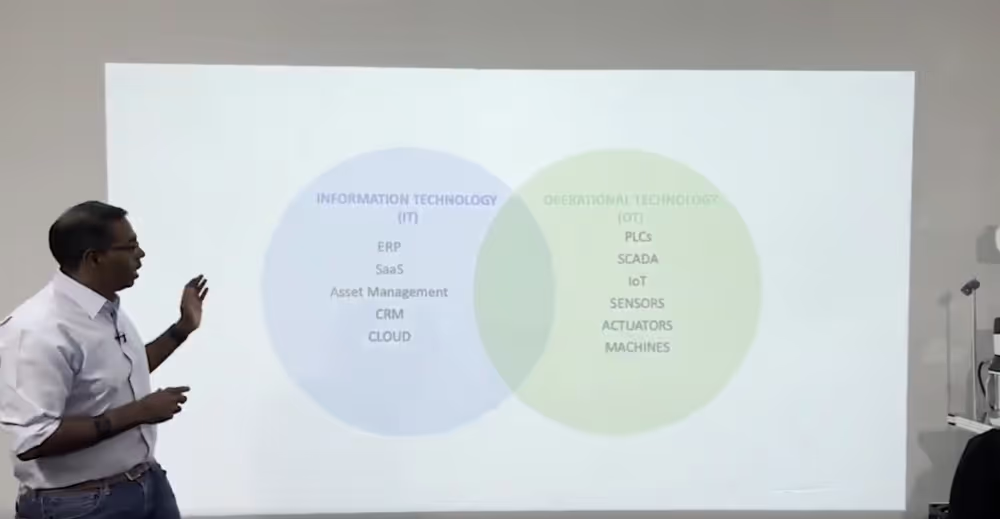
Image courtesy of Jendamark
You've been in the industry for years and you're so passionate about it. What is it that keeps you interested in manufacturing?
Our company has this ethos that factories can only be better with better people. I'm on a mission to try and make a bigger impact on manufacturing by making people more effective and happier.
It's a lesson I learned at VW; there was a six-week period in my life that changed the way I think for the rest of my life.
When I finished university and started at VW, part of the graduate training involved working for six weeks on the production line as an operator. I just happened to draw the short straw and I had to work night shifts fitting exhausts inside a car.
I developed a huge respect for what operators have to do and I think that if factories want to be better, they have to start with the operator and make things easier for them. That could be everything from mechanical, electrical and now AI to assist the factories.
Simple things like predicting that the barcode printer is going to run out of ink. A stupid thing like that can stop a production line and, trust me, I've seen that many times.
We've introduced many processes over the years from the top down, ISO is a good example. An ISO procedure is very much coming from a CEO to make sure when you get audited you’re following compliance.
By the time it gets to the people on the shop floor making stuff, the maintenance crew, the operators, it’s a tick-box exercise. It means nothing. They're only doing it because somebody's looking for some compliance certificate.
It doesn't add value to the business, whereas if we can drive behavioural change using data from the bottom up, we can get operators directing CEOs correctly.
That’s what I hope Industry 4.0 will become so that operators are more empowered, so factories can make more money, and then CEOs will be getting their direction from operators and maintenance guys, not the other way around.


.avif)
.svg)