From Chanel to Alpine: 3D Printing Mass Production with Erpro Group CEO Cyrille Vue


Erpro is a 3D printing powerhouse.
From million-unit runs with fashion giants Chanel, to collaborations on high-end sports cars, their story is a testament to the power of quality solutions and exceptional customer service.
At the helm of this success has been Cyrille Vue, CEO of Erpro Group, made up of 6 entities across 3 production sites. Cyrille has been involved in Erpro and 3D printing from the technology’s infancy in the late 1990s, and has presided firsthand over the transformation from prototyping tool to legitimate method of production.
Since 2023, AMFG has worked with Erpro to optimise workflows and speed up quoting across additive manufacturing, CNC, and injection moulding.
We sat down with Cyrille to explore the French AM landscape and how Erpro have become market leaders, offer advice to companies looking to scale up production, and predict what the future holds for additive manufacturing.
When did you get involved with 3D printing?
A long time ago, I'm not sure that you were born. 1997. We bought an EOS machine, a P350.
They weren’t so different from the machines we have today, except that at that moment, the machine had a platform like you have on an FDM machine, a very simple machine that you can now find on Amazon for €300. You just have a platform and then a head that deposits a filament, layer by layer, to make a part.
At that time, on that machine, it was the same thing; just a platform, and you spray a layer of powder out on the platform. First, you had to build the wall to sustain the powder, and then you started to build the parts with the laser. The platform went down, you put a new layer of powder, and, to continue the process, you had to make a new wall. It was so boring, took so long, and it wasn’t reliable at all. It was, to be honest, very complicated at the time to produce parts.
Now, the platform is moving into solid boxes. You don't have to produce the wall anymore, so it's much faster, much easier, and, on top of that, much more reliable. It’s a completely different experience now.
How long is the difference between print times then and now? How long would it take in the late 90s to run a full job?
For a complete job of 600mm high, to be honest, you usually didn’t succeed in completing a full job. You always had an issue before you could finish, you always figured out that there was something wrong in the system, so the job was never completed before its scheduled end.
But imagine that we were successful in running a full job at 600. It would take something like sixty, seventy hours, maybe eighty hours. It depends on how many parts you have inside, but nowadays, it takes around 24 hours.
Wow.
We reduced the time needed by two, maybe three. At its core, the principles of how we produce the parts have remained the same. Current methods are 99% similar to those used at the beginning (except the absence of the wall of powder), except the fact that we are much faster. The main difference between the machines from the late 90s and those now is speed.
Interesting! I saw that you've been with Erpro since 2001.
Yes, I set up Erpro with my family in 1997, but I’ve been 100% involved in managing the company since 2001. Beforehand, I worked freelance, particularly for the automotive industry, but also for Erpro. In 2001, we needed to scale up, so I decided to spend all my working time at Erpro.
Wow- that’s quite a long time with the same company–
Yes, you can see from my white hair!
What is it about Erpro that keeps you engaged and striving to continue pushing what's possible with active manufacturing?
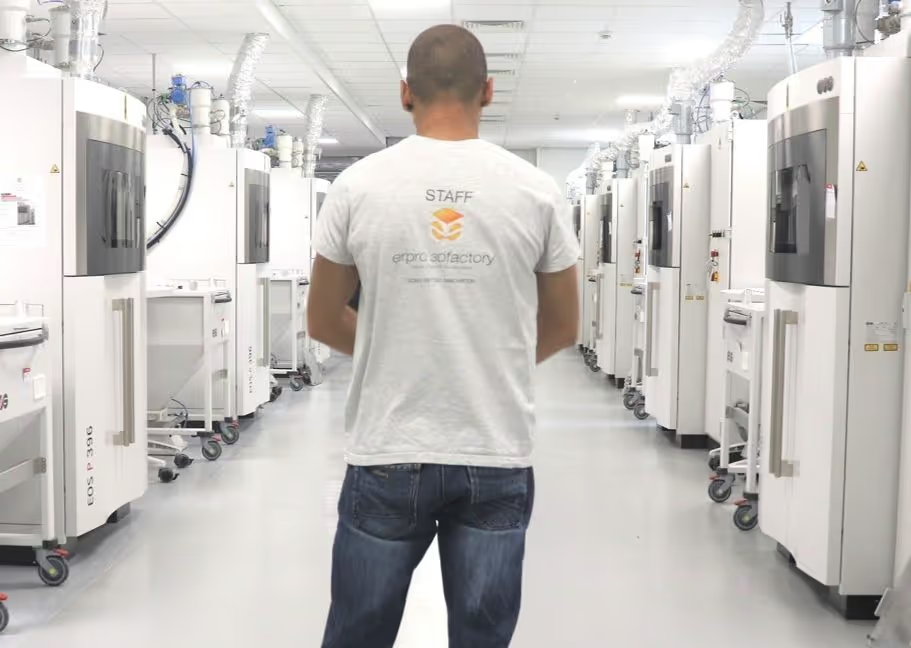
To be honest, it was a long journey, and can be summed up as a story of meeting some key people- in the automotive industry, in luxury brands, in cosmetic brands, in aerospace, and so on.
Some of our customers said that we are the best- but I don’t think so myself. However, we are the most engaged AM company that you could ever find in France. We were always present at meetings with our customers, always ready to succeed with them, to deliver at the right time and with the right quality they needed.
Customer service is the main reason why we grew from starting in a small garage with just one machine, to having three different plants- two in Paris and one in Northern France- and more than 90 people at Erpro, fully dedicated to our customers.
So Erpro are unique for the strength of their relationships with customers, but how would you assess the state of additive manufacturing in France as a whole?
I think it’s very similar to the UK or Germany. There are a lot of service bureaus and a lot of big industries like aerospace and automotive have their own facilities, fab labs, or factories with many additive manufacturing machines. So in terms of services, France is in a similar situation to other countries.
However, in terms of technology providers, we only have a few compared to Germany or the USA, for example. But in terms of services, we are up to date.
I read an article about the collaboration with Alpine to produce to the A390_β–
Yes, it's a concept car, the A390_β. Beta means that it's a prototype– a show car, a one-off.
Yes. I saw that you described your team as digital craftsmen. Could you elaborate further on that conception of their role?
I think I have to give you a bit of history. Today, I think that you can identify two groups of customers.
One group are those customers who only want a prototype. They don't care about how it’s designed, how it’s manufactured–they just want a prototype. We call it rapid manufacturing, rapid prototyping.
In house, we have a lot of different technologies to provide one, or two, or ten prototypes. And then the project will move on, and then they will choose injection machine injection molding, stamping, or whatever to produce the final parts.
The second group of customers are those who want to use additive manufacturing for production. If you want to win this kind of project, if you want to succeed, you must design for additive manufacturing. If you don't design for AM, you will definitely lose the match. If you want to win the match, you must design for the technology.
That’s the reason why you see in this article that we are a kind of digital craftsman; we have our own designer to design for additive manufacturing, and to be able to make really impressive parts like those on the A390_β , with the lattice structure and so on. If you don't design for additive manufacturing, you cannot imagine a lattice structure, for example.
We have people in house who are dedicated to designing for additive manufacturing. Did you see the article about the other Alpine, the A110 Monochromatic? It’s even more amazing.
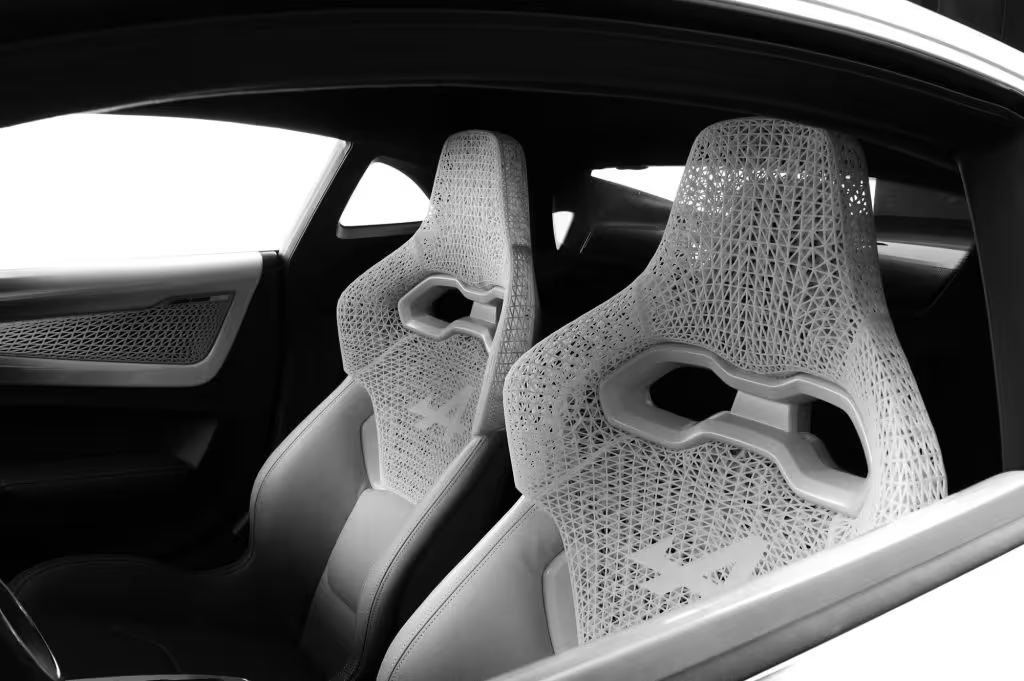
Alpine A110 Monochromatic. Image courtesy of Mathieu Cesar
There is a part of the seat that is fully 3D printed, and you can also see a part on the panel on the door. It’s a very nice collaboration between Alpine and Erpro. We made the design and we produced a lot of parts for this very popular car. We call it an art car– they were a trend in the 70s or 80s, people decided to use cars as a medium for art.
Nice! I can see exactly how particularly the headrest just wouldn't be achievable with other technologies.
What is very impressive is that even before we put this image on LinkedIn, some people saw pictures of the car from Alpine and asked me: “Cyrille, is this your work? Did Erpro make these parts?”
People see something amazing in digital manufacturing and immediately think of Erpro. They don't think about our competitors.
That’s a real testament to the brand that Erpro has built. Beyond the art cars and collaborations with Alpine, Erpro has worked extensively with Chanel to produce millions of mascara brushes. In what ways do you see additive manufacturing and the fashion industry intersecting?
To make this long story short, I explained that we have two different types of customer: people that want just prototypes, and people that strive to make series with additive manufacturing.
We had this mindset in 2014. We implemented our strategy, and we decided to start developing, in house, the capacity and the mindset to offer customers the possibility to properly produce with additive manufacturing. The first customer that trusted in that vision, in Erpro, was Chanel.
We started collaborating in 2014, for two years of research and innovation. In 2016, we gave Chanel a proof of concept for new mascara brushes with a raw material that is 100% bio-based, and with a shape that you could never imagine with a commercial technology. And in 2017, we got their approval.
The product was launched in 2018, and between 2018 and 2024, we delivered more than 20 million parts. Usually people say that additive manufacturing is not designed for mass production, and that’s become a kind of joke for us, as we ask: “Really? You really think that additive manufacturing is not able to produce huge series? What about the use case of Chanel? Because we deliver more than 20,000,000 parts for them.”
You can ask Chanel directly, and they will confirm– everywhere you look in the world, in shops, in airports, London, Paris. When you’re looking for mascara brushes, to gift to your mother or your girlfriend or whomever, I encourage you to look at the Chanel corner and you will find two products: Le Volume Révolution and Le Volume Stretch. Those products have a 3D printed brush, and they’re made here, in Paris, at Erpro.
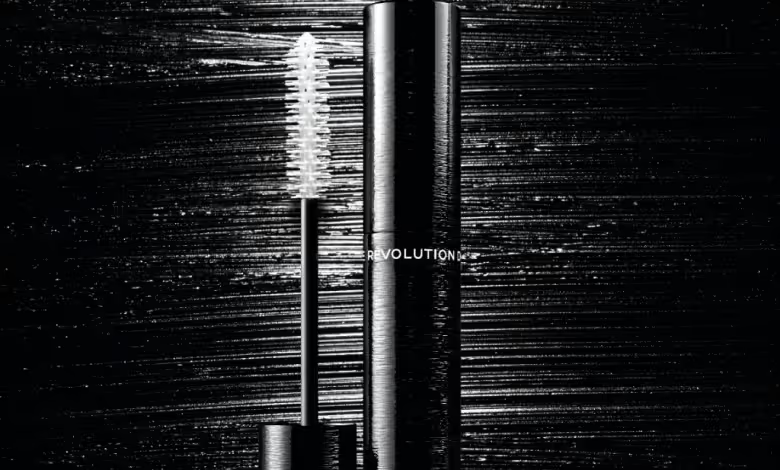
Le Volume Révolution by Chanel, produced by Erpro.
In 2024, Chanel reduced the order because they're a product within the fashion industry, insomuch that they have a lot of success upon release, and then the curve gradually slows down.
In 2024, we only produced 1 million parts for Le Volume Révolution, which is nothing for us as at the beginning, we used to produce 1 million parts per month. So it’s a huge difference.
But if you ask anyone in the world who works for a company similar to Erpro if they’re producing one million parts per year for a single product, nobody will answer you affirmatively.
So you're definitely market leaders in that regard. You’ve mentioned scaling up operations to reach these dizzying heights of producing one million brushes, be it per month or per year. What advice would you offer to smaller companies who are looking to scale up operations and get involved with mass production with 3D printing?
To be honest, there is only one key piece of advice, and that’s to find the business case where additive manufacturing brings enough value to switch from something conventional- injection molding, for example- to additive manufacturing. If you don't bring value, the match is over.
For example, if you take the Alpine car with the 3D printed seat, it brings some comfort, there is no material fatigue, you have natural ventilation because it's completely hollow, so that the air can pass through the seats easily. You don't need a pump to push the air and refresh the seat, and in the heat of the summer you don’t get a sweaty back against the carseat.
So you can find a lot of advantages using AM, but you must find enough because, at the end of the day, it's usually more expensive to do it than with conventional methods. But if you bring enough value, people will buy it.
For example, take Porsche (although they’re not a use case at Erpro).
If you have time, have a look at this video, it’s just incredible.
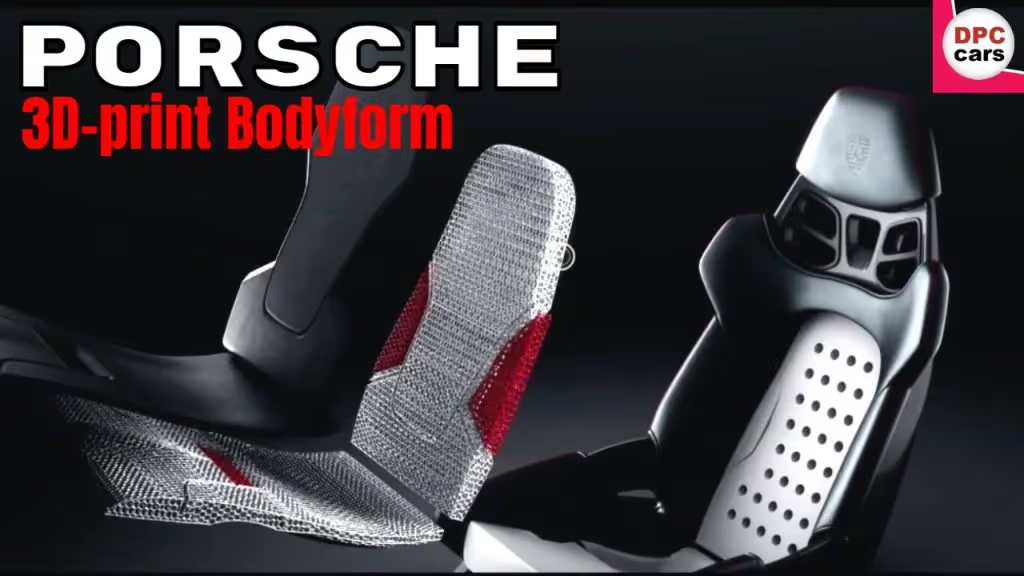
They explain that they have built a big part of the seats with additive manufacturing. Sure, it will cost maybe 10, 20 times the price of the normal foam that you find on a car seat. It's an option you can have on the GT2 and GT3, for a more sporty, racing car.
I heard that 80% of people chose this option, and it costs something like €10,000. But the value that this option brings for the car and the user is so significant that people want it.
So to be honest, it's very simple. Just find enough value, and then you will move to production.
Exactly- if you build it, they will come. I saw yesterday (01/04/2025) on LinkedIn that Erpro released a poisson d’avril-
In English, do you call it an April Fool’s joke? I had this conversation with my daughter yesterday as she’s learning English at school.
Yes, an April Fool’s! In the post, you joked about Erpro building an Eiffel Tower in New York– obviously this isn’t on the cards, but I was wondering what progress looks like for Erpro in the next five years? Where do you see the company going in the near future?
To be honest, each year, we have more and more customers that request additive manufacturing as a solution for production. More and more, our turnover is moving from rapid prototyping to series.
That’s the main transformation we are experiencing. Today, the technology is not brand new, but still new, always changing and moving. But I’m quite sure that in five years, it will be conventional.
Today, we always distinguish between conventional technology and additive manufacturing. My thought is that in five or ten years, these kinds of sentences will disappear. We will stop making that distinction. In the near future, using this type of technology for production will be common.
Not the main technology used in production, but another one.
Today, additive manufacturing is too slow. But it’s making a space for being a method of production.
We are ready and willing to be a company that uses additive manufacturing for production. We started this ten years ago, and I’m quite sure that, in ten years, AM will be a conventional method of production.
About AMFG
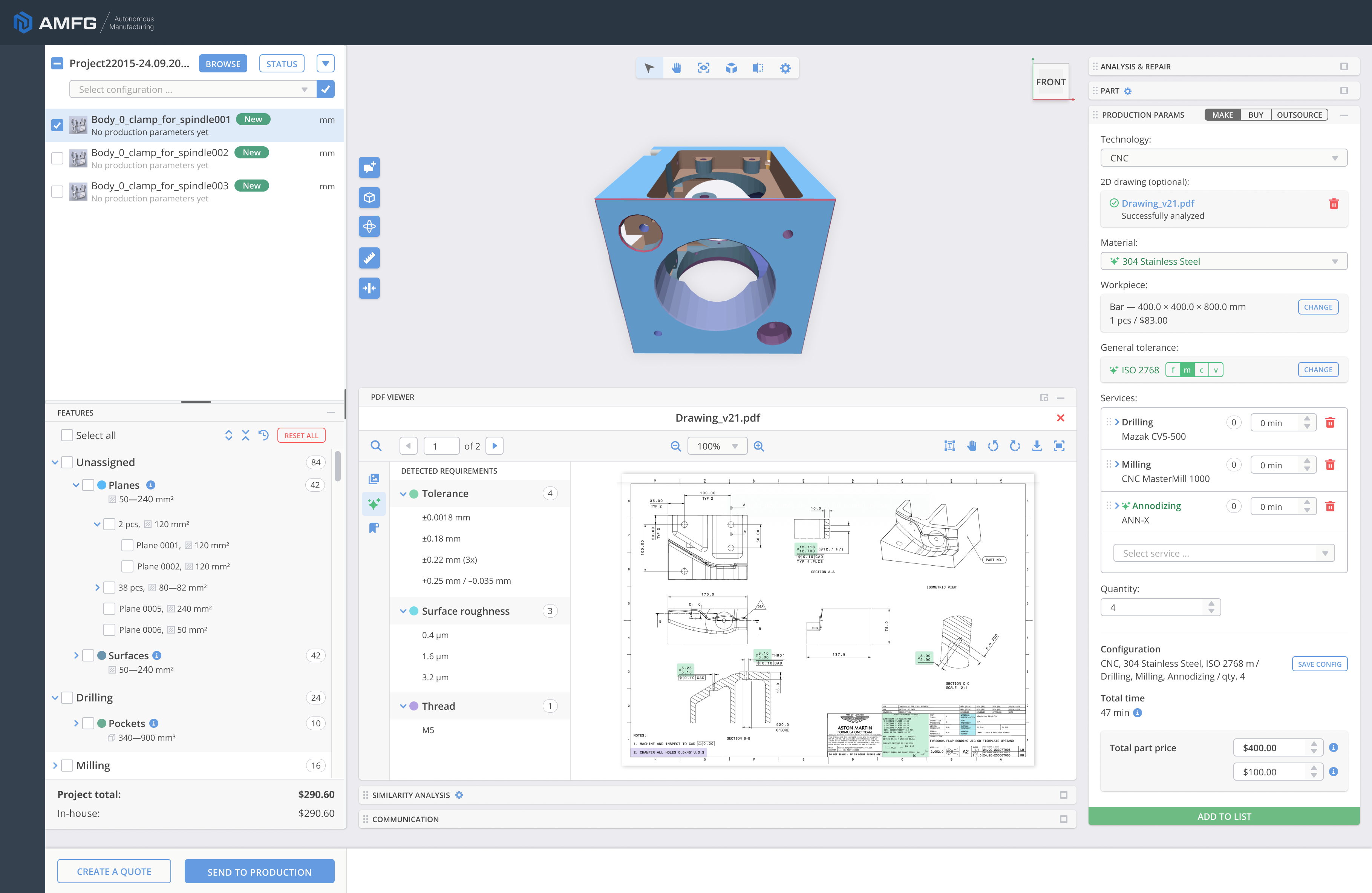
In 2023, Erpro Group and AMFG announced the commencement of their strategic partnership, uniting Erpro’s innovative additive manufacturing operations and expertise with AMFG’s leading MES and workflow software.
With over 500 successful implementations in 35 countries and across a range of industries, we specialise in enabling companies to successfully integrate our software for AM and CNC production, into their wider manufacturing processes and scale their AM operations.
Learn more here: Book a demo

.avif)
.svg)