Giving Back to Manufacturing – an interview with Matt Guse
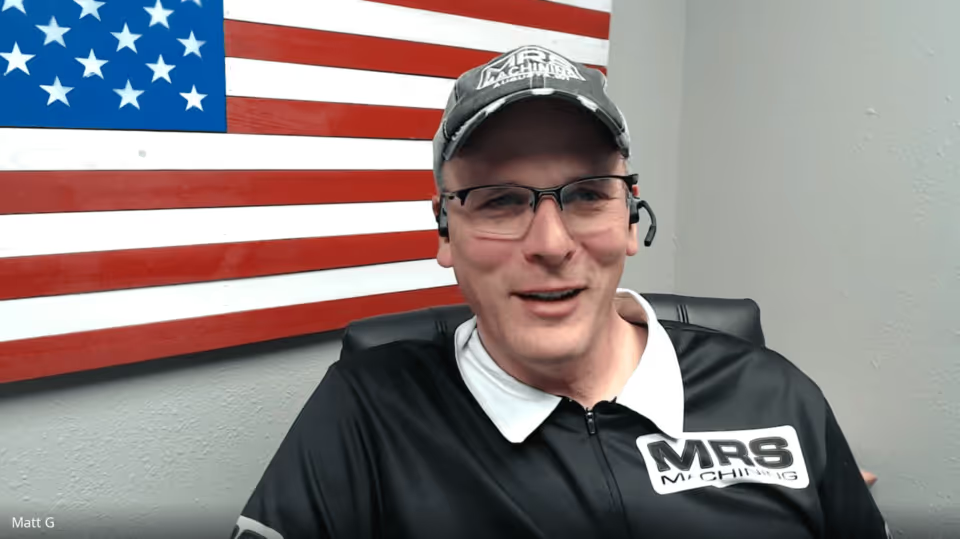


All of us in the industry are working to get better, we're all working together, not against, because that never works out well. So that's my passion.
I sat down with Matt Guse, President of M.R.S. Machining, author of MRS MACHINING A Manufacturing Story, and NCAA Football Official, to discuss how he’s successfully tackling the skills gap, and why his company has always been woman-owned.
An inventor with two patents to his name and featured in the New York Times, Matt discussed his own career in manufacturing, the challenges facing those starting out in the industry today, and the process of writing his first book.
14th October, 15:30 BST
Rosie Manford: You’ve been involved in the manufacturing community for several decades, as a machinist, company President, and as a mentor to younger generations. How did you get into the industry?
Matt Guse: Well, I got into it by accident, like many others. I grew up on a dairy farm and my dad was a machinist. He worked evenings, and then once we got older we moved into town and I ended up taking a part-time job at a machining company sweeping the floors. I was always good with my hands and I like making things, I’m not really a carpenter but I was good at making art. So that's kind of how I got into it.
And what keeps you interested in manufacturing?
Well, I just love making things. Like I said, art was very appealing to me as a kid and I like making sculptures. That’s really what machining is, what manufacturing is, you're making art and you can feel pride and joy from that. You take a piece of raw material and turn it into a sculpture and at the end of the day you look at it and go “wow that's cool!” That's what keeps me going.
M.R.S. Machining is a woman-owned company, is that right?
Yeah, we're woman owned, that started out by accident, too. When my dad started the company, we did a lot of government contracts and he thought that being woman owned would put us on top of the list. So my mom was the owner, and that worked for a while, but we’ve since moved away from that way of doing things. We weren't drawn to the commercial side, but we wanted to go with the flow of M.R.S. being a woman-owned company. So now my wife's my boss at home and at work, even if she’s not here day-to-day she’s the owner. We just kept the M.R.S. name, and that's what it stands for, "Mrs." We're women owned and I think around 30% of our team here is women, anywhere from machinists, to the in office staff, to quality control, to shipping. We're proud of that, and the reason we like hiring women is that women can multitask, they can do 20 things at once and us guys, we can maybe do two at once if we're lucky. So, it's a really good blend and then, of course, when we're doing critical parts they're often more detail oriented than the guys. So that's why we stuck with being women owned, and we push for women employees.
It's great to hear that you’re still pushing for more female employees. As well as hiring more women, when did you first start focusing on younger employees and the growing skills gap?
I knew something wasn’t right around the turn of the century, I knew that there was going to be a gap because a lot of us baby boomers are getting out of the industry and it just didn't seem like the momentum was there for younger generations to take our spots. A lot of schools are struggling financially so they cut out all the tech-ed programs to save money, which doesn’t help. I wanted to be proactive instead of reactive, so we started looking into this 25 years ago. We tried our own training here on staff and we failed at it. I always use the three Fs, fail fast, fix fast, and forget fast, and that’s what we did. The reason we failed the first time is that we put education on our shop floor, while using the same equipment for production. It was definitely not suitable for training, but you know, things have deadlines, and you have to use the equipment that's available.
Then I ran into a wonderful spark plug teacher named Craig Cegielski. He wasn't teaching yet, but he had this plan about starting a job shop in the local high school. And I thought, "Well, I've got the equipment here" and my dad always said “one hand’s for receiving, one hand's for giving.” So we gave Craig some equipment and he started this program and turned it into a success. When I go over there today it's my happy place because these kids are excited about manufacturing, they're excited about making things, and they run it just like a business. So are they my competitor? Yeah, they are, but if I'm threatened by some high school kids that work one or two hours a day, I’ve got other problems to deal with!
Once they experience manufacturing and we show them the opportunities available we hope they go into manufacturing full time. When we first started out, a lot of the kids went into manufacturing. Today it's getting tougher because there's so many other jobs out there. We're hurting over here in the states, getting people with a good work ethic is harder than ever. We tend to teach more of the soft skills with that program than hard skills because the hard skills can be taught once they’ve got a job. We focus on soft skills and once you’ve got that, that's what makes those kids shine. They’ve got that fundamental baseline, you know, you have to show up for work, play nice in the sandbox, stay off your cell phone, be a team player, and we have the ten commandments of soft skills.
Everybody asks “I’ve got this kid here applying for a job, what should I do?” and I always say your next question should be “when can you start?” And then we started spreading it to other schools. There's quite a few schools in the United States today that have these little chop shops set up in them and we need more momentum like that because it's still getting tougher. All of us in the industry are working to get better, we're all working together, not against, because that never works out well. So that's my passion.
Do you work with teachers and parents as well?
Yeah, you know that's the most untapped resource there. People that are middle aged, like moms that have their kids in school, they can come work part-time for us. One of the best things we've done for teachers in education is during the summer, teachers come and work here. We get them working and they learn about manufacturing, maybe they find a passion for it. We always say that we won’t hire them away from school though, that’s rule number one with teachers, because a lot of them can make more money working in manufacturing than in teaching. This way, they learn skills about manufacturing and about M.R.S. and they can go back to their school and say, "Hey, I worked at M.R.S. this summer. Here's a real life problem, here's a math problem, English problem, communication problem." So, they can teach that in schools, and what's better than a real life experience? Of course, then that gets kids talking about manufacturing and M.R.S. so then we invite them in and show them around. Teachers are actually some of our best recruiters because I'm not in school every day and they are. So, just something we did differently here.
That's unique, I haven't heard anyone talk about getting teachers into their shops, but I think that's genius!
Yeah, we actually took it one step further. What we found is I've been doing career fairs in schools for well over 30 years now, and who wants to come and talk to some old guy about manufacturing? So we hired a wonderful young lady who goes to the schools and talks to the kids, and we send our shop manager in there as well. People say they don’t have time to do that, but I can tell you from a business perspective that it’s worth it. If I hire one person out of those visits that's about $300,000 in extra revenue in our sales. So spending a couple of hours in a few schools is well worth that. Then in the summer we usually end up hiring five interns and then out of those interns, we usually hire two full-time. That's pretty simple math if you ask me. This last year, we had to turn people away, which was sad, since we had several dozen apply, but they can always come back and reapply again next year if they’re still interested. I think you’ve got to be in the schools and then it's pretty simple. You go to them, tell them about manufacturing, and then invite them to your building for a tour. That’s why we have a very young workforce here, our average age is under 30 now which we're proud of. Of course you have to have a mix, we have mature and young people working here. So I always say get out there and go see the kids because they’re hungry for attention quite often.
Is that why you started the Coffee With Matt initiative?
Yeah, well that started by accident too. It's funny because two years ago I had a cycling accident and I wasn't able to travel to schools like I should because I had so many injuries. I'm fine now, it's all good. I was chatting to Craig and saying I’m sorry I didn’t get over to the schools with him, and he goes,
"Well you’ve an excuse, but did you know these kids like coffee?"
And I said, "I'll tell you what. I'm gonna come over and have coffee with the kids."
So, I did it a couple times and it’s been kind of cool. I don't talk about anything specific, just about life in general, so I called it ‘Coffee with Matt.’ I get to the school around 7:30am, meet the students, and then we get the coffee on and just sit around and talk about life. What's nice about that is they get to know you as a person and you get to know them, and maybe you’ll end up thinking, that's somebody I’d like to come work for me. It's not instant success but hopefully in two or three years some of those kids will want to come and work for me. Even if they don't, they become your friends.
One particular school, Augusta High School, had a FANUC robot and when I went over they showed it to me and I said, "All right, when I come back here next time, I want that robot to take that coffee pot and pour my coffee for me."
They said they couldn’t do it, but I just said, "Yeah you can, figure it out. I'll be back in a month." By golly, I went over there and sure enough, I posted a video on LinkedIn and the robot picked up the coffee and poured it for me. They felt proud, and I felt proud of them, it was lovely. It's just about getting out there and mingling with the high schools and meeting the kids. That's what you’ve got to do.
So when you're chatting to the kids, or picking interns, what kind of characteristics do you look for?
Well, I want them to be a team player and I want them to have communication skills, but some of our best people are the ones that are from broken homes that don't have a mentor, a person to help them in life. We bring them over to M.R.S. and we inspire them and show them that they have gifts and talents and show them they're good people. We give them a great career path and we can also give them confidence in themselves.
Some people look at young kids and say, "Well, they're here to take my job away" but that's not the case. When we hire somebody here, we take them in, put them underneath our wing and build them up, because it makes our jobs easier in the long run. It's a team effort and culture, that's why kids are interested in us, and why we’re interested in them. They're young, they're asking questions, and I always get better around people who are asking questions, there's no such thing as a dumb question. When I ask a ‘dumb’ question, it helps everybody get better.
How do you ensure that your manufacturing jobs provide workers with something that has purpose and meaning as opposed to just a salary?
So, here we show the benefits that come with working for us. Money isn't always about happiness because I know some people that are really, really wealthy and they’re the unhappiest people I know. They have everything going for them but they’re just always worried about controlling their money. I always tell people there's a few things in life you need. You need a good car, and you need a good place to live. Money isn't everything.
We lay it all out, what they can afford, what they can't afford, and we build them up. The big thing I tell people is that the fastest way to become a millionaire, besides winning the lottery, is putting money in a 401k. At M.R.S. we match 6% of it so that by the time they're 50, they're going to have a million bucks in there, if they do it right. It's about the benefit package. You've got health care, insurance, vacation. The kids these days just look at that dollar sign, they've got to look at the whole package. Some people that listened to me 15 years ago have started looking in their IRAs, and they’ve got $400,000 or $500,000 in there and they're 35, 40. That's the thing that we like to show people about career paths.
"Manufacturing is coming back to the United States, and we need people."
How do you think that the development of AI and automation software will impact the skills gap going forward?
Well, AI is the big buzzword right now. I've been testing some AI programmes for the last two months and they’re only as good as the training materials, so we have to be really careful about what we’re using. AI is a great tool for writing and grammar, that's pretty dead on, but as far as information, it's only as good as what’s out there.
At M.R.S. we mostly use it for programming, you can download a model, hit a button, and it'll program the part, but you still have to go and edit it and that's never going to go away. You always have to change it to perform how you want, because metals vary so much. AI is never going to fix that. It’s similar to robots, everybody thought they would take people's jobs away and they haven’t. They're actually making our jobs easier. It's a different skill set, how to program a robot, but at the end of the day the robots do the heavy lifting and carrying during the day, so you don’t have a sore back or arm. Technology makes us more productive, it's not taking anybody's jobs away. I think AI is going to help, but I don't think it's a replacement for everything. I still like to see people and speak to them in person, you can feel each other's energy. It’s going to help, but in 10 years there'll be another new buzzword coming through.
I think everybody's going to have to have AI and know what it is. That's not wrong, but it's not bulletproof yet. I'm on the tech board at a school and we have a whole program on AI, it’s just like IT work in a way. I think everybody will have to adopt it and get used to it. I do wonder though at what point will the technology taking care of the little things make life less fun, you know? I mean, I still like riding a bike without a motor, and if I had a robot in my house to do my dishes, wash the floor, clean the house, that’d be great. But I would still like to fold my clothes sometimes because it brings a kind of satisfaction, and I don’t want AI to make me lazy. So it's just how much of it you want, how much of it you think is going to help you, and then at what point are you going to cut it off and do things yourself.
Being on school boards and involved in education programmes, have you found some schools easier to partner with than others?
10 years ago, there were very few people that really wanted to listen to you about manufacturing, but I think they're starting to listen. In the last few years, as a country and as a world, manufacturing has become the new buzz word, too, along with AI. Now, people are starting to open up to it because we're all working together at it, superintendents, guidance councillors, and principles. Manufacturing is coming back to the United States, and we need people. There again, I hate to say it but AI is wiping out the white collar jobs. So the schools want to get on board with it. I think us private sector people are actually invested in the high schools to get the technology into the schools to teach the kids and learn about it because it's expensive.
What advice would you give to other machine shops that want to follow your example and get young kids excited about manufacturing?
So if you're a machine shop, you’ve got to go to the schools. Every guidance counselor, every principal within your local school should know who you are by first name. People have to know who you are. If they don't, well then you're not going to succeed. We invested a lot into it and it's really helped, and having a workforce that’s under 30 at M.R.S. is great, it's exciting. So that's how we do it here.
I heard that you are a sports official in high schools, what prompted that?
Well the reason I got into it was because I was a volunteer coach and we couldn't find officials. Once my son got into high school I said, "Well, I'm going to try this." Of course, I failed at it at first.
I like being a sports officiant because it's another way in the door, poking people about manufacturing. You see them on the football field, you see their leadership skills and ask them what they’re doing after school. If they say “well, I don't know” I say “have you ever tried manufacturing?”
And then you also get to talk to the coaches. You know, a lot of the high school coaches are great coaches, good people but they don't really know all the rules as well as the officiants. So I ask if I can come round and talk to the players about rules and leadership skills. Well, what coach in the world doesn't want that? So then I go and speak to the kids and then I invite them to our company to have a look at what we do.
There's two important things to do when you invite people into your factory. The first one is a shirt. Give them a t-shirt, or something materialistic. The second one is food. Make them some really good food because I still have people today that tell me, "Oh, those hot subs I had when I was there were awesome." A simple $5 t-shirt can pay dividends because they go to school and they’ve got your shirt on and everybody starts asking about it. And then they're telling mom and dad, uncles and aunts, and now you’ve got a free advertisement from a $5 t-shirt.
Is there a specific food that you always make sure you have on hand for people?
Just a hot meal usually. Subs are one thing, but usually a good, home cooked meal. If there's going to be a lot of people, we'll cater it in. Otherwise, if there's just going to be a few people I'll give them a restaurant gift card. Take them to a restaurant, I’ll have to start “lunch with Matt” tonight during the interview process. So, who knows?
That would be cool. Coffee with Matt, lunch with Matt, job with Matt.
Yeah exactly!
Is there anything new in the next couple of years that you're planning?
Well, we're always trying to reinvent that wheel. You know, kids are changing, life's changing, man technology is changing, and it's really hard to say how things will look in a few years. We’re just staying active, being present in the schools and tech colleges. Middle school is the best because once they’re in high school it's too late, they already have their career path laid out for them. So middle schools are great and even elementary schools. People have made coloring books for kids instead of just offering firemen and policemen, why not color a welder, or a machinist, or a machine. You’ve got to plant that seed somehow. It doesn't always work that well, but we just try to make manufacturing cool. Nothing too great yet, but talk to me in six months and we'll have dreamed up something.
Yeah, I'm sure you will have!
"If you're starting a new business there's three things. You have to risk everything financially, your family's got to be all in, and you have to be ready to go 24/7 for the next three to five years."
What do you think the industry could be doing to help close the knowledge gap and get more workers under the age of 30 in machine shops?
Well, we're all working together and in the last five years I’ve seen a lot of progress. A lot of us are getting into the schools now and trying our best, but the problem is nobody's having kids any more. Out here in Wisconsin, our 42 schools have about a thousand less seniors graduating than they did 15 years ago. That’s a thousand less people we’re fighting for. So, you have to come up with creative ways of doing things. And of course, everything's getting expensive. You just have to stay after it. As Jerry Garcia says, “Somebody has to do something. It's just incredibly pathetic that it has to be us.”
I enjoy it, I'm lucky to have a great team here, and now I'm trying to turn it over to a younger generation, which is even more exciting for me because I can mentor them through it. They have a lot of great ideas, I'm not great at tech savvy stuff but the kids are and so it's exciting. We’ve just got to stay after it, in a few words.
Is there a difference between cities and more rural areas when it comes to getting kids into manufacturing?
I think every area is different. One of the things that I've come up against, and I just recently wrote an article about this on LinkedIn, is that schools are struggling so much financially right now. Costs went up and they're struggling to get teachers just as much as we are to get skilled help. So my idea is to bring kids into our businesses, teach them, and give them school credit for it. That way the schools don’t have to invest in all the capital equipment, we already have the capital equipment. Otherwise you’ve got high schools investing in capital equipment, colleges investing in capital equipment, and then us investing in capital equipment. That's a lot of money that's being wasted and the equipment's not getting utilized like it should. I think that the companies like us could use our capital equipment and then the state or government can fund us to help buy that capital equipment and get people to work. I think that's a little bit better. It’s an idea, I'm trying to pursue it. Some people think I'm crazy, but some people think it isn’t such a bad idea. It just requires time, space, and a teacher. So, that’s just my vision, it's a win-win for everybody, not just me.
What would you say is your biggest success when it comes to educating younger people?
Well for me it's these kids that come from broken homes or people that come for that second chance in life. You know, they made bad decisions, I’ve made bad decisions. I wasn't a good kid in school. I still think of a teacher today because he told me I better go into the tech program because there was no hope for me. I had that chip on my shoulder, I said ‘I'm going to prove you wrong’. I did prove him wrong because this summer we met up and talked about it. It's funny how we laughed because he did that on purpose, he knew I was heading down the wrong path. I did make mistakes in my life and some people need second chances. I like to get the troubled kids in here, and they don't all work out, you can lead a horse to water but you can't make it drink. That's what keeps me excited when I start seeing people from bad situations become successful in life and put the past behind them.
It’s lovely to see someone consistently providing second chances to those that need them.
I know your book came out this year, would you mind telling me a little bit about that?
Yeah, I did write a book, it came out in July. When I was doing podcasts, everybody said I should write a book given some of the things I come up with. Well, here's a kid from Wisconsin that struggles with English very, very badly and didn’t do well in grammar class. How am I going to write a book?
So, about two years ago, M.R.S. was coming up on its 40th year in business, and I thought that could be a good time to write. I just asked God how I could write a book, I don’t have the time. I'm sports officiating, trying to run a business, and cycling a lot. Well, God made it happen, he gave me the time. So I just started jotting things down. I hired an editor to help me get through it and it took about a year. I started really nailing it down last December. I ended up taking a whole 10 days off.
It's a manufacturing story, it's my story, and the life lessons I learned along the way. A lot of failures and my goal is to learn from my failures. I want people to learn from them too so they don't do the same thing. There’s some of what we talked about, what I think the future of manufacturing is, and then I get into 41 life lessons that I learned, and then I talk about “save your fork because the best is yet to come”. I really think that's true in manufacturing and in life.
Everybody that's read it up to this point, I usually get an email, or a call, or text, saying how they bought my book and they loved it. The hardest part was trying to go back 35 years ago and remember things! I think chapters 13 and 14 are really motivational for people and a couple of people said it's changed their life. That's why I wrote it so that gives me goosebumps. My editor asked me when I’m going to start writing my second book and, well, I have to tell you I'm kind of doing it right now. I won't tell you what it's about yet but ever since I finished with my last one I started jotting things down again. So here we go again.
It sounds like you're going to write book after book after book!
Yeah, well someone told me grass doesn't grow on my shoes. They’re right, I’m always moving.
If you had to give one piece of advice to someone just starting out in manufacturing today, what would you say?
Find a mentor. Find one that's going to tell you what you don't want to hear because if you're just trying to do it on your own, it's tough. If you're starting a new business there's three things. You have to risk everything financially, your family's got to be all in, and you have to be ready to go 24/7 for the next three to five years. If you can't say yes to all three of those things, don't do it.
If you're interested in manufacturing, go knock on somebody's door and say, "Hey, can I come and take a tour?" That's usually what we do. And then have a proper chat. I can sit here and tell you how wonderful this place is, but talk to the team members and see if they tell you the same thing. After that if you really enjoy it, you can start talking more about it. Let's build a career and let's lay it out and see how we can get from point A to point B. At the end of the day if it's not for you, well, at least you explored.
Try it first, so you don't go to college or go to school and throw a bunch of money at something you don’t really want to do. I have a lot of people here that got a four-year education with a $100,000 debt hanging over their head. The number one goal in my life is to save someone from doing that. The people that didn't do that, well now they’re buying new cars and their own homes. I love helping, I'm addicted to seeing people be successful. So, if I can help I will, that's who I am, it’s what I love. That's what drives me.
This interview has been edited for length.

.avif)
.svg)