How 3D Printing Enables Same-Day Dentistry
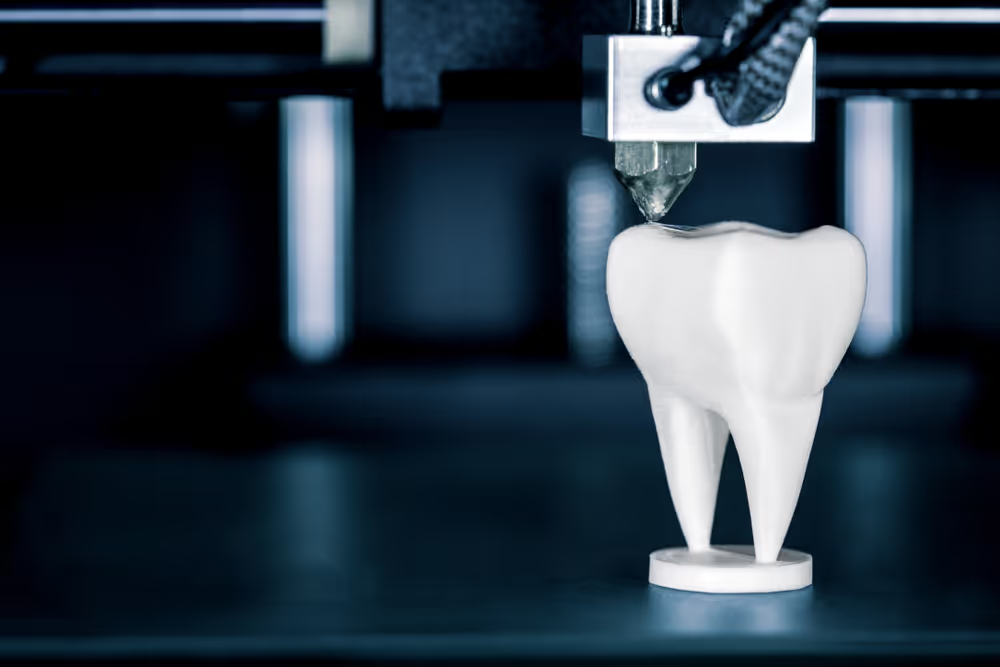


As it stands, patients wait for days, maybe even weeks, for crowns and dentures to get an appointment, have the impressions taken, have those impressions sent to an external lab, manufactured, and returned. In some cases, improper fitting can delay this process even further.
But our smile is important, and eating is pretty crucial, too. 3D printing provides the capacity to fix dental issues and walk out the dentist’s office with a permanent solution within the day.
The dental industry has witnessed a technological revolution in recent years, with additive manufacturing playing a pivotal role. Among the most significant advancements is the emergence of same-day dentistry, where 3D printing technology enables dental professionals to design, fabricate, and deliver customised dental restorations within a single appointment.
AM is reshaping the traditional dental care model by improving efficiency, reducing costs, and enhancing patient experience– it is no longer a technological trend, rather a cornerstone of modern dental care.
In this article, AMFG explores how additive manufacturing is developing same-day dentistry. We look at how the process functions and the benefits that AM brings to the industry, and we cast a spotlight on the companies championing the tech.
How does it work?
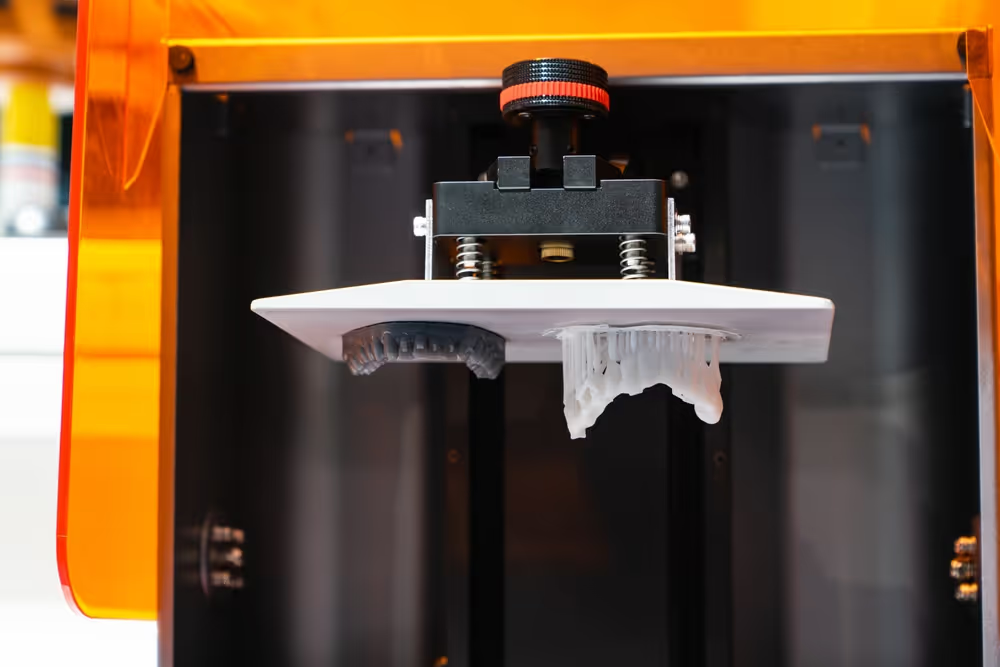
AM in dentistry has a broad range of applications. Devices including customised crowns, bridges, surgical guides, and dental implants can be achieved with 3D printing at a fraction of the normal time, and this is bringing a boom to the industry– the dental 3D printing devices market is predicted to hit $50.1 billion by 2033, growing at a CAGR of 18.96% in 2025.
Same-day dentistry relies on digital dentistry tools such as intraoral scanners, computer-aided design (CAD) software, and various 3D printing technologies. The typical workflow includes the following steps:
1- Digital impressions
The process begins with an intraoral scanner capturing a digital impression of the patient’s teeth and gums. This eliminates the need for traditional molds, which can be uncomfortable and time-consuming.
2- Computer-aided design (CAD)
The digital impression is uploaded into CAD software, where the dentist or dental technician designs the restoration– be it a crown, veneer, bridge, or denture.
3- 3D printing and material selection
Once the design is finalised, it is sent to a 3D printer, which fabricates the restoration using biocompatible resins, ceramics, or composite materials. Advanced AM technologies, such as digital light processing (DLP) and stereolithography (SLA), ensure high accuracy and detail.
4- Post-processing and customisation
The printed restoration undergoes post-processing, such as curing, polishing, and staining, to match the natural appearance of the patient’s teeth.
5- Same-day placement
The final restoration is fitted and bonded to the patient’s tooth, providing immediate results with minimal discomfort.
Some dental 3D printing companies offer a comprehensive workflow for all steps in the process. Zylo3D provide an all-in-one system that includes a dental 3D printer, a washer, and a UV post curing unit, granting dentists the ability to produce a complete dental device almost immediately.
Key benefits of AM same-day dentistry
1- Faster turnaround and improved efficiency
Traditional dental restorations often require multiple visits, as impressions are sent to external dental labs for fabrication. AM eliminates this delay by enabling in-office production, allowing patients to receive their restorations in a single appointment. This not only enhances convenience but also increases practice efficiency.
For example, in late March 2025, Solventum partnered with SprintRay, a leading provider of chairside 3D dental printing, to address the needs of dentists with in-office chairside 3D printed crowns, inlays, onlays, and more.
2. Enhanced precision and customisation
Digital workflows combined with AM ensure superior accuracy compared to traditional manual methods. The ability to customise dental restorations with precise anatomical details leads to better fitting and longer-lasting restorations, improving patient satisfaction and oral health outcomes.
3. Cost savings for patients and dentists
By eliminating third-party labs, dentists can significantly reduce costs associated with outsourcing restorations. Additionally, AM minimises material waste, making it a more cost-effective solution for both dental professionals and patients.
AM applications in same-day dentistry
1- Crowns and bridges
One of the most common applications of AM in same-day dentistry is the production of crowns and bridges. Digital design and 3D printing enable dentists to fabricate durable, aesthetically pleasing restorations with precise fit and function.
2- Veneers, inlays, and onlays
Patients seeking cosmetic enhancements can benefit from same-day veneers, inlays, and onlays. AM allows for rapid production of these restorations, providing immediate smile makeovers.
3- Dentures and partial dentures
AM enables the quick fabrication of full and partial dentures, eliminating the long wait times associated with traditional denture production. Digital workflows also allow for easy replication and modification of dentures as needed.
4- Orthodontic appliances and aligners
Custom clear aligners, retainers, and other orthodontic appliances can be 3D printed in-house, reducing the reliance on third-party manufacturers and speeding up treatment timelines.
Recent developments in AM same-day dentistry

The Form4B Dental printer. Image courtesy of Formlabs
High-volume production with Formlabs and Henry Schein
In February 2025, Formlabs and healthcare giant Henry Schein announced their collaboration on same-day dental solutions to accelerate the adoption of digital dentistry and democratise 3D printing high in speed and precision.
Leveraging Formlabs’ latest range of dental 3D printers, dental professionals can create crowns, dentures, bridges, surgical guides, and aligner models in a matter of hours, not days.
Henry Schein’s reach extends across over a million customers worldwide, and this collaboration will further the adoption of high-volume production of dental devices worldwide.
VOXELTEK improve on current AM production methods for aligners
VOXELTEK, the Hungarian dental 3D printing firm, recently launched Smilemaker, the world’s first desktop system for fully automated clear aligner production. This innovation promises to improve even on current dental 3D printing practices.
With current AM methods, the production of clear aligners involves multiple steps and necessitates high amounts of labour, requiring the conversion of dental scans into 3D models, which are printed as molds, then undergo thermoforming, trimming, and post-processing by various labs.
VOXELTEK’s Smilemaker integrates 3D model printing, thermoforming, and laser trimming into a single device, eliminating the need for attended, manual post-processing. Should this technology be adopted further, AM could become an even more efficient way of apportioning dental care with miniscule lead times.
3D Systems champion jetting technology for dentures
Currently, SLA and DLP dominate the dental market. However, 3D Systems, with its new NextDent 300 MultiJet 3D printer uses jetting technology to produce monolithic dentures in a single process using one machine.
This solution strives to deliver more colourful, cost-efficient, and durable dentures. Although current 3D printing methods for dentures are successful, jetting technology has the potential to enable multi-colour printing in a wide range of tooth shades, all in a single print.
Moving forward, this method could reduce manual labour and cut costs at the same time, particularly if 3D printing continues to establish itself as a key player in the dental industry.
Final thoughts
Same-day dentistry powered by additive manufacturing is radically transforming the dental industry by improving efficiency, precision, and patient experience. The technology is continually evolving and improving on itself, a trend conducive to wider uptake in the coming years.
There is constant research into new materials, and AM is being used more and to a greater extent in printing bone grafts and other surgical materials for complex dental procedures, not just prosthetic devices.
However, there are some challenges. Regulatory worries persist and implementation of AM methods after employing traditional techniques could be costly. However, these qualms over cost could be assuaged if the entire money-saving process once implemented is taken fully into account.
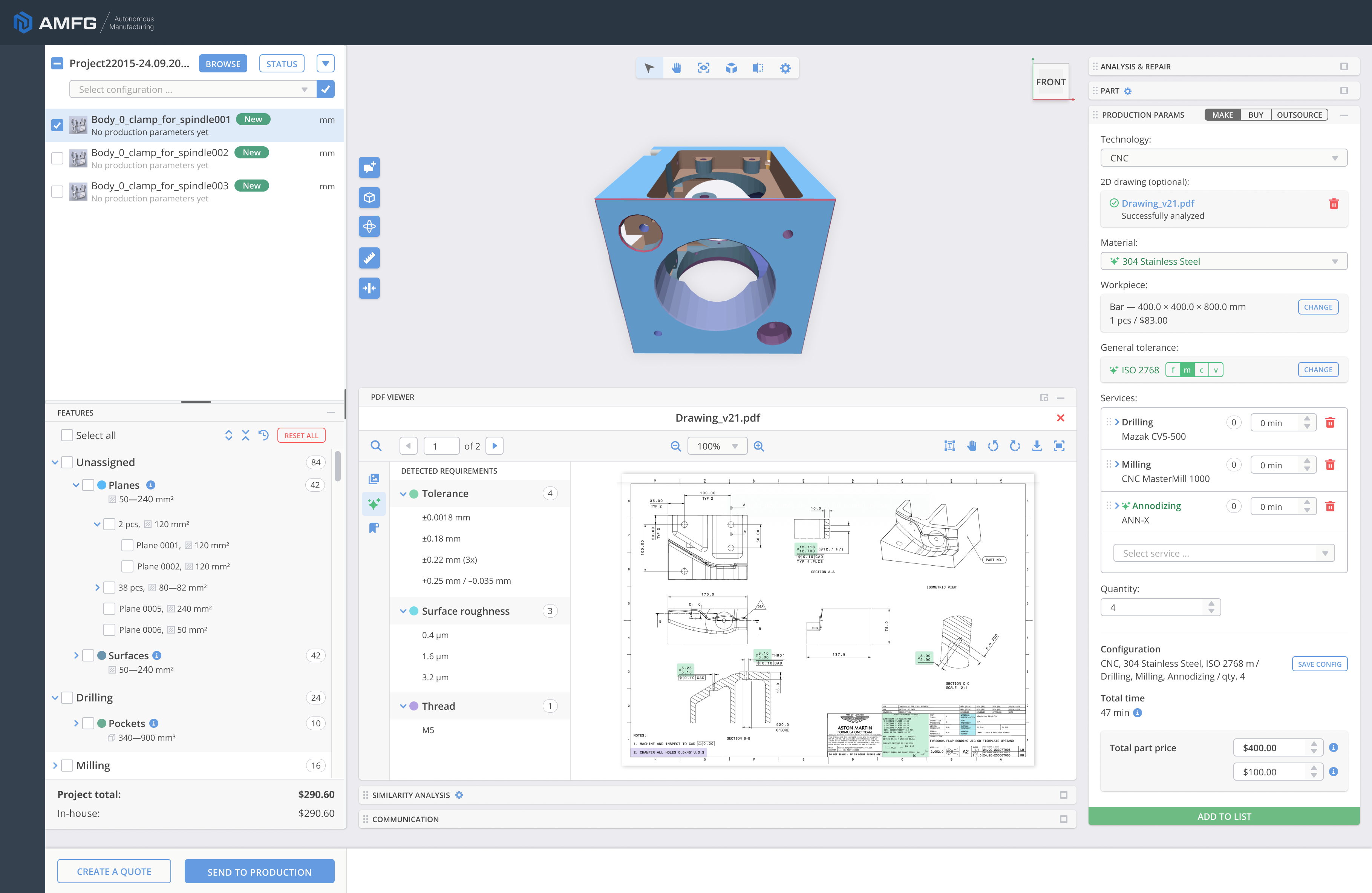
Ensuring regulatory compliance can be achieved by ensuring a visible and organised workflow, and companies like AMFG provide solid solutions that streamline manufacturing operations.
Likewise, with the continued integration of AI and the advent of Industry 5.0, AM dental practices will only get more efficient. Digital workflows are becoming standard practice for dental professionals around the world; over 90% of US dental laboratories and nearly 50% of dental practices have already adopted digital technologies.
Make sure your manufacturing business is prepared by speaking to one of our experts about workflow management:

.avif)
.svg)