How Additive Manufacturing is Improving Semiconductor Production
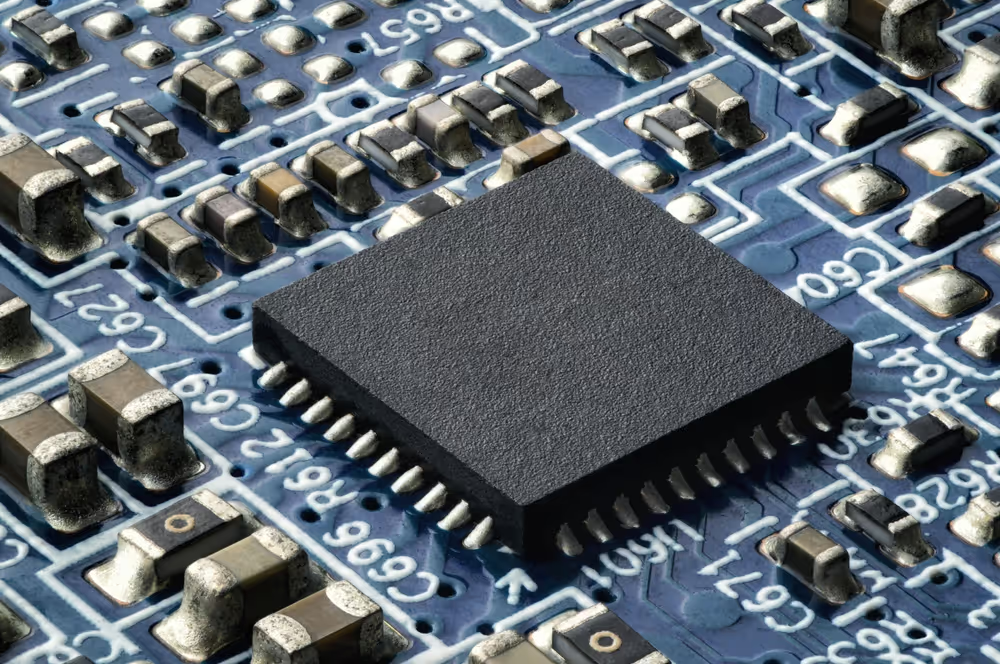


Semiconductors are really, really important.
These devices, which include microchips and integrated circuits, are the foundation of modern life. We use them every minute, in phones, computers, appliances, gaming hardware, and medical equipment. Moving forward, we’ll be employing them in autonomous vehicles, AI, quantum computing, advanced robotics, and biotechnology. In 2021 alone, semiconductor unit sales reached a record 1.15 trillion shipments.
However, the fallout from the pandemic and phenomena like the Suez Canal obstruction tested the supply chain resilience of the crucial Semiconductor Capital Equipment (SCE) used to fabricate chips.
President Biden attempted to recall semiconductor manufacturing back to the US with 2022’s Chips and Science Act, but President Trump’s explosive, tariff-heavy return to office has complicated the picture further.
In this article, AMFG examines the threats to SCE fabrication, the underlying reasons behind them, and how additive manufacturing can address these sticking points for an industry burgeoning with potential.
We will examine the applications for 3D printing technology for specific parts involved in SCE production, and suggest ways in which companies can streamline their operations and make the most of AM’s adoption in the semiconductor industry.
Why are semiconductors important right now?

Trump speaks about the US Accelerator Investment in the Oval Office on 31 March 2025. Image courtesy of Saul Loeb/AFP/Getty Images
Semiconductors are a hot commodity and are greatly desired by the US, but production has historically been ‘conducted’ further afield, specifically in Taiwan by the TSMC, who produces more than 90% of the world’s advanced microchips.
This has led to attempts to reshore production to the US, in an effort to decrease reliance on foreign suppliers, boost American manufacturing, and improve supply chain resilience.
President Biden introduced the CHIPS and Science Act in August 2022, a law which appropriated $52.7 billion, made up of $39 billion in subsidiaries and $13 billion for semiconductor research and workforce training.
However, President Trump has shown contempt for the law, calling it “a horrible, horrible thing”, and in late March passed an Executive Order to set up a new entity to speed up corporate semiconductor investments in the US.
The US Investment Accelerator aims to negotiate better Chips Act deals by reducing regulatory burdens and improving connections, and after the threat of tariffs, the TSMC invested $100 billion in expanding their US presence.
Although the US has changed from an approach that offers subsidies to attract investors, to aggressive, tariff-based tactics that require companies to bring production to the US, one thing is clear: onshoring semiconductor production is a high priority.
The benefits of AM for SCE production
Additive manufacturing is poised to support the onshoring of SCE production. With current methods, fabrication of SCE is expensive and complex, and suffers from long lead times and increased waste.
3D printing technology supplements current processes, with capital equipment manufacturers seeing significant advantages:
Customisation
The principal benefit for AM in any application is the customisability that the technology permits. SCE manufacturers can quickly produce custom parts and address production bottlenecks than would otherwise hinder wider adoption.
AM allows design flexibility and a seamless transition from prototyping to customised part production. Manufacturers are no longer inhibited by design capabilities, and can design parts with more complex geometries, such as manifolds with internal cooling channels.
Lower costs
Both chip and SCE fabrication is highly specialised, requiring intricate components and precision tooling. This means that production is costly and complex throughout the entire manufacturing process, so any way of reducing cost is welcome.
AM eliminates the need for brazing and multipart assemblies, reducing part count and labour costs. Instead of wasting expensive materials in the same way that subtractive methods do, AM uses only what’s needed.
Waste reduction
SCE is an energy-intensive production process. In order to mitigate lost money from waste material and the subsequent negative impact on the environment, manufacturers are considering 3D printing to create components directly from digital designs.
High-precision semiconductor parts are often made from expensive materials like aluminium, titanium, or specialty alloys, whereas AM is near-net shape, and only uses what is needed.
Additional technologies, which are easily digitally integrated with AM, can also aid in this goal. Machine learning and AI are optimising production processes, enhancing energy efficiency, and reducing waste.
Shorter lead times
SCE industries must equip themselves with high-performance equipment that is constantly functioning; producing a rapid supply of spare parts is a must in such a critical area.
Yet existing companies are saturated, meaning meeting customer need is a challenge, and manufacturers have to wait extended periods of time for equipment.
With additive technology, companies can print capital equipment to repair existing machines and manufacture highly sophisticated objects. AM also leverages part consolidation, which streamlines the production process and simplifies supply chains.
Structural optimisation
SCE produced with 3D printing technologies benefits from structural optimisation with lightweight, high-strength components, improving strength-to-weight ratio and corrosion resistance.
AM is able to fabricate complex fluid manifolds, with decreased disturbances, reduced pressure drops, and improved accuracy by 1-2nm, optimising fluid flow. Additionally, the technology facilitates the production of lightweight, high-strength parts, improving performance and reducing system vibration.
Applications
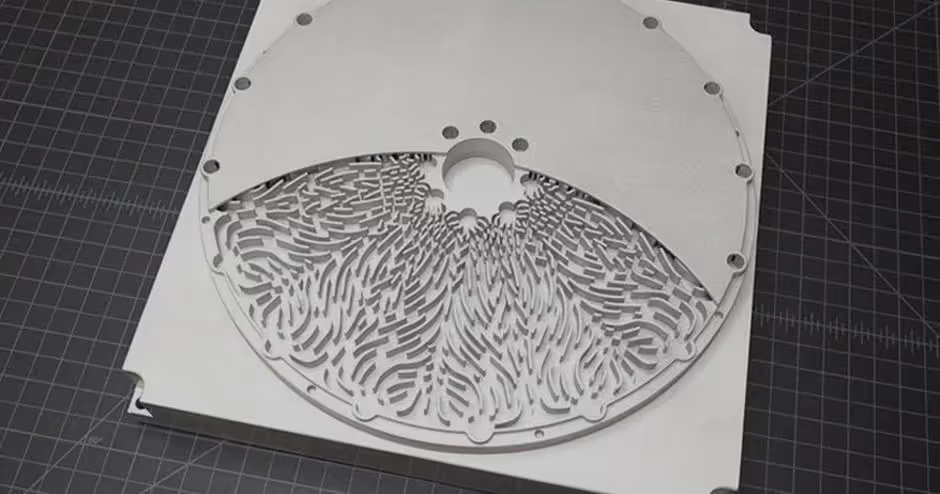
Wafer table with thermal management features. Image courtesy of 3D Systems
Both semiconductors and additive manufacturing are critical emerging technologies, and marrying them together could be a match made in heaven.
Metal AM technologies, including laser powder bed fusion and near-net-shaped tech like Norsk Titanium’s Rapid Plasma Deposition, have found some success in recent years within SCE manufacturing. 3D Systems have collaborated with SCE manufacturers for over ten years, and companies like Norsk Titanium, Oerlikon, EOS, Additive Industries, and VELO3D currently market solutions for the industry.
Metal AM applications include:
Manifolds that are optimised for fluid flow, with a 90% reduction in liquid-induced disturbance and 50% more lightweight, minimising inertia and system vibration.
Wafer tables with optimised thermal management properties. These developments are particularly important as maintaining a specific temperature range is essential when fabricating semiconductors. AM is able to produce components with built-in cooling channels and other thermal management features, such as surface patterns.
Wafer stages, but developments are in early stages. This component is a crucial part of semiconductor manufacturing, and is used in the positioning of the wafers in the lithography process equipment. For example, a recent collaboration involving key players produced a 3D printed wafer stage that showed improvements of 15%.
Technical ceramics have also shown promise due to their high thermal stability, electrical insulation, chemical resistance and exceptional strength. In particular, 3D printed ceramic gas distribution rings and vacuum chucks have been utilised by virtue of AM’s ability to optimise geometries.
How AMFG can help
The market for SCE manufacturers is clamouring for 3D printing technology. Demand for semiconductors will only continue to rise, and the US’ tariff-based approach may reshore fabrication.
Innovation is keeping pace with customer demand; the need for efficient, sustainable production processes has never been clearer. Additive manufacturing technology is perfectly suited to bolster SCE supply chains, and there is a real opportunity for AM service bureaus to capitalise on this.
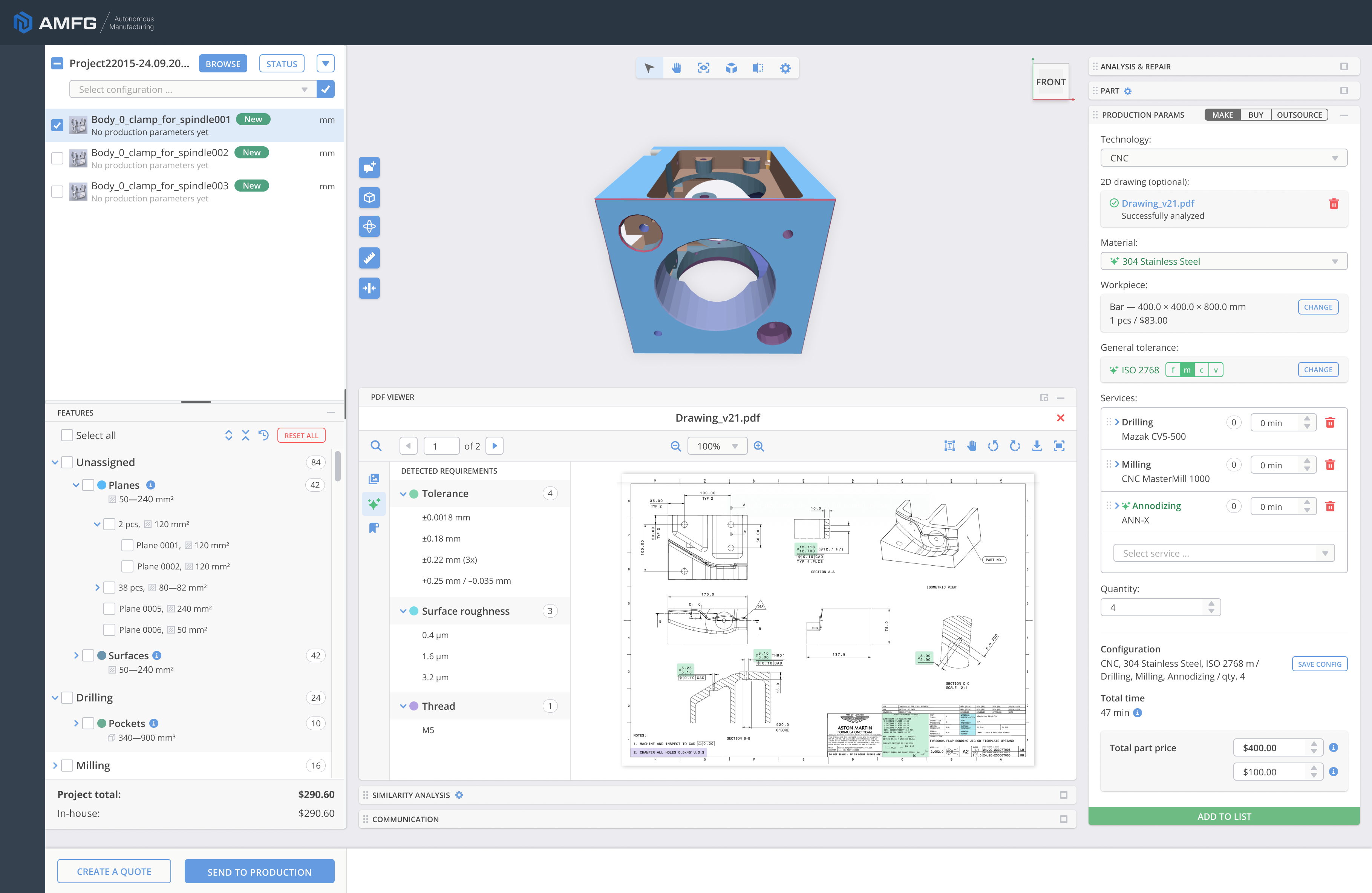
At AMFG, we empower organisations to orchestrate sophisticated manufacturing processes with flexibility and precision. Customers looking to scale AM operations in key industries can benefit from improved production workflows, from order placement to shipment, with seamless integration and precision automation.
Speak to one of our experts in scaling AM here: Book a demo


.avif)
.svg)