Inside the Small Job Shop


Image courtesy of Quantum Machinery GroupAs machining technology continues to evolve, AMFG has explored the implications for the future job shop, from AI to the latest advances in 5-axis machining. However, despite our excitement for the future of this technology, the question remains: what does the present-day job shop look like?Jesse Casto’s Small Machine Shop Survey might just have the answers.Last month, we had the pleasure of sitting down with Jesse Casto, Founder and CEO of BetterCNC, a Texas-based job shop with the mission of machining “better”. During our interview, Jesse provided his insights into his background in machining and major topics affecting the industry such as the skills shortage.Earlier this week, Jesse released a survey that offered a look into the small machine shop. Jesse surveyed 50 job shops, offering insights into their manufacturing processes, machine centres and media. Here we take a look at what the survey can tell us about the Small Machine Shop.
The Job Shop Owner
[spacer height="50px"][caption id="attachment_41823" align="alignnone" width="1000"]
Image courtesy of Quantum Machinery Group[/caption]So who are the people behind the the job shops? Unsurprisingly, the data shows us the job shop owner is likely to know machining inside and out. Over half of the respondents have worked in the industry for over a decade and 60% had formally worked in the administrative side of a machine shop. On the other hand, there were also owners with less experience in the industry with around a third of respondents only having worked in the industry for 1-6 years (34%) and 40% having never formally worked in the administrative side of the shop.In terms of education, 42% of the respondents reported having college degrees with the next highest response being a yes to a high school diploma or GED. Most of the respondents, started their machine shops alone (74%) with only 24% reporting starting their shop with a partner and 90% started the shop from scratch as opposed to those who took over existing businesses.
The Job Shops
[spacer height="50px"][caption id="attachment_41829" align="alignnone" width="1000"]
Image courtesy of AMD Machines[/caption][spacer height="50px"]Despite the long careers of the job shop owners in manufacturing, the majority of respondents report that their shops have been in operation for under 10 years with 36% reportedly being in operation for 1-3 years and 3-6 years being the second most common response at 28%.The overwhelming majority of the machine shops surveyed reported offering job shop work as a service at 96%. Other popular responses included reverse engineering work at 40% and design services at 38%. The survey paints a varied picture of the industries served by the shops with automotive and consumer goods being the most popular responses at 44% and 40% respectively. However, other popular industries include aerospace at 36% and electronics manufacturing at 36%.When it came to manufacturing equipment, 3-axis mills were the clear favourite with 92% of respondents claiming to own them. However, there were also some more surprising finds with 34% of shops reporting owning 3D printers and manual mills and lathes featuring as popular choices at 36% and 38% respectively.When it comes to marketing the job shop, the Small Machine Shop survey turned up some unexpected results. 22% of the respondents reported that they didn’t have a website. Moreover, the two most popular social media platforms among respondents were Facebook (54) and Instagram (28%).
What can we learn from this?
[spacer height="50px"][caption id="attachment_41827" align="alignnone" width="1000"]

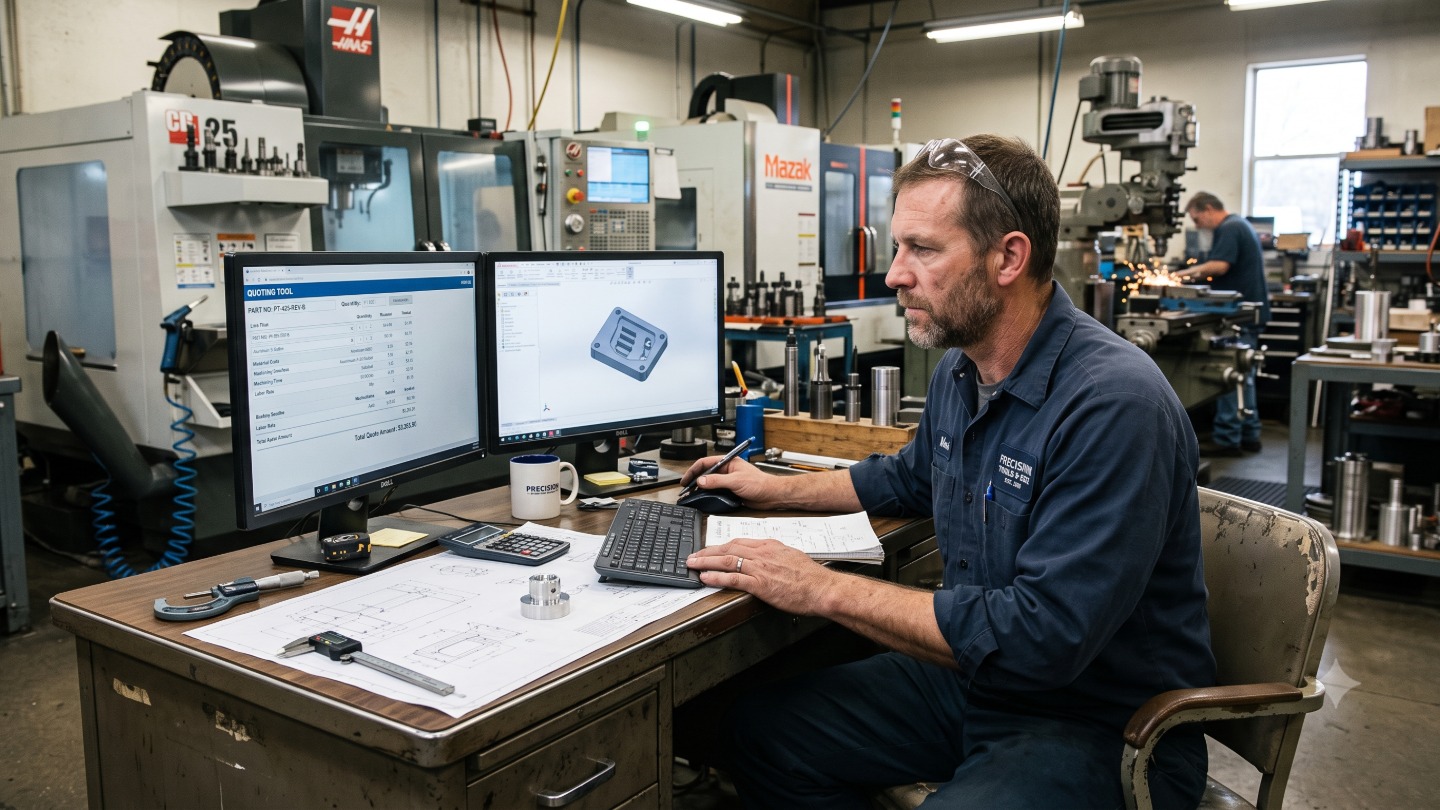
image courtesy of Quantum Machinery Group[/caption][spacer height="50px"]Despite the small sample size, the survey turns up some fascinating insights into small job shops. According to the results, the average job shop owner already has had a long career in machining before taking the leap and starting their own shops. Many of the job shop owners surveyed had previous formal administrative roles in job shops but a significant percentage did not. This entrepreneurial spirit is reflected in the respondents’ reported motivations for starting their jobs. “I’ve wanted to own my own business and make something of myself”, one owner comments, “I love machining and got tired for working for someone else”, echoes another. In a nutshell, the average job shop owner has a long history in machining and frustrated by the practices of their boss, decided to start their own business, typically within the last 7 years.AMFG has written at length about how machine shops will have to constantly adapt their processes to stay competitive in a changing manufacturing landscape. The Small Machine Shop Survey paints a picture not of lack of trying but of stifled ambition. “Every shop I worked at - none of them ever let me work to make improvements in the shop and its profitability,” comments one respondent. Another adds, “I’ve never worked in a machine shop where the person calling the shots had a clue what was going on.” If the results of this survey can be extrapolated to a wider scale, we could say that these new shops are pushing against the outdated or limited practices of traditional shops. Jesse’s “BetterCNC” was one example of this but we may see this trend repeated across the industry.The most surprising find was the revelation that 22% of respondents didn’t have a website. Rather than a reluctance to embrace new technologies, it may be a sign that company websites are becoming obsolete or at the very least not as necessary as in previous years. With over half of respondents reporting having Facebook, Instagram and LinkedIn pages for their businesses, we could extrapolate that job shop owners see platforms as more essential than websites.Finally, as the Top Job Shop Quoting Tool, AMFG understands the importance of having a streamlined quoting and estimating process. However, looking at the data these processes are either nonexistent or still using cumbersome software such as Excel with around 18% of job shops reporting using specific programmes for quoting and estimating. Compared to 73% of respondents who use a programme for accounting, it’s further proof that there’s a long way to go when it comes to job shop adoption of automation software.
Final thoughts
[spacer height="50px"][caption id="attachment_41831" align="alignnone" width="1000"]
Image courtesy of Rapid Direct[/caption][spacer height="50px"]Jesse has commented that he’s looking to expand the scope of the survey and continue “building it out more, launch its own site by the time we run it next year to help its reach and usefulness!”We’ll certainly be keeping an eye out for 2025’s responses and seeing how the small machine shop continues to evolve.
.avif)



.svg)

Subscribe to our
newsletter