Long Read: Has Hybrid Manufacturing Lived Up To Its Promise?
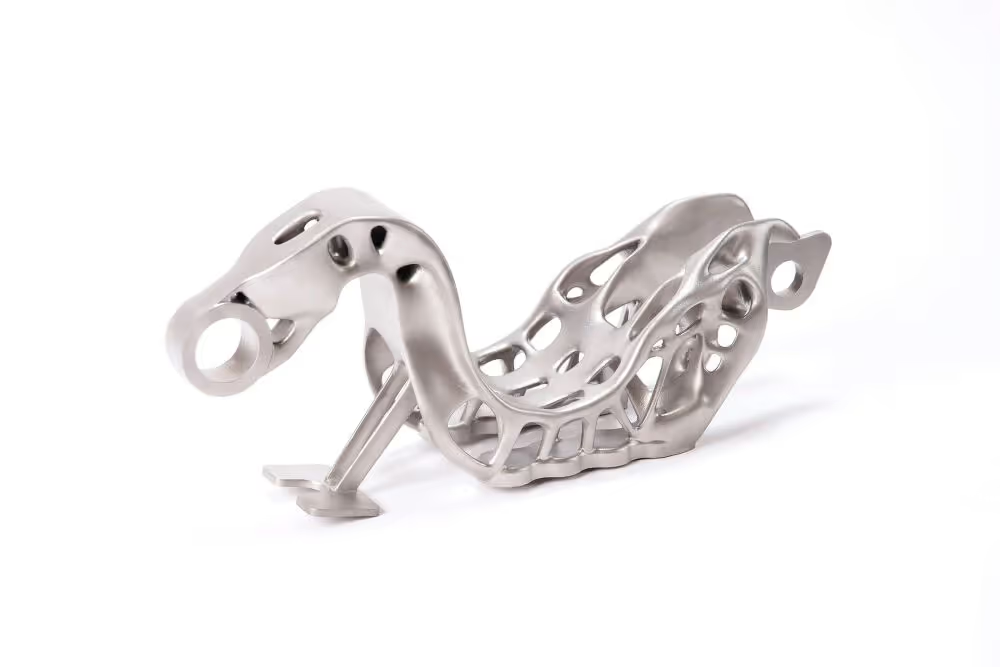


Image courtesy of Nikon SLM SolutionsWhat do you get if you cross additive manufacturing and subtractive manufacturing? While this may sound like a joke, with the industry set to be worth $948.6 million by 2030, hybrid manufacturing is serious business. You can’t get far into an article about hybrid manufacturing without reading the phrase “the best of both worlds”. However, by combining subtractive and additive processes to produce parts, that’s exactly what hybrid manufacturing offers.In 2018, AMFG asked whether hybrid manufacturing was the future of Additive Manufacturing (AM). In the six years since then, the capabilities of hybrid manufacturing and its use cases have evolved significantly. However, questions remain as to whether hybrid manufacturing offers scope for widespread implementation.Here we look at how hybrid manufacturing has developed since 2018 and explore what the evolution of hybrid manufacturing means for machining. How is machining embracing AM technology? And how can job shop owners capitalize on the market?
The best of both worlds
[caption id="attachment_40470" align="alignnone" width="1000"]
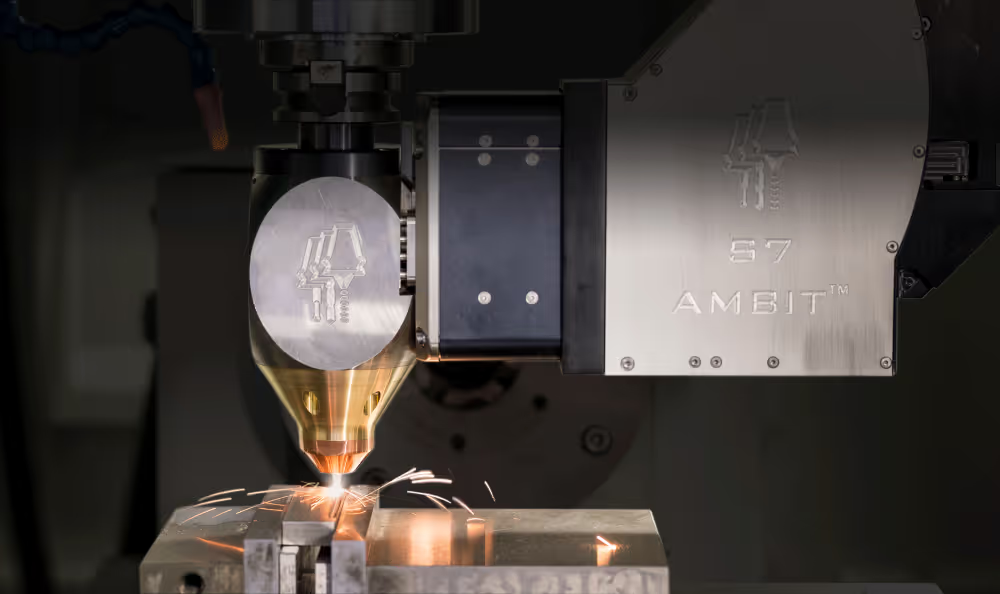
Image courtesy of Hybrid Manufacturing Technologies[/caption][spacer height="50px"]AMFG has long outlined the lengths of both CNC machining and additive manufacturing processes. Machining is an ideal process for precisely making complex parts with high repeatability and volumes. The development and adoption of 5-axis machining, has only provided new possibilities for precision machining. As far as AM is concerned, it’s no understatement to claim that the technology has caused a tectonic shift in manufacturing innovation. Additive manufacturing has made great strides in sectors such as aerospace, automotive and medical - particularly concerning orthotics and prosthetics.Combining these processes allows manufacturers to take advantage of these technologies and fill in the gaps of their limitations. As 3D modelling company Spatial points out hybrid manufacturing marries the speed of 3D printing with the flexibility of subtractive detail work. Hybrid processes may be used to print parts using metal deposition with a metal power with subtractive machining used in post-processing to smooth out the rough edges. Alternatively, a part may be machined using milling or cutting techniques with additive manufacturing used as a coat to finalise the part. As a result, parts can be made more quickly and efficiently. By reducing the amount of waste expended in the process, hybrid manufacturing companies can save money too.
The companies going hybrid
[caption id="attachment_40476" align="alignnone" width="1000"]
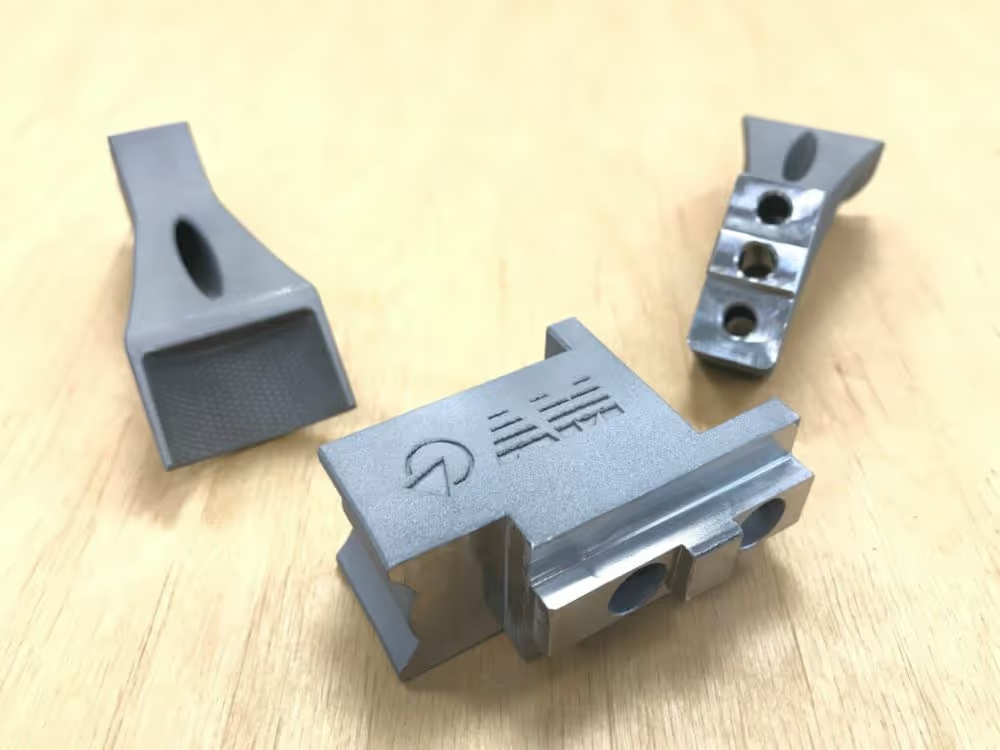
Image courtesy of Burgmaier[/caption][spacer height="50px"]It’s no surprise then that machining companies are incorporating hybrid processes into their businesses.Take German precision engineering company, Burgmaier. Established in 1931, the company has been manufacturing parts for over 90 years and claims that there are five Burgmaier parts in every car made in Europe.In 2018, Burgmaier announced a partnership with Nikon SLM Solutions to further evolve their hybrid processes. Burgmaier now uses hybrid manufacturing to build additively on conventionally manufactured parts. Sales Manager Johannes Mayer and Application Engineer Philip Albrecht described how they decided to incorporate AM to complement their “previous business model and [...] expand their service portfolio for other sectors.” Moreover, Mayer and Albrecht describe how their toolmakers were looking for a solution to address the limitations of milling and drilling. As a result, Burgmaier has found great success with this hybrid approach and reports that “problems such as lightweight design, special tools and long delivery times are no longer existing.”Nikon SLM Solutions has invested heavily in hybrid manufacturing technologies in recent years. In 2022 they announced their investment in Hybrid Manufacturing Technologies, a US-based company specializing in combining additive and CNC solutions. These two cases are an indication hybrid manufacturing capabilities are more than just a good idea but that they’re being put into practice. As a result, companies are saving time and materials while delivering high-quality parts.
Hybrid manufacturing at sea
[caption id="attachment_40474" align="alignnone" width="1000"]

Image courtesy of US Navy[/caption][spacer height="50px"]Aboard the world’s largest aircraft carrier, you would expect to find fighter jets, pilots and sailors. But what about a machine shop? The USS Gerald R. Ford (CVN 78) features just that. In fact, the machine shop is crucial to the running of the ship. Its responsibilities include, “fabricating and repairing vital parts for the ship as well as the entire strike group, upkeep of the vacuum collection holding and transfer system (VCHT), and overseeing all piping systems across the ship.”The Ford is not a unique case. As you might expect, self-sufficiency is key in the Navy and machining plays a vital role. To keep operations sailing smoothly during long periods at sea, ships need to be able to carry out equipment maintenance and manufacture parts independently.According to Mass Communication Specialist 2nd Class Jackson Adkins, “Ford’s machine shop can take a piece of stock or scrap metal and turn it into nearly anything. Their potential is unlimited when it comes to fabricating tools needed for specific jobs or creating parts for ship systems aboard Ford or other ships attached to the Gerald R. Ford Carrier Strike Group (GRFCSG).”Hybrid manufacturing solutions may be changing machine shops like the Ford’s. Additive manufacturing capabilities have seen increasing demand in recent years in the defence space. To take one example, drone manufacturers are taking advantage of AM’s distributed manufacturing capabilities to produce the vehicles where they’re needed. However, the past six years have also seen the defence sector embracing hybrid additive and subtractive manufacturing processes.[spacer height="50px"][caption id="attachment_40466" align="alignnone" width="1000"]
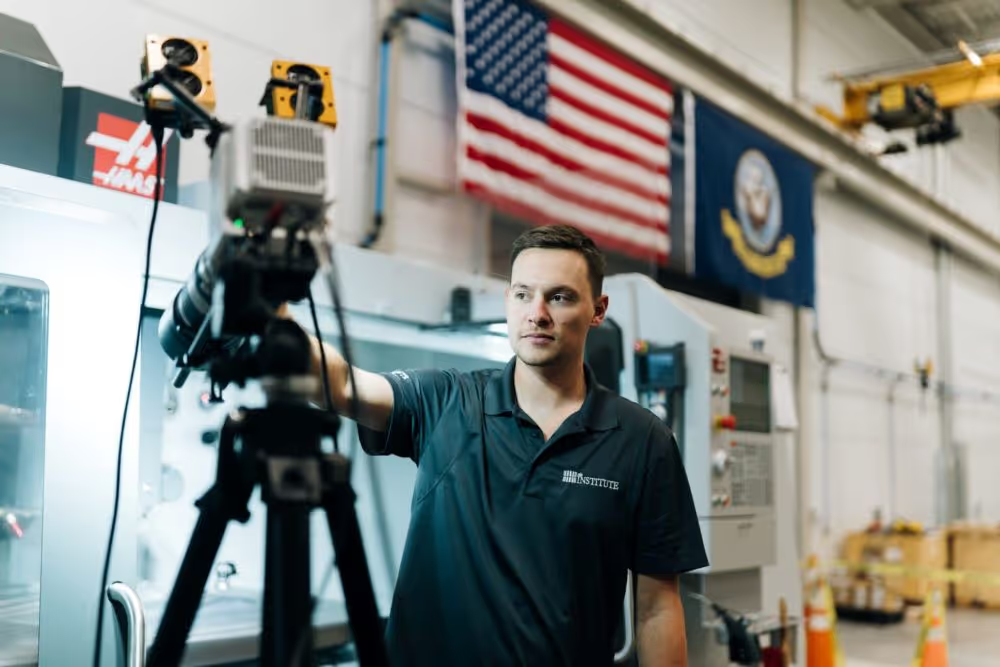
Image courtesy of IALR[/caption][spacer height="50px"]New hybrid manufacturing capabilities have emerged in the Navy following the announcement of The Accelerated Training in Defense Manufacturing program (ATDM) in 2021. The program, which aims to address the ongoing skills gap in manufacturing from a defence perspective, spurred the US Navy to open its own Additive Manufacturing Centre of Excellence. According to the US Navy, the centre will enable innovative production of submarine components to bolster naval shipbuilding and repair supply chains.While this announcement may seem like a win for additive manufacturing alone, the centre will collaborate with partner labs focussing on metrology, Industry 4.0 and of course, CNC machining. In fact, the AM CoE works hand in hand with the CNC Machining Innovation Lab at the Insitute for Advanced Learning and Research (IALR). According to the IALR, “machining will be crucial for part post-processing and verifying that the design used for additive manufacturing can successfully be machined.”As the IALR points out, “it may seem odd that a subtractive manufacturing method would play such an integral role in the Navy’s additive manufacturing operations. While 3D printing and additive manufacturing are the primary focus of the AM CoE, subtractive methods are still essential in creating and verifying any part.”In 2023, we hybrid manufacturing technology take to the high seas with the news that the US Navy ship Bataan has implemented the Phillips Additive Hybrid system to manufacture and repair parts. This development marked the first time a metal 3D printing solution had been installed on a US Navy ship. The Phillips Additive Hybrid system combines the laser metal deposition technology of Spanish AM company Meltio with Haas’s CNC vertical machining centres control mill. Rear Adm. Brendan McLane, commander of Naval Surface Force Atlantic commented, “The introduction of additive manufacturing (AM) into naval operations supports readiness and self-sufficiency.” NAVSEA Chief Engineer Rear Adm. Jason Lloyd added, “These printers have the ability to help the Navy overcome both obsolescence issues for ships and systems that have service lives measured in decades and directly contribute to enhanced operational availability of our systems and ships.”According to Beth Stackpole, “The system was used to 3D print and fabricate a replacement sprayer plate for a de-ballast air compressor (DBAC) in only 5 days as opposed to taking weeks, potentially, to source through conventional Navy supply channels.” These cases are evidence that the increased introduction of additive manufacturing processes is not intended to replace machining but work alongside it to offer an optimized production process.
Hybrid systems implementation
[caption id="attachment_40464" align="alignnone" width="1000"]
Image courtesy of Optomec[/caption][spacer height="50px"]With the clear benefits posed by hybrid manufacturing, job shop owners may be wondering how to implement this technology onto their shop floors. If that’s the case, investing in a hybrid manufacturing machine may be the natural next step.In recent years, the hybrid machine market has gone from strength to strength and is predicted to be worth $437.27 billion by 2029. In addition, Lukas Hoppe, director of R&D at Spanish AM company Meltio estimates that 30% of its sales now involve hybrid manufacturing systems. Other major manufacturers of CNC machines such as Matsuura, Mazak and DMG Mori, now also offer hybrid systems.Of course, hybrid manufacturing centres can offer multiple production processes on a part from the same machine, saving manufacturers set-up time and potential errors caused by part handling. Despite these benefits, job shop owners need to think hard about the practicalities of installing these systems.As Peter Zelinski points out, the COVID-19 pandemic has brought supply chain challenges to the forefront of manufacturers’ minds. As a result, processes like casting and assembly may result in a “considerable lead time, complexity or supplier vulnerability to a given product’s process”. Zelinski adds that machines can overcome “casting by making the part from scratch; it can overcome assembly by allowing machining to generate precise internal features of a complex form as the part is being built.”However, Zelinksi also highlights the limitations of hybrid systems machines, namely the fact that only one process, either CNC or AM can be used at a given time. Where one process is only a minor part of the production process, this may be a less efficient way to process the part. Therefore, he concludes that hybrid processes are useful for cladding and repair but that we have a long way to go before it becomes “an option for complete parts as a workaround for steps that might otherwise involve time or complexity.”With some hybrid machining centres setting job shop owners back millions of dollars, the significant financial investment needed to purchase these machines may prevent some manufacturers from getting in on the action.In 2016, America Makes launched two projects in conjunction with Digital Manufacturing systems supplier Optomec aimed at making additive manufacturing more financially accessible. One of these projects resulted in the development of Optomec’s Low-Cost LENS Engine, “an additive module that can be attached to traditional subtractive manufacturing machinery.”Without the need to invest in an entire machine, the modules save space and money and require less intensive training for machinists. As well as lowering the AM barrier for entry, investing in hybrid solutions has seen great success for Optomec. The company now has a total installed base of 600 LENS Engines across more than 250 customers including industry leaders such as BOSCH. As the hybrid landscape develops, there will be more opportunities for job shop owners looking to incorporate hybrid manufacturing solutions onto the shop floor and take advantage of this market.
Final thoughts
[caption id="attachment_40472" align="alignnone" width="1000"]

Image courtesy of IALR 2[/caption][spacer height="50px"]In its follow-up article about the Modular Hybrid Manufacturing project, America Makes states that, “Throughout its existence, the story of AM has been all about potential.”Combining AM technology with machining is one way to harness that potential. Additive manufacturing and machining are two highly important processes for producing parts, however, no production process is perfect. The ability to combine these processes has the potential to change the landscape of manufacturing.As we mentioned in our article on the future of job shops, owners are facing a dual pressure to keep up with customer demand while navigating their own financial pressures. Hybrid manufacturing represents another opportunity for job shops to expand their operations and stay competitive. However, in order to drive true innovation, this potential and opportunity offered by hybrid manufacturing needs to translate into feasibility and manufacturing. Since we last wrote about hybrid manufacturing in 2018, we’ve seen this potential materialise into practical manufacturing solutions. From the wealth of hybrid manufacturing machines, to research and development and industry adoption. Despite the gains that hybrid manufacturing has made, as Stackpole points out, it’s still “nowhere near mainstream”. Perhaps over the next decade, the use cases of hybrid manufacturing will have broadened and the technology will have evolved. For some job shop owners, this emerging technology may prove to be conceptually intriguing while practically unfeasible. Nevertheless, there will be those who can take of advantage of additive manufacturing in their operations and experience the best of both worlds.


.avif)
.svg)