Loss, Opportunity, and AI: an interview with The WorldWide Machinist, Tony Gunn


"I was headed down the wrong path and manufacturing, looking back on it, probably saved me."
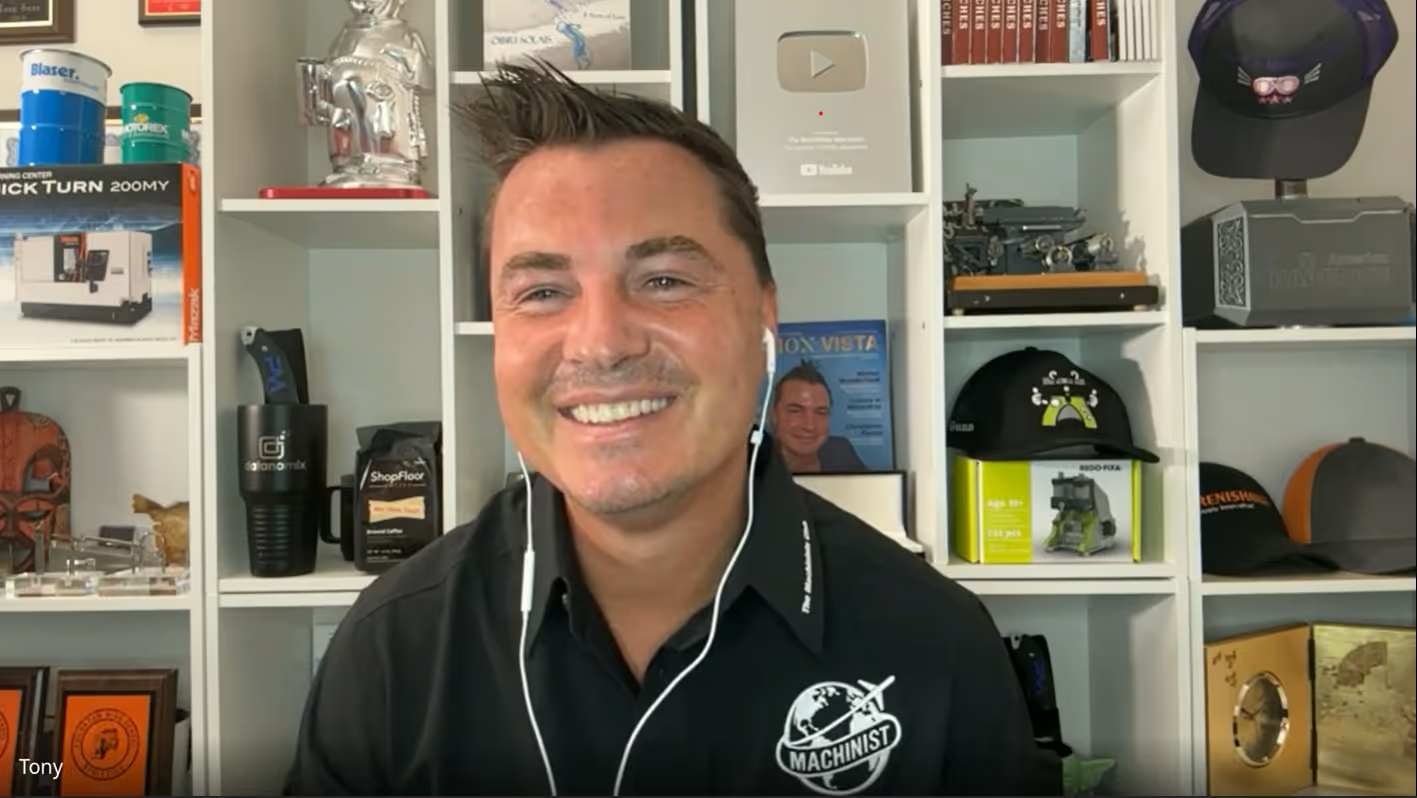
Buzzing with energy, and seated in front of a shelf filled with gifts, Tony talked me through some of the challenges he faced as a young man, from dying of pneumonia to working in interior design, his love for manufacturing, and his thoughts on the challenges currently facing the industry.
Last week I sat down with Tony Gunn, Director of Global Operations at MTDCNC, also known as The WorldWide Machinist. With over 250,000 subscribers on YouTube, and the face of MTDCNC in the U.S., Tony is a well known, and loved, figure in the manufacturing industry.
August 4th, 16:00pm BST
Rosie Manford: Is that a YouTube trophy I see behind you?
Tony: It is! That's for 100,000 subscribers, although we're about to cross a quarter of a million in the next day or so.
Wow!
Yeah it’s exciting, but you don't get another one of those trophies until you hit a million. So a long way to go to get the gold one.
Oh I’m sure you'll get there.
I hope so!
(I’m pleased to say that as of writing this, Tony’s subscriber count is now well over a quarter of a million.)
This is my swag wall. People send me gifts from all over the world and I keep them here. I have a few favorites and then a couple of bragging pieces as well. Laughs I've written a couple of books, you can see the YouTube thing, a couple of magazine covers, things like that. So, I try to sneak in some shameless bragging, but it's mostly about other people.
Well I think that sums you up in one go, “It's mostly about other people.” I have noticed that about you, from your LinkedIn posts to episodes of the Gunn Show, you always focus on others instead of yourself.
Well, flattery will get you everywhere, Rosie. I mean that is the goal, my heart's happiest when I'm of service to others.
For those that don’t know you, how did you get into manufacturing?
My journey into manufacturing was a complete accident. I was on track to be a professional soccer player. I was a complete idiot in school. I dropped out my junior year, although I ended up going back, I graduated high school with a 1.26. I got kicked out of three universities, but I didn't care because as a freshman I was sixth in the nation for scoring goals.
Very Cool!
Yeah I thought so, for me that was important but not for those who make the real decisions, and so I was kicked out. I was also a lifeguard as a teenager and into my early twenties. But I was a troublemaker, I would play games in the pool while there was a lightning storm to see who could stay in the longest while holding a metal pole. I would play American football on the roof of the pool house, I was always getting in trouble, but it was a fun gig. Also saved a lot of lives of course!
Of course
But I hit my 20’s and realised I didn't know what I wanted to do with my life. I had no real experience but I needed a job, health insurance, stability of some kind. I was headed down the wrong path and manufacturing, looking back on it, probably saved me. But I started by mopping floors and running one of the most basic, generic, boring press machines on the planet. But I saw hope, I saw opportunity, and I saw the potential for growth.
I worked at a facility that provided the unique opportunity of working with precious metals; gold, platinum, silver, things that most people don't work with day-to-day. I ended up running a department of about 40 machines, I even joined the company improvement committees. I mean I failed out of trigonometry and calculus in high school, but suddenly I was able to actually automate these machines and understand the theories of lean manufacturing, so that was kind of cool. I was considered in the top 5% globally for machining precious metals. And I always make the terrible joke, that I would only rank that high because so few people actually do it. Laughs It wasn't actually a skill, you know what I mean? But I enjoyed doing it. I saved the company over $100,000 a year on understanding how to machine platinum.
From there I bounced into some more of your standard materials, steels, aluminum, brass, inconel, and then I moved into woodworking. So over my 12-year span as a machinist, before diving into other parts of manufacturing, it was quite diverse. But manufacturing, just the idea of taking something that has lesser value and turning it into something valuable that can actually help people, whether it be a wedding ring or a smartphone, I love that. So I think that's answered your question, but way longer than you expected.
No no, it was very interesting, especially the bit about holding a lightning rod in a pool.
Laughs I was quite the troublemaker, Rosie. I mean, anything that was dangerous, I wanted to be a part of. To this day, if there's a hurricane, I'm grabbing my surfboard. If there's a volcano erupting, I'm trying to hike it. I love the thrill, I love being alive. So, we'll see how that plays out.
It seems to be going well so far, you're still here all in one piece.
So far, fingers crossed!
"I laid in the hospital and I spent the entire night beating the crap out of my lungs because that was the only way to get the fluid out. Whenever my right arm got tired, I switched to my left, and I kept doing that throughout the night."
It sounds like quite a journey, from failing in school, to becoming an expert in precious metals. And am I right in thinking you then moved into international consulting before joining the media?
Yeah, that was by accident, too. So, I was living in Washington DC, working in woodworking and I ended up moving into the design department and then accidentally became an interior designer.
As you do
Yeah exactly! But working in interior design with higher end clients took a lot of my time and resources, and while the company was making great money and I was making pretty decent money too, the stress was higher than it's ever been. And I'm not a fan of stress. So I said, you know what? I'm out of here. So, I put all of my stuff into a U-Haul and I drove from Washington, DC to Miami, Florida. So I arrived, and I had driven about 26 hours through the night, I took a 4-hour nap and immediately went and did three job interviews.
Oh my god
I know, and I got an offer from all three!
Oh they must've loved you
(laughs) Yeah I guess so, but I took the one that offered the potential for becoming an international consultant. I started as a machinist there, but I became a consultant over time, and my first territory was the US and Latin America. So I got to explore places I'd never been before. I grew up very poor. I had always dreamed of seeing the world, but I was broke. I didn't even get on a plane until I was 26. And I didn’t become an international consultant until I was about 32, but I still had that dream to fly and see the world. So after the first few years, I moved on to Europe, and then India and Asia, and I did all this during a 10 year span.
Wow that must've been so fun!
Really fun! And moving into that international consulting role has helped me more than I could have ever imagined, and that’s thanks to the owner of the company, Simon Shane. He helped me take what I was as a machinist, apply it to real life, and then broaden it to the nth degree and I’m just beyond grateful for that.
I think it's fair to say most people, if they get to be an expert in something, often stop pushing themselves, but you keep challenging yourself to learn and grow. Where does that drive come from?
I think the easy answer is coming from nothing, wanting more, and seeing the good that can be produced in the world by providing for others and being of service. I think that's probably the core of it. But really the first thing that pops into my head is, of course, another story.
Brilliant, I love a Gunn story!
Ok, here comes the story. When I was 21 years old, I contracted a very aggressive version of viral pneumonia and died while in the hospital. I remember laying in the hospital bed and I was concerned if I had anything to offer this world, if there was more living that I needed to do, or was 21 years a good enough life? By this point I had already been a lifeguard, I was working in precious metals, I was a low-level professional soccer player, so there were a lot of things that had happened already. But I didn't think that I was done, and maybe that was my ego speaking, but looking back on it now and seeing what's been accomplished, it could be determination or it could have been the path I was meant to take. I'm not sure. But I laid in the hospital and I spent the entire night beating the crap out of my lungs because that was the only way to get the fluid out. Whenever my right arm got tired, I switched to my left, and I kept doing that throughout the night. When the doctors came in the next day, they were pretty shocked.
Yeah I can imagine
They were like, "Holy crap, you are resilient - you might actually live a life." So then I started really living, I launched a natural healing company. I performed hip-hop music and released five albums. I've written two books, I've been on the cover of magazines. You know all of these accolades that have come, I think, with determination because I am by no means the smartest person. On the daily I'm surrounded by people a lot smarter than me. And I've realized that it's partly work ethic, but there’s also a lot of joy. Being able to stay creative, being able to support people, that's why we do what we do today.
That's really quite something Tony. I don't know many people that would be that resilient and determined, and then become someone who focuses so much on helping and uplifting others. Does that attitude come from your upbringing, or is that just you?
I think that life allows us, if we choose to do so, to live an authentic, transparent and beautiful life - if we're brave enough to do it. So certainly an upbringing has a piece of course, but all of life has a piece, and you mention a couple of difficulties and I won’t go into too much detail, but during that same time frame of my young twenties, my best friend was killed by a police officer which is why I went into music. My brother was diagnosed with schizophrenia and he burnt down our house. So every physical thing that we had collected from childhood, and we weren't rich but I had hundreds of trophies from playing soccer, baseball, karate, track, all burnt to the ground. So all our material items were completely lost. My nephew ended up transcending into the next life at four years old. There was a list of obstacles that continued to present themselves. I think when you're in the middle of the turmoil, it's often difficult to find gratitude, but I was able to find bits and pieces, and that gratitude allowed for continued growth. And now it's easier, every trial makes it easier the next time, to find the good in the darkness. They say you don't know what a good apple tastes like if you've never had a bad apple. And I think this is very important to understand when we're experiencing life, we can only experience something in its opposite. So I don't know what pure true love is if I don't know what pure true hate is right? In order to appreciate all the things of life, I want to stretch as far as possible in every direction, because although some of it may bring on suffering, the other part brings on the most beautiful aspects of life and that's what being a human is all about.
So where does it come from? I think kindness is an innate thing. I think that most of us have it in us. It's just a matter of lighting the candle. I think most of us want to be good to each other. It's just that sometimes life drags us down. So making a conscious effort to create the best version of ourselves allows us to then help others. They say no one can pour from an empty cup, but if our cup is always full, then we can always give to others. And I think that's the goal of what I try to do with my work and my life.
That's really beautiful. I think I'm going to come away from this interview feeling like a better person.
Thank you, I think we both are.
Would you say that that philosophy of life has impacted your consulting? I mean the way you approach the problems that shops present to you, and the solutions that you come up with?
Yeah, that's a really great question because the answer, the easy answer, is yes. When I was young, I chased power, I wanted to control people. When I was in my mid to late 20s, I chased money. And then I realized that these things weren't true happiness. So what is? Well, being of service. By taking this idea, and applying it to every opportunity to help someone, others realize that you're not there to sell them something that only benefits you. If I walked into a shop, and I tried to sell something while only thinking about my commission and not the task at hand, then that would be a very selfish way to do sales, because it would all be about me buying my next boat, my next car, my next house. It's never been like that with me. Walking into a shop prepared to truly listen and engage in their problems, and then taking those problems and helping them through any brand, product or situation that's possible - whether you're calling a friend or a competitor - making sure that that person is taken care of is what’s important to me. So yes, I would say that this lifestyle helps greatly when it comes to my consulting.
How many shops do you think you've been to in your entire life?
I feel like a thousand is too big of a number, but it's certainly in the hundreds.
Would you say there's one piece of advice that would apply to every shop, or do you think it's not so easy to have such a blanket statement?
The easiest advice, and also the most difficult to implement, is to continually adapt to modern technology. There are so many shops that are comfortable with where they are, that have been doing the same thing for a long time. There are a lot of shops that don't see the upfront cost as an investment, so they hesitate to spend the money, or they spend it on something else that’s more immediate. There’s so many situations where we've shut the door on advancing our machine shops instead of just going for it. So, that's the easy answer - always adapt and try to keep up. Do your very best to constantly innovate and adapt to what's changing in the industry.
Speaking of adapting and changing, how do you think AI, chat GPT, all of the automation software that we're seeing at the moment, is going to impact the skills gap and labor shortage that we're currently seeing in the industry. Do you think it's going to be a “machines taking everybody's jobs” kind of situation, or the exact opposite?
I think it's somewhere in between. I don't know, honestly, I don't think anyone does. And anyone who pretends to, they're just going off of guesstimates, right? They have ideas and they're optimistic, or pessimistic, or whatever angle they take, but it's moving so quickly that we don't actually know. I'm an optimist, I'm always hopeful. I do see it taking jobs, but I only see it taking jobs we don't want to do. It'll take the jobs that are less desirable, the heavy lifting that results in insurance claims for bad backs, trips to the doctor, the hospital. One of the stats I’ve heard is that for every automation cell that is set up, seven jobs are created. So someone's programming the robot, maintaining the robot, maintaining the cell, all of these types of things. When we get into what AI can do, we’re talking about unlimited potential.
We are traditionally very tribal knowledge based. We have ladies and gentlemen that have been in the industry a long time, they know a lot, and they have not written anything down. With AI, adaptable ERPs, intelligent machine monitoring, we could have every aspect of tribal knowledge documented and available in real time. Not tomorrow, not the next day, but when I'm looking at it right now. I know my job is going to be early, late, if I need to place orders, it can be all done systematically now. And the impact on quoting - you would not believe how many people are poorly quoting just to compete with the Joneses next door, so they'll take an undercut and make no profit whatsoever. Quoting is one of the curses of our industry, thinking we can work harder to make up for lost profits. If we do this correctly, and we adapt modern technology to truly understand how our shop is working, we don't have to undercut ourselves anymore because we know exactly where our profit margins are. We know our own value and what we can deliver, and we have actual information, instead of just taking a guess.
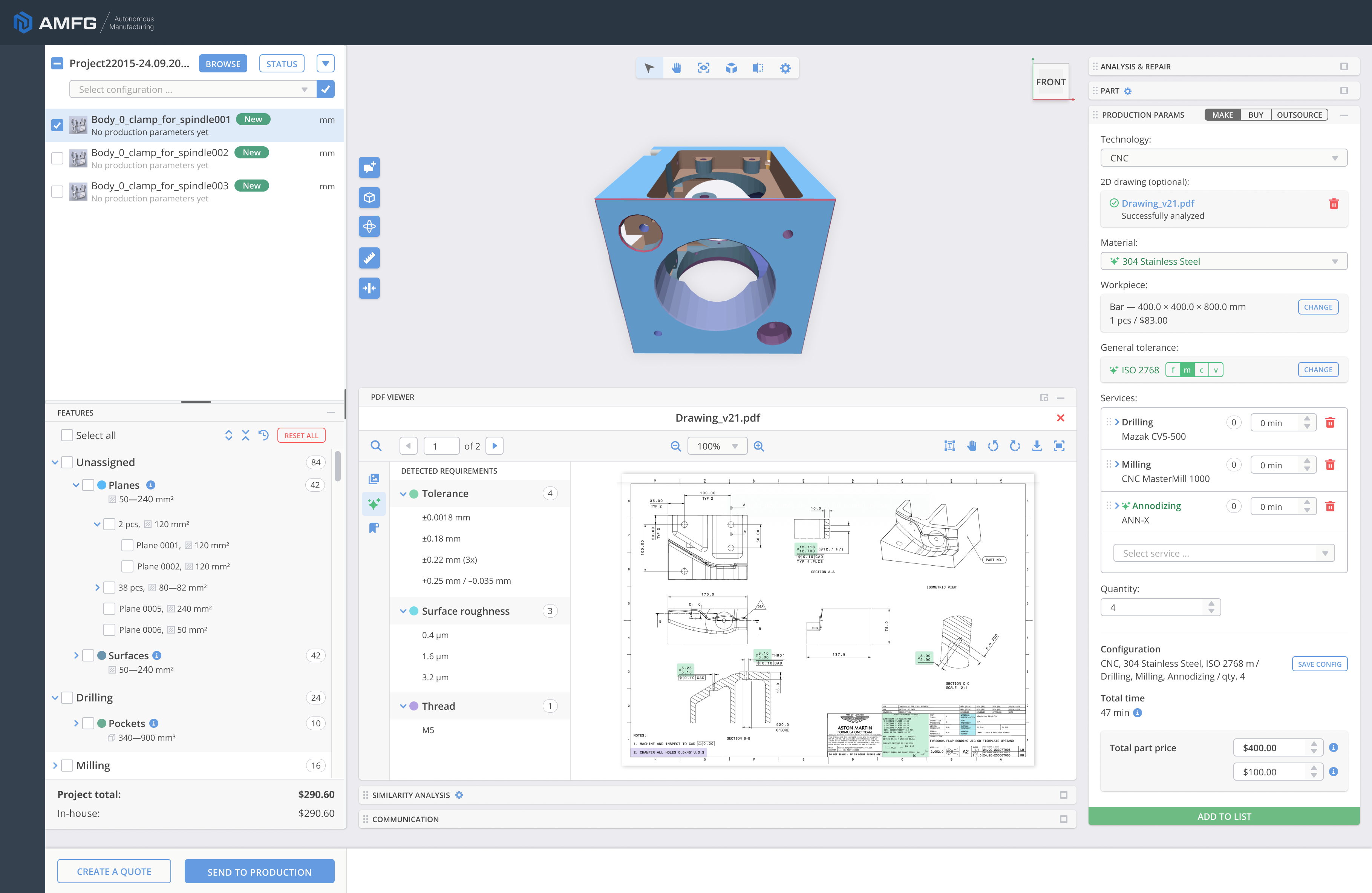
AMFG has a rapid quoting tool precisely because we want it to be quick, accurate, and easy. How do you think that kind of software is going to impact the machine shops in the next 5 to 10 years?
Well, first of all everyone should do it. A lot of smaller shops would argue, “I only have a few machines. I already know everything that's going on, I only have a few employees, or I'm mostly running it myself.” It's a mindset that will not work moving forward, because even the small shops have to know what's going on. I mean, within a couple of years, there will be widespread technology adoption, quote automation, and Sentinel style AI’s for drawing recognition will become standard. In three to four years, integration with ERP, MES systems, predictive quoting using historical job data, and smart margin rules will all be normal. And within five years, we’ll have software capable of digital quoting, ordering, scheduling workflows, potential integration with supply chains, suppliers, pricing, APIs. That is something I obviously just read, but it's something that we see every day. It's something I know to be true. We cannot be afraid of technology. We must learn it. We must appreciate it. And to be fair, if we're going to close the gap between the boomer generation and the younger generation and get to a place where they’re actually getting along, it’ll be because the boomer generation has all the money, and the younger generation knows all about AI. Imagine if we could come together and actually work and figure this thing out. We have to, if we're going to compete globally. It's not locally anymore, it's not regionally, it's not even nationally. It is full on global competition. And competition in a way that's productive. I've seen a shop with 40 machines fully automated with two people running it. Now, does that go back to “people are losing their jobs?” No. It means manufacturing makes the world. We need more science, more technology, more healthcare. We need more productivity. Imagine what we could create if we all realized how important manufacturing is and it wasn't the secondary option if you couldn't get into a university. Imagine if everyone cared again about how important it is to make a society.
"Manufacturing, engineering, the trades in general, offer a stable job that'll last a lifetime, that pays really well, and you get to take care of the world while doing it."
It does feel at the moment like manufacturing is misunderstood. There's a lot of stereotypes about the people in the industry and I know you, with The WorldWide Machinist, really focus on changing that. But what more do you think we could be doing as an industry to reshape the public's perception of manufacturing?
Oh, you're going to get me heated now. How can we make sure that the world pays attention to manufacturing? There's lots of flaws, but one major flaw is that education in general is not supported enough, by whatever resource you want to pick whether it's government, machine shops, associations. What we need to do, in my opinion, is find charismatic people who have been on a journey in manufacturing - and not a traditional journey but a journey of inspiration - that can share their story across their own country, or internationally, for about 2 years. They're funded financially by these groups - government, machine shops, associations, - and they go to middle schools and high schools across the country, like a religious thing “preaching the good word of manufacturing.”
30 to 40 years ago, manufacturing was a great job. Everyone wanted to be in it. But then all those people who had these great jobs saw their work disappear and go overseas, to people who were less expensive. So, not only do we need to convince the kids that you're not a loser for going into the trades, because that's what every guidance counselor is teaching them, we need to invite every single parent into those conversations at the middle schools and high schools because we need to convince them as well.
A kid can get super excited at 10 years old, go home and say, "Mom, I want to be a machinist." And she's going to go, "No you’re not, that’s for losers, you're going to university.” We're all stuck in this “I need to be a programmer. I want to be a graphics designer. I'm going to sit in a cubicle. I'm going to work the stock market. I'm going to do Bitcoin.” All of these things are potentially really great, but the percentage of people who succeed in them are very few. We see the successes of the few, not the failures of the many. It doesn't work like that, none of it works like that. Manufacturing, engineering, the trades in general, offer a stable job that'll last a lifetime, that pays really well, and you get to take care of the world while doing it. And I think that's important to understand. But that's how we get to it.
We bring all the generations together. We talk about opportunity, growth, fun, and we enjoy what is going on in manufacturing. That is difficult sometimes because the typical engineer is an introvert and doesn't want to do a little dance on camera, you know what I mean? So it's a game we play, we all work together to take care of one another. Coming from an engineering background and doing that type of work, but realizing that I talk too much, it was my responsibility to take on a role that not a lot of people wanted. It wasn't something I wanted. I didn't chase popularity, or the camera, and when I'm done doing this I'm going to delete all my social media. But it's the right thing to do right now to help an invisible industry, and we all need to come together to support each other instead of acting like crabs and yanking each other down.
I think that's an excellent way of putting it. Are you really going to delete all of your social media after this?
When I retire, I'm happy to eventually give it away to someone who deserves it. I don't care for social media as a general rule. I plan to give it away, change the name, or delete it altogether. When I retire, I'm going to be laying on a beach surfing, snorkelng, scuba diving. I've done my work, the world can now pass me by.
Will you be making any music in retirement? Will we see a resurgence of albums?
I would like to, I have three books that I'm writing right now. I'd like to finish those.
Wow.
Yeah, a children's book, an autobiography, and more of a science fiction style Lord of the Rings. Music? Maybe. I'm so embarrassed when somebody finds my music online right now. I haven't made a song since 2010, I'm like, "Put that away!" But in retirement, I would love to learn acoustic guitar, sit around a campfire on the beach and sing along. Yeah, I don't see why not, I think that'd be lovely.
Honestly I would love that, that sounds perfect.
Right? Bring the marshmallows, you're invited.
(laughs) Thank you
Having met so many people, done so many things, do you have - and you can say no - top three favorite shops that you've ever worked with?
The impossible question. No, the answer is absolutely not. I really enjoyed what I learned from every single one of them. But if I'm going to think back to the ones that were the most exciting at the time? I did some work with Samsung, in Vietnam. They have about 20,000 machines, all of the same machine, 70,000 employees, their own day-care, it's a small city. And knowing that I walked in there and helped them take a two and a half minute program and take about 40% off of that cycle time, then multiplying that times 20,000 machines. That was kind of fun. It felt like a hall of mirrors, it's not every day you see that many machines in one place.
I would say my first trip to India was interesting because I didn't know what to expect. I walked into some shops that had dirt floors and thought, how can you even balance a machine, or create zero vibration? And then I walked into some shops that looked like a bomb had gone off, rocks everywhere. And there's, I don't know, 20, 30, 40 million dollars worth of machinery in there, top class machines. And the programmers are in flippy floppies.
So for me it's less about the shop itself, and more about the area of the world, because every area has offered me a bit more insight on how to think outside the box, and appreciate the difficulties that every country goes through in its own way. Is it labor shortages? Is it resources? Is it the climate? There's so many different aspects to constantly prove just how amazing machinists are to still make quality work in any given environment whatsoever.
I've worked with Apple, Google, Tesla, Facebook, SpaceX, NASA, Boeing, Airbus. You name it, I've probably worked with them, been inside their machine shops, and signed an NDA saying I can't say anything about it. And every single one of them is a piece of learning to apply into a conversation or an adaptation of somebody else's shop. So, I guess I gave you a little bit of an answer, but I think the first one is really the right answer, which is absolutely not, I like them all.
A very diplomatic answer.
I have to be these days.
Would you say, having been to so many different countries, seen all the different challenges that everyone's facing, do you think there's a specific country or geographical region that's going to come to dominate manufacturing globally, or do you think it's not quite as simple as that?
Oh man!
Sorry, a hefty question.
Well, it's hefty because if we're going to take this from a neutral perspective, not taking anyone's side, the number one country in the world right now is China, and they're not slowing down. Number two is the USA. Not only are China number one, but their output is almost double the output of the USA. I mean that, to me, is fascinating. So that’s the first thing, the second is that India over the last five years jumped from tenth in the world to fifth. That is a hell of a jump. And they have started to realize the importance of investing in precision products and not just making a whole lot of crap fast, and that I think is going to be their evolution. The fact that they have a billion and a half people, their government believes in manufacturing, they jump from number 10 to number five, and now they're going to start making quality stuff?! That's tough to compete with.
But these things always coexist with training and educating the next generation. I was in Brazil recently and they have a great educational program, Senai, where they take millions of kids every year and put them into manufacturing for an opportunity to do something amazing. Although I would say that Germany and places in Europe have the best apprenticeship programs, when I'm thinking about the implementation and the size, the magnitude of possibility, what Brazil is doing I've not seen anywhere else in the world. So, knowing that Brazil is in the top 25 in the world, knowing that they have lots of people, and capabilities, and they've been in the top three in aerospace manufacturing, that gives them an edge as well.
Places like the UK and the US, we are quite stubborn and we don't like to lose. So, when we see other places doing better, we think, well we're going to do that better, too. So I do have hope for all the reshoring and nearshoring that's going on in countries like that. Mexico is making huge investments as well, but I still think it goes back to places like China that’s double the second place, India who's making major investments and has the people and the opportunity, and places like Brazil who have implemented an educational structure that exceeds anywhere else I've been on this planet. So to me those make the most difference. I hope I've answered okay, but it was a loaded one.
Sorry, I just suddenly thought, oh! I wonder what Tony thinks.
Ask me whatever you want. I love loaded questions, especially when they're unprepared, that's my favorite.
Now, if you could go back in time just briefly, talk to Tony when he was a young man going through quite a difficult time, would you give him any advice?
Butterfly effect, right? I wouldn't say a damn thing, but if I did, it would be “everything's going to be okay. You know, it's going to be a roller coaster ride, and put on a parachute, and put on some wings, grab your surfboard. The journey is going to be one hell of an adventure, but everything is going to be okay.”
I think everyone needs to hear that sometimes.
Yeah, sometimes this life can be suffocating and a reminder is helpful from time to time.
Well, you've got a shelf of reminders behind you that it's all worked out okay.
I do indeed. I'm grateful. I'm grateful for this life, I'm grateful for you, I'm grateful for manufacturing, I'm grateful for everyone who's taught me anything. The mean ones, the nice ones, the in between ones. Everyone's beautiful in their own way. I'm just honored and grateful to be here.
And I'm very grateful for this interview. Thank you so much for giving me the opportunity to talk to you, for answering all my questions, just for being here, for being you, for shining the light on all the manufacturers, thank you.
This interview has been edited for length.
About AMFG
AMFG works with high-mix, low volume manufacturers across the globe, streamlining their operations with our cutting-edge software platform. Our scalable tools automate all stages of manufacturing operations, providing automatic quoting and order management. Using our software, our clients can adapt to complex demand with efficiency and precision, securing their place at the forefront of the manufacturing industry.
For more information, please visit www.amfg.ai or contact: press@amfg.ai

.avif)
.svg)