Portable 3D Printing: Additive Manufacturing in the Field
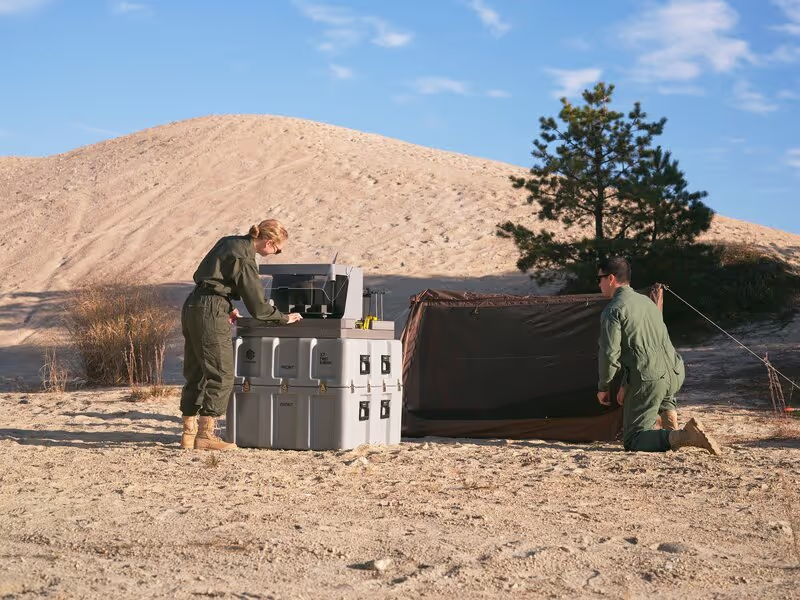


In modern warfare, adaptability and rapid response are paramount.
Portable 3D printing, also known as field-deployable additive manufacturing, is emerging as a transformative force in military logistics, enabling forces to produce critical components on-site, reduce supply chain dependencies, and maintain operational readiness in challenging environments.
Last week, we discussed the maritime applications of additive manufacturing. In particular, offshore printing is granting naval forces the ability to print components at sea or in coastal hubs, reducing the need for extensive transportation, cutting carbon emissions, and speeding up lead times.
The same is true for the military’s on-land counterparts. The defense sector is adopting similar strategies to ensure that critical equipment remains functional without the need for extensive logistical support.
Interest and investment from governments and defense departments is keeping up; in the UK, the Ministry of Defence (MoD) has awarded British defense company Babcock a proof-of-concept contract to help Ukrainian personnel 3D print military equipment. Over in the US, Ohio Governor DeWine has recently announced over $60 million for defense and space.
The defense industry is rapidly adopting 3D printing as a production process, from bespoke devices like prosthetics, to life-saving organ implants. AMFG streamlines workflows for companies involved in discrete manufacturing, collaborating with organisations like the UK MoD to maintain the right digital infrastructure, manage production workflows, and ensure adherence to regulatory standards.
Read on to discover how portable 3D printing is revolutionising defense...
The problem:
Military operations often occur in remote or hostile environments where traditional supply chains are strained or disrupted. Delays in obtaining spare parts can ground vehicles, hinder equipment functionality, and compromise mission success.
Transporting replacement parts can be risky and expensive, and in a sector in which operational readiness is essential, inefficiency and costliness could endanger success and cost lives.
Increased defense spending and rearmament are high priorities for governments across the world, and innovative solutions that save both time and money are being sought.
The solution:
But do not fear, 3D printing is here! AM is, by definition, portable, customisable, and efficient, and can be used to address the problems preventing military operations running as smoothly as possible.
The on-site fabrication of crucial parts helps reduce downtime and enhances operational efficiency, leapfrogging potential hurdles thrown up by remote or hostile production environments.
The benefits of portable 3D printing for defense
Rapid response and reduced downtime
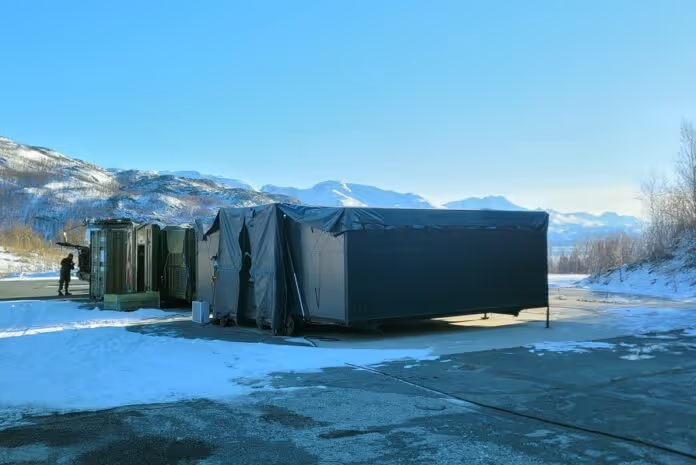
Image courtesy of Fieldmade
On-site manufacturing capabilities allow for immediate production of necessary components, minimising equipment downtime and maintaining operational momentum.
Maintenance of military platforms is key, but due to their complex underlying structures, they require customised spare parts and equipment components that with AM could be manufactured directly on-site, drastically reducing restoring times.
For example, Fieldmade, a provider of mobile and deployable AM solutions for defense organisations have joined forces with Plastometrex, a provider of non-destructive mechanical testing technology, to quickly bring quality assurance to on-demand metal AM. Leveraging a PIP technology, the collaboration addresses the current limitations of conventional testing methods (like tensile testing).
Large format additive manufacturing (LFAM) for the military is also possible– take CDG 3D TECH, whose Omni robust material extrusion systems, replete with a digital library and a deployable printer, are ideal for producing high-strength, functional parts for BMP-1 tanks.
Supply chain resilience
By reducing reliance on extended supply chains, portable 3D printing enhances logistical resilience, particularly in contested or remote areas.
As CDG outlines, 3D printing technology offers a revolutionary approach to battlefield critical situations, empowering military forces with the ability to produce essential parts on-demand. This eliminates the need to rely on external suppliers, storage, logistics, and minimises the impact of disrupted supply chains. This can be quickly achieved by setting up with forward-deployed production units equipped with 3D printers and a digital library of critical parts.
For example, The Battle Damage Repair and Fabrication (BDRF) effort is using additive manufacturing to quickly replace damaged US Army ground vehicle parts, developing a database of more than 600 3D CAD models that can then be printed to help keep battle-worn vehicles operational for longer.
A stronger supply chain entails greater time and cost efficiency, both crucial factors for any military outfit. Air Force and X-Hab 3D are collaborating to produce a deployable construction 3D printer to quickly rebuild infrastructure in contested logistics environments, enabling the US military to save valuable time and money in reduced transport.
Customisation and adaptability
The technology enables the production of tailored solutions to meet specific operational requirements, including modifications to existing equipment to address evolving threats.
Modern warfare is fluid, and armies have to be responsive to fluctuating trends in technology. ExOne is collaborating with the US Department of Defense to use binder jet 3D printing to fulfill critical needs. The specific technology is used by virtue of its speed, flexibility of materials, and ease of use.
In March 2025, the US DoD unveiled new, 3D printed barracks at Fort Bliss, home to the 1st armored division. The structures were then printed in layers using ICON’s Vulcan 3D printer and the company’s proprietary Lavacrete material. This concrete-based material is designed to adapt to environmental factors such as humidity and temperature, underscoring the benefits of customisation for the military.
Case study: RapidFlight's Mobile Production Systems

A drone museum at RapidFlight's facilities in Manassas, Virginia. Image courtesy of Colin Demarest/Axios
Meet RapidFlight, a US-based company founded in 2021 that uses AM to design and manufacture unmanned aircraft systems (UAS). The company’s approach to manufacturing prioritises speed, quality and innovation. As well as using AMFG software to automate its workflow, RapidFlight’s use of AM is central to its operations, reducing the need for costly tooling and ensuring an accelerated design-to-manufacturing process.
In 2024, the company announced the release of its Mobile Production Systems (MPS). MPS enables the manufacturing and deployment of unmanned aerial vehicles (UAVs) from forward locations to enable mass manufacturing of drones from anywhere in the world.
According to RapidFlight, a single MPS can produce 28 Group 3 aircraft per month, and each MPS unit can be operated independently or in coordination with other MPS units by two trained technicians. For example, 2,500 or more Group 3 UAVs of the same or varying designs can be manufactured in a year by deploying as few as eight MPS units. The footprint for this production would be half the size of a standard basketball court and set up in less than one week.
Global defense initiatives in portable 3D printing
United Kingdom: Project Brokkr
The British Army has pioneered the use of portable 3D printing through Project Brokkr. This initiative involves deploying mobile 3D printers capable of producing metal and plastic components directly in the field. During NATO's Exercise Steadfast Defender, the British Army utilized these printers to fabricate spare parts for vehicles, significantly reducing repair times and enhancing mission readiness.
The ability to produce parts on-demand has proven invaluable, particularly for aging equipment where spare parts are no longer readily available.
United States: ExOne's mobile 3D printing factory

ExOne’s portable 3D printing factory. Image courtesy of ExOne
In the United States, the Department of Defense has contracted ExOne to develop a portable 3D printing factory housed within a standard 40-foot shipping container. This self-contained unit is designed to be deployable via land, sea, or air and is equipped to produce parts from over 20 metal, ceramic, and composite materials.
The facility includes 3D scanning capabilities and CAD workstations, enabling personnel to recreate or design components as needed. This initiative aims to provide rapid manufacturing solutions in support of battlefield operations and disaster relief efforts.
Australia: SPEE3D's field trials
The Australian Army has conducted field exercises using SPEE3D's additive manufacturing systems. These trials demonstrated the ability to produce end-use spare parts in extreme temperatures, showcasing the technology's robustness and suitability for deployment in diverse operational environments.
In various trials, the company was successful in proving its Expeditionary Manufacturing Unit (EMU) has the capacity to operate in sub-zero temperatures. Previously, they have shown the technology’s ability to perform well in extreme conditions during a collaboration with the Australian army in which the EMU functioned in the extreme heat of the Australian bush.
The future?
As technology advances, portable 3D printing is poised to become an integral component of military logistics and operational strategy. The development of more rugged, user-friendly, and versatile printing systems will further enhance the capability to produce a wide array of components in diverse environments.
The integration of digital design repositories and standardized part libraries will facilitate the rapid dissemination of design files across units and allied forces, promoting interoperability and collaborative innovation.
Governments and military departments are considering AM as a legitimate resource for production; in late March, head of US Army Futures Command told an audience at the Global Force Symposium and Exhibition that the branch is currently assessing its capabilities for 3D printed drone production, towards the objective of a potential scale-up very soon.
Whilst portable 3D printing for military applications is promising, companies must ensure that they’re ready for contracts. Security is paramount, quality assurance is essential, and a smooth, efficient workflow is necessary to ensure military contractors are satisfied.
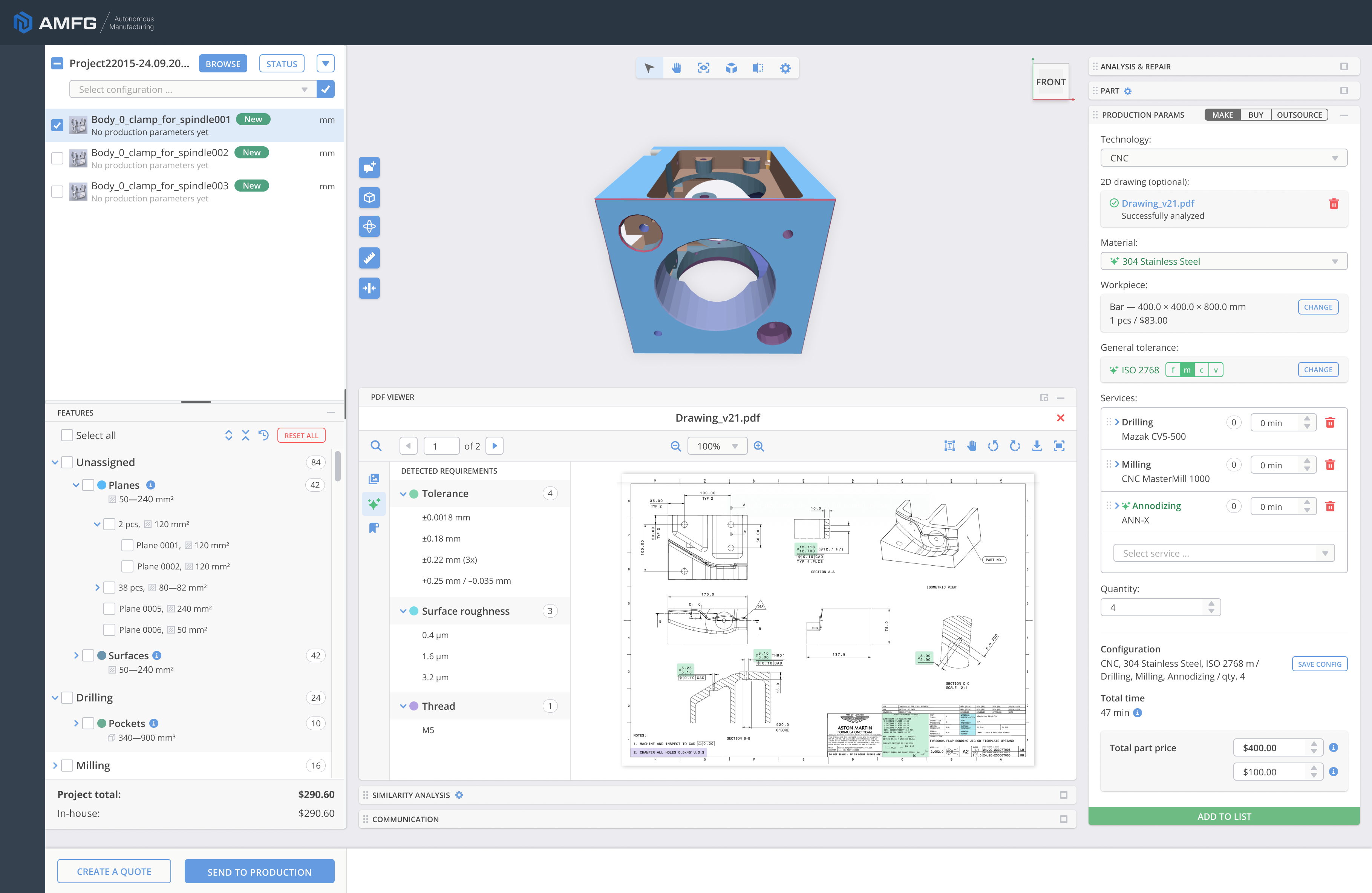
AMFG’s software solutions empower manufacturers, allowing them to manage their workflows and achieve streamlined, automated processes. We are fully ITAR compliant and ISO 27001 certified.
With over 500 successful implementations in 35 countries and across a range of industries, we specialise in enabling companies to successfully integrate our software for AM and CNC production, into their wider manufacturing processes and scale their AM operations.
Have a chat to one of our experts here: Book a demo
Thumbnail image courtesy of Markforged


.avif)
.svg)