T-Code: The Future?
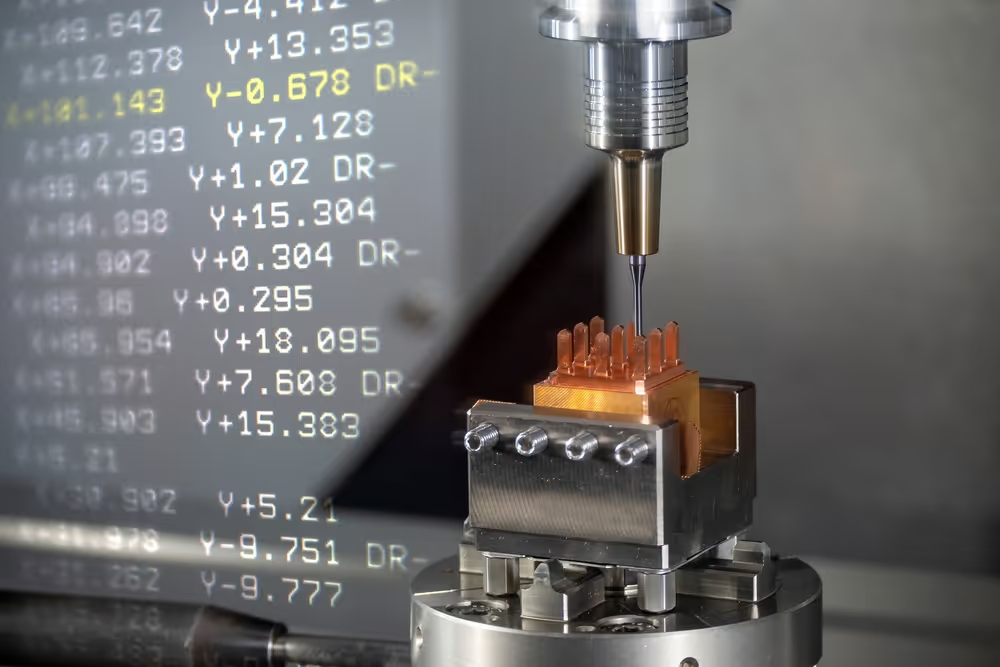


Staying on top of technological innovations is critical for companies in additive manufacturing. New soft and hardware is always being developed in an effort to overcome obstacles and improve efficiency. ‘The norm’ is an unstable concept and it is in the interest of any manufacturer to keep on top of these changes.
With this in mind, researchers from Johns Hopkins University have recently published their findings regarding a new 3D printing programming language, Time Code. The language, known familiarly as T-Code, claims to improve 3D printing speed and quality for complex, multi-material parts, offering potential for a rehauling of the software behind 3D printing.
In a paper published in scientific journal Nature, creators Sarah Propst and Jochen Mueller assert that T-Code has the capacity to enhance speed, precision, and material versatility for complex prints in a way that current language G-Code cannot.
But is it worth the hype?
In this article, AMFG outline how T-Code works and the purported benefits it would bring to the printing process when compared to G-Code. We assess any potential challenges to a hypothetical adoption and whether T-Code is a suitable pretender to G-Code’s proverbial throne.
What is T-Code?
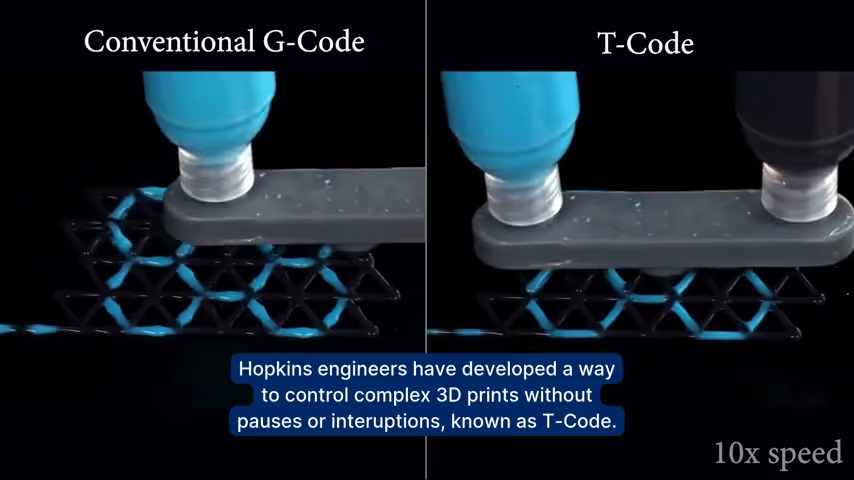
3D printing with G-Code on the left and T-Code on the right. Image courtesy of Johns Hopkins University
After conducting work with Direct Ink Writing, Propst and Mueller argue that they have identified the limitations possessed by G-Code. Under the current language, print movement is paused for the print head and for other actions to take place. This pause may entail a failure to print, with a risk of under/over-extrusion, pressure buildup, premature hardening, adhesion problems, and layer profile changes.
T-Code aims to address these challenges. A Python script is used to divide traditional G-Code into 2 separate tracks, with one controlling the 3D printing path, and the other managing printhead functions.
Whereas traditional G-Code executes tasks line-by-line, T-Code uses time to synchronise the motion of the 3D printer with key commands like material switching and flow adjustments.
So, how does it work?
- A regular G-Code file containing the desired locations of auxiliary commands is imported into Python
- The script separates the movement and auxiliary commands into 2 groups while keeping them properly aligned
- Once decoupled, separate movement commands are merged into an uninterrupted 3d print path
- The Python script calculates the 3D printer’s speed and velocity to generate a velocity profile
- The script maps the location of the auxiliary commands on the velocity line, therefore determining their exact timings
- Timestamps are formatted into a list, ready for execution
- A signal from the 3dp executes the script, synchronising the printhead operations. At the specific timestamps, events are triggered accordingly
T-Code works on time, not space. The possibilities that simultaneous manufacturing unlocks when compared to G-Code could be extremely promising for scaling mass customisation. The parallelised approach facilitated by the Python script eliminates frequent pauses that slow down prints and generate unwanted defects, meaning downtime could be halved– a welcome side effect for any manufacturer.
Where we are now: G-Code
The existing programming language utilised by CNC and AM machines is G-Code, short for Geometric Code.
This language is a set of commands that instructs a machine what to do or how to do something; where to move, how fast to do so, and what path to follow. In the case of AM, commands instruct the machine to deposit material, layer upon layer, thus forming a precise geometric shape.
The commands are comprised of three components: first is the G-Code command, which gives a particular instruction for the printer to follow. Common commands include G01, ‘move in line to a specific position’ (which makes up 95% of G-Code files), G28, ‘perform homing routine’, and M104 and M109, extruder heating commands. These M-Code commands are incorporated into the language to generate a fully-fledged, complete programme.
The second section of a G-Code command declares the coordinates of the material, and the final value determines the feed rate (the speed at which the move will occur). As this explanation shows, G-Code boasts an open and readable format. Users can troubleshoot issues by inspecting the code itself, and can easily read and modify the instructions given that it is a text-based format. Likewise, the language is customisable and optimisable, and users can have detailed control over every aspect of the printing process.
G-Code vs T-Code
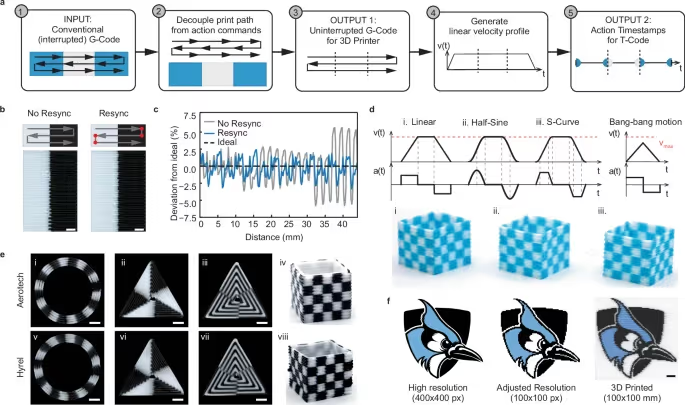
T-Code methodology. Image courtesy of Nature
Despite these capabilities, however, there is room for improvement that T-Code is seeking to address. The proposed new language removes the stop-starts typically required for each new command, meaning that T-Code saves time along with expanding the possibilities of what can be produced.
Complex designs that are challenging to manage with G-Code become a great deal easier, broadening the limits of what is possible in areas like biology, electronics, mechanics, and optics; for example, the paper highlights the production of 3D printed wearable electronics and smart prosthetics as promising sectors with the usage of T-Code. As we have covered in previous articles, these areas represent a lot of potential for the AM market.
T-Code allows the creation of objects with superior functional gradients to G-Code, as properties like filament diameter and composition can be altered dynamically along the print path. Designers can optimise mechanical performance (like stiffness, strength, energy absorption) in a single print, without requiring multiple runs or complex post-processing.
As a result of this, T-Code promotes scalability for mass customisation, as printhead controls no longer require pausing motion for every switch or command. Multiple printheads can operate in parallel, each executing its tasks in unison, drastically cutting down overall production time. T-Code commands even allow for the simultaneous creation of disparate geometries, meaning it could be possible to produce highly customised products in a single automated cycle.
Is T-Code the future?
This discussion is currently hypothetical; T-Code is only a recently proposed methodology designed to address problems with the existing language. Yet there are some potential barriers to adoption.
As we have seen, G-Code is designed to be understood by humans, and users can easily perform troubleshooting. T-Code is less readable, and could make restarting a print after failure increasingly more difficult.
Similarly, if it were implemented, the community support available to users of G-Code just doesn’t exist to the same extent yet, potentially hindering adoption.
But these problems could diminish in significance as more and more users become accustomed to the new system. T-Code is designed to be largely hardware-agnostic, meaning it can be integrated into existing 3D printers with minimal modification. Given that the core motion planning is left intact and only a Python script for auxiliary commands is added, T-Code can be adapted to a wide range of materials.
Overall, T-Code is an exciting innovation that, at the very least, showcases an AM landscape continually looking to improve on itself. At most, the language could revolutionise how we approach production, permitting higher volume and customisability alike, and placing 3D printing technology at the front of the queue for usage in real-world applications.
About AMFG
AMFG is an award winning MES designed to empower production workflows, from order placement to shipment, with seamless integration and precision automation.
With over 500 successful implementations in 35 countries and across a range of industries, we specialize in enabling companies to successfully integrate our software for AM and CNC production, into their wider manufacturing processes and scale their AM operations.
For more information, please contact us here: Book a demo


.avif)
.svg)