Exploring the Story of The CAM Factory with Founder and Owner Chris O'Brien


The CAM Factory is a company offering CAM programming services based in Portland, Oregon. From web designer to CNC hobbyist to entrepreneur, the career journey of its founder and owner, Chris O’Brien, is anything but conventional. By offering an opportunity to outsource CAM programming, The CAM Factory is supporting small machine jobs to access these services flexibly and affordably. In less than a year, The CAM Factory has grown from a single LinkedIn post going from strength to strength to build a network of clients across the US.We sat down with Chris to discuss the machining market, CAM programming as a product and how he got into CNC machining thanks to a beer flight paddle.[spacer height="50px"]
[caption id="attachment_41434" align="alignnone" width="1000"]
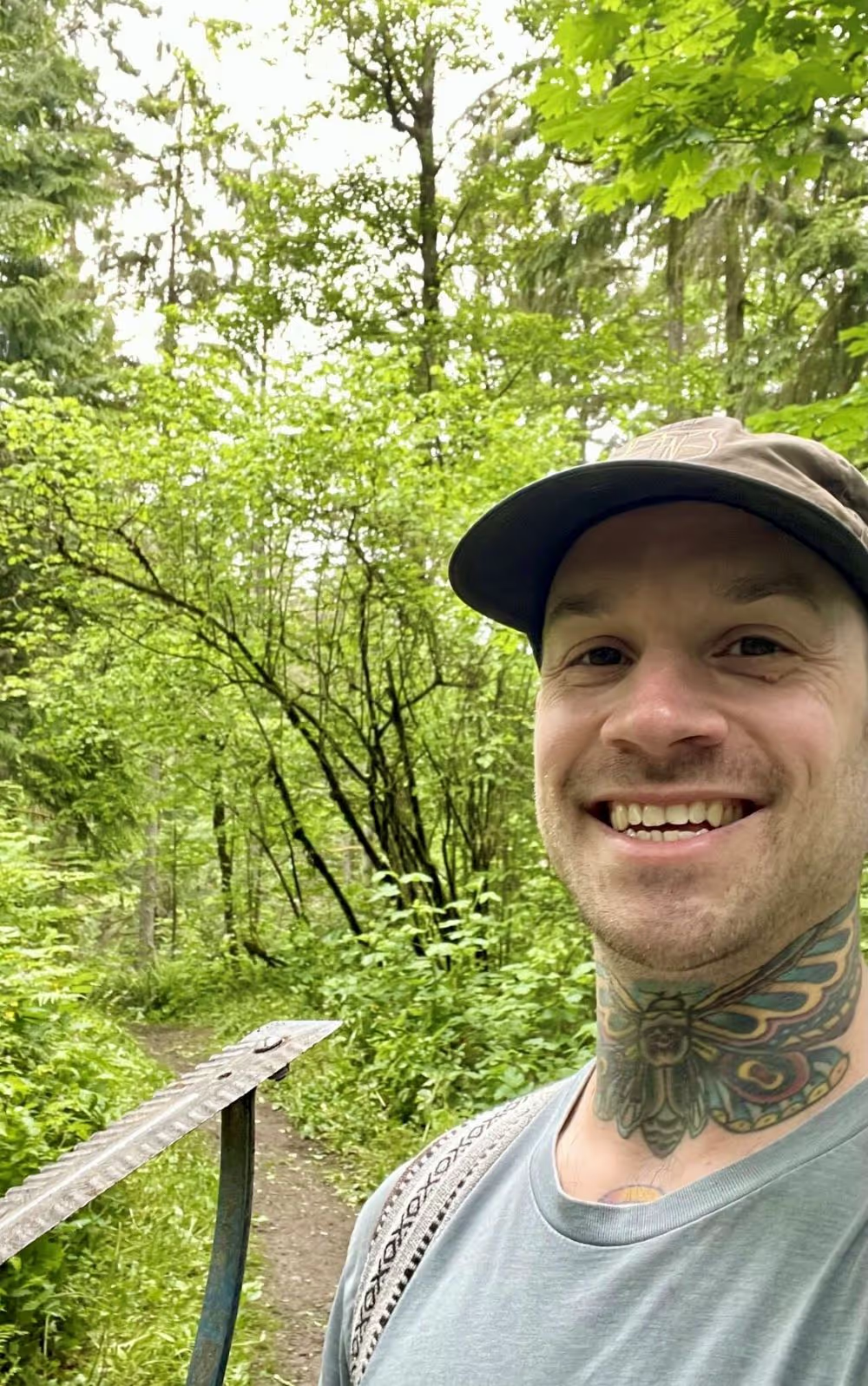
Image courtesy of Chris O'Brien[/caption][spacer height="50px"]
How did you get into manufacturing?
[spacer height="50px"]I never intended to pursue manufacturing - I got into manufacturing through my hobbies.One of those hobbies was web design. I ended up making a website for a restaurant that wanted beer flight paddles (those wooden things to hold a series of beer samples) so they sent me to a local community workshop. That’s when I started manufacturing using laser cutters, CNC machines, and CNC routers primarily.While working there and creating things for my friends, my Etsy shop and myself, I ended up creating this unique portfolio of custom items. That, basically, became the portfolio that I used to get into my first machine shop to show that I was competent with tools. I started at a start-up in San Francisco that was working to automate the machining process and they only needed low-skill level workers to start because they were automating everything - I was just testing things. They hired me despite having no experience and then quickly learned that they needed more programmers so I began programming immediately after starting. [spacer height="50px"]
What made you decide to make the move from being a CNC hobbyist to a professional?
[spacer height="50px"]I just enjoy creating things. I think the process of creating is so fulfilling, whether it be physical objects or music, it’s just always something that I’ve found fulfilling. I ended up finding my first job by going on Craigslist and typing in CNC because that was my interest at the time. I was considering building my own desktop CNC machine to use in my apartment. A low-horsepower, very simple 3-axis. At the time, I was very interested in CNC machines even though I had never made anything out of metal - I was just doing wood. Creating is super interesting to me and naturally, I just wanted to do that and spend more of my time doing that. [spacer height="50px"]
What made you set up The CAM Factory?
[spacer height="50px"]For a long time, I’ve been interested in entrepreneurship. Last year, a few pieces started falling into place. I saw an opportunity to bring on-demand CAM programming to market in a fresh way, and some of that inspiration came from companies outside of manufacturing.One of them was a graphic designer. He had a monthly subscription service where he packaged his services up into something that you can buy online, pay monthly and just drop design requests off to him. I really liked that business model and I saw a need for it in manufacturing because there’s a shortage of skilled labour in this particular position - I know that because recruiters are constantly reaching out to me.Also, this industry hasn’t quite adopted the remote workforce yet. There’s still this idea that you have to have your programmer or your programmers in the office. You do need to have a couple at least, but you can outsource some of the programming work. I liked the business model, I saw a potential future for it in the industry and I also had a little bit of validation. I used to work as a manufacturing consultant and every now and then we would get a strictly-programming job where I would program a part and send it off. However, the rates are so high for consulting that it’s not sustainable - it’s “emergency only”.I felt like I found a spot right in the middle. This can be done remotely and cheaper because the in-house programmer is much cheaper. Now, we can offer the customers the talent regardless of where they are located. If they’re in a rural town and they don’t have that many people in the population in a 10-mile radius, they’re going to have fewer people to choose from. But I can source people from anywhere because people are pretty willing to work from home to program parts and make some money. Now, we can offer that talent pool from anywhere to people in any place.I saw a bunch of little holes and started to make sense in my mind that this might be a good opportunity. It started with a LinkedIn post. Right away I got a hit and I got my first client. I started the business and it’s just grown from there.[spacer height="50px"][caption id="attachment_41432" align="alignnone" width="1000"]
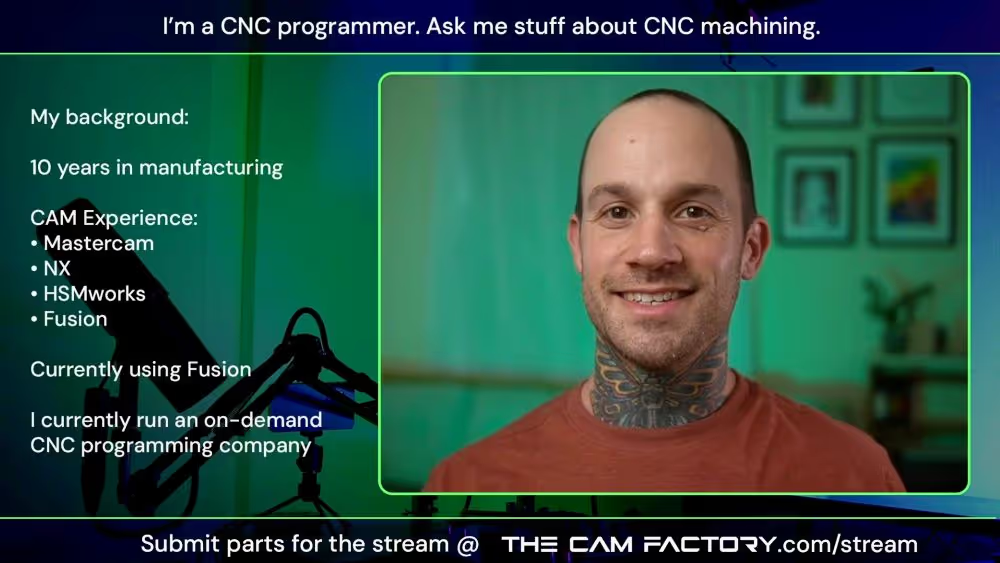
Image courtesy of Chris O'Brien[/caption][spacer height="50px"]
How has The CAM Factory grown since you started it?
[spacer height="50px"]In terms of how I’m acquiring customers, it’s been organic, LinkedIn completely the whole time. I am not doing any outbounds so it’s been a case of posting things on LinkedIn, sharing the success stories of the work that I’m doing for my other clients and just growing my following. I try to be consistent in my messaging and branding so that everybody knows when they see a post from me, it’s from me. On the weekends, I take one day and I schedule everything out into the week, potentially into the next week and just talk to people. I think that people are open to the idea once they start communicating with somebody and learning more about it. That’s been the growth strategy so far and it’s working.Because I’m only one person at the time, I’m okay with that slow growth. I’m setting up all the systems right now. I’m putting them in place so that this is scalable; that is the plan. This first year is all about testing and validating the systems I’m building.I am in talks with people to potentially start scaling this beyond just me. That may not come until later this year or possibly next year. That’s been the growth so far. [spacer height="50px"]
What do you do now, what does your day-to-day look like?
[spacer height="50px"]It can change every day. Right now, because I’m a solo operator, I have to do everything myself. I have to do all the marketing, the website design, all of the programming, and all of the selling.Yesterday I woke up at 7 am, I hopped on a call with four people, two of them were in India. I had a three-hour training session with them before hopping into a few hours with another client.And then I did another one-hour training with someone who’s in Florida. Then I spent six and a half hours programming parts until 2:30 am. That is not a typical day, that was just yesterday, and there are some days when I don’t have nearly as much workload and I focus more on the marketing side of things. It’s half and half at this point, marketing and actual billable time. [spacer height="50px"]
What kind of clients does The CAM Factory work with?
[spacer height="50px"]Most of my clients are small machine shops in the quick-turn prototype space. It could be a solo operator that’s doing everything themselves. Adding that one extra employee increases their overheads substantially and puts them at risk of burning cash if they’re not getting consistent work. That owner has to be really busy finding more work which means that they’re being removed from what they were doing. Now they have to pay for somebody else to fill their spot. That’s a lot of pressure.For those small shops of one to five people, they can now outsource what has historically been the most expensive part of the machining process for a prototype shop. If they can outsource it to me and only pay for what they need when that work spikes, it really helps them out. Then I have a handful of clients that are coming to me for 1-1 training because I offer that as well. I’m trying to offer help in the world of CAM, not just CAM programming services. I also offer digital downloads for assemblies that you can use in CAM, CAM services, 1-1 training, custom workflow development and a little bit of consulting. But CAM programming is the core service I offer.[spacer height="50px"][caption id="attachment_41430" align="alignnone" width="1000"]
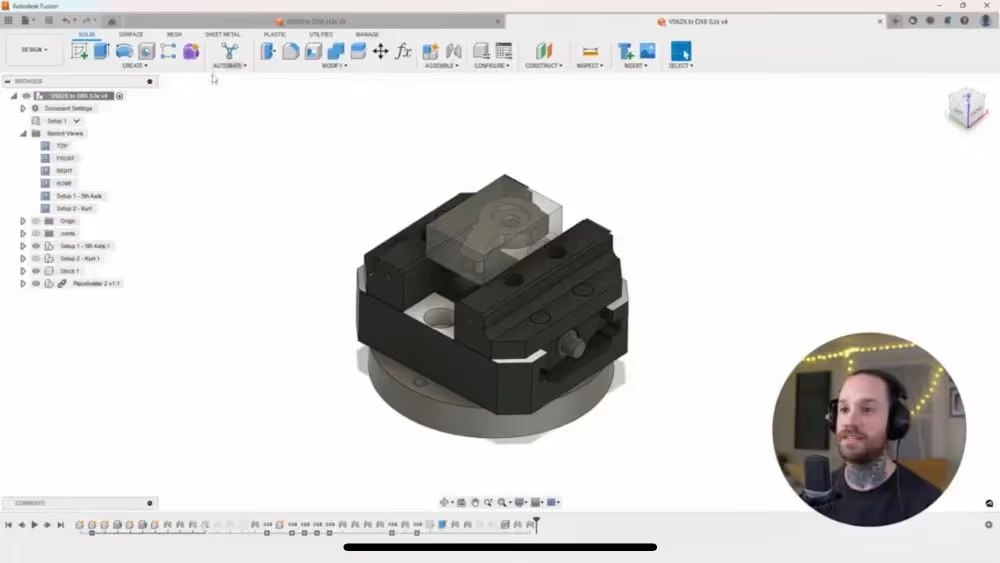
Image courtesy of Chris O'Brien[/caption][spacer height="50px"]
What changes have you seen in machining since you started working in the industry?
[spacer height="50px"]I started my career at a start-up that was trying to automate the industry. As I’ve gone through my career and heard other people express things about automation, especially CAM automation, and the future of manufacturing, I feel like I was already tasting the future of manufacturing on my first day. I was so naive that I didn’t even understand that what we were doing was a revolutionary attempt to change manufacturing.The changes we’re seeing now with CAM automation have been in the works for a long time. We’re just now beginning to reap the benefits of all the people that have tried to tackle this challenging problem.[spacer height="50px"]
What are you excited about in the future of manufacturing?
[spacer height="50px"]A couple of software companies are building automated CAM technology and I am excited to see that roll out and become more sophisticated. I do think that the future of CAM will be almost 100% automated toolpaths with human oversight to just fine-tune things and I think that we’re making the jump right now. The difference will be similar to when people were just hand-coding and went to CAM.I think the integration of these AI tools into CAM will fundamentally change the way we program. The next generation of programmers will look at the way that we’re doing it now and think, “Wow, they had to do all of those things, all of those inputs and button clicks, that’s archaic!” I’m excited to see those tools become more sophisticated, and integrated and to see a more diverse market. Because right now there are basically one and a half options available. [spacer height="50px"]
How would you encourage people to get involved in machining, CAM, manufacturing etc?
[spacer height="50px"]It’s fun! I mean, we’re creative beings by nature. This line of work is exciting because you can’t fake it. You produce a physical object that proves you’re good at what you do. There’s something really gratifying about that, that cycle of programming it, making it whatever role you play in it… You’re holding it in your hand or someone else is holding it in their hand and it’s doing something in the world. That’s a really cool way to participate I think.[spacer height="50px"]
What challenges do you think the industry is going to have to face?
[spacer height="50px"]While most manufacturers are focused on addressing the skilled labour shortage and supply chain management issues, we are overlooking a critical challenge: developing holistic solutions for sustainable manufacturing. True sustainability means that the Earth can replenish the materials we use at the same rate we consume them and that the products we create can re-enter the ecosystem at the same rate we produce them; without harming our planet.If we only focus on increasing output without considering the impact on our planet, people, and animals, we are worsening an already prevalent problem. Achieving this necessary shift requires greater awareness of the real impact that manufacturers, engineers, and designers have on the world. It can't just be about throughput or production; our focus must include the entire lifecycle of product development and its environmental impact. This is the challenge I would like to see manufacturers working together to overcome.[spacer height="50px"]

.avif)
.svg)