The Search for High-Speed Additive Manufacturing
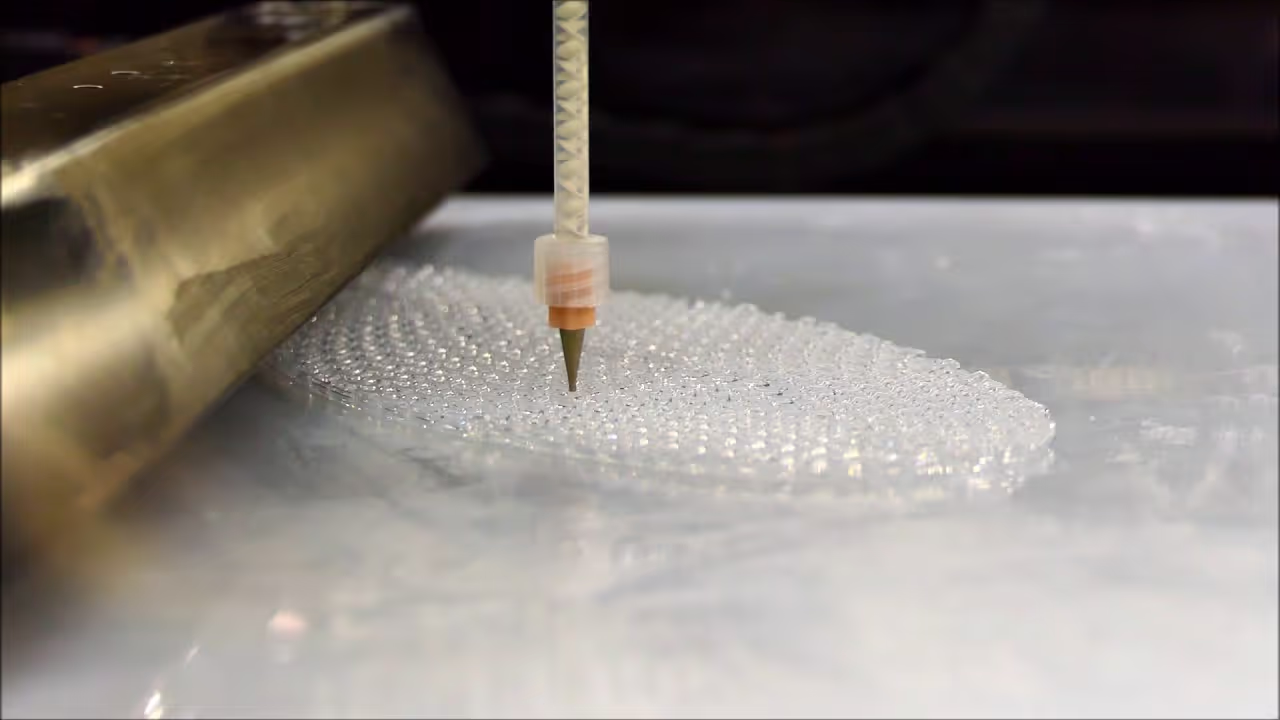


Additive Manufacturing (AM) is an incredibly versatile technology that has revolutionised manufacturing. Nevertheless, the technology has been let down by one particular disadvantage: speed. Printing even a small batch of components could take hours and may require post-processing to smooth out any rough surfaces. In comparison, a small and complex part might take only a few minutes minutes to machine. When it comes to speed, more traditional technologies are the clear winner for high-volume manufacturing.No manufacturer wants to labour under the burden of lengthy lead times and indeed this was one of the factors that we identified as hampering the scaleability of AM. Nevertheless, as AM technology develops, a new era of high-speed printing is just around the corner. We explore the current options for fast 3D printing and how these processes can accelerate even further in the future.
What’s taking so long?
[spacer height="50px"][caption id="attachment_41902" align="alignnone" width="1000"]
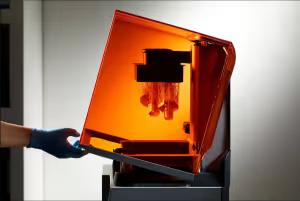
Image courtesy of FormLabs[/caption][spacer height="50px"]Additive manufacturing is the term that describes a wide range of processes which each have their pros, cons and speeds. Dr. Hideo Kodama developed stereolithography (SLA) in the 1980s. According to FormLabs, “Stereolithography (SLA) 3D printing is the most common resin 3D printing process and has become vastly popular for its ability to produce high-accuracy, isotropic, and watertight prototypes and end-use parts.”However, this level of precision comes at the cost of speed, with SLA-printed parts potentially taking days to print depending on complexity.Luckily, there are new processes being developed that may ramp up production such as digital light processing (DLP) or continuous liquid interface production (CLIP). These methods. According to Tomorrow Bio, “These methods use light to initiate a chemical reaction, allowing for the rapid formation of intricate structures.”Researchers are particularly optimistic about iCLIP with 2022 bringing the news that Stanford University had developed a polymerization process that’s “five to ten times faster” than the current quickest high-resolution resin 3D printers on the market. According to Joseph DeSimone, one of the study’s authors and Co-Founder of digital manufacturing company and 3D printer manufacturer Carbon, “This new technology will help to fully realize the potential of 3D printing. [..] It will allow us to print much faster, helping to usher in a new era of digital manufacturing, as well as to enable the fabrication of complex, multi-material objects in a single step.”
Large Scale Liquid Metal
[spacer height="50px"][caption id="attachment_41904" align="alignnone" width="1000"]
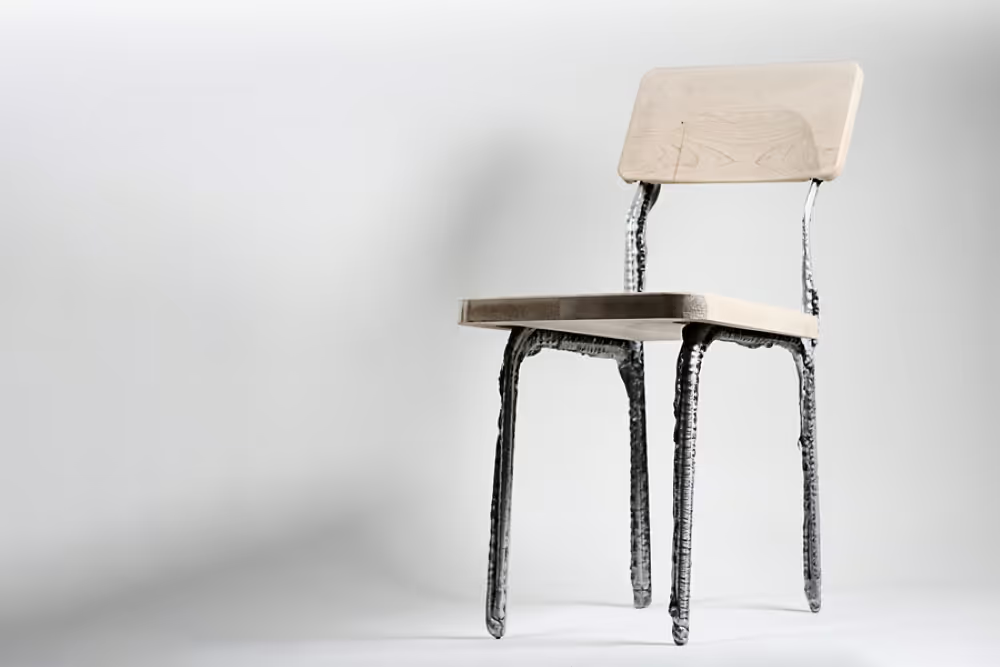
Image courtesy of MIT[/caption][spacer height="50px"]The benefits of techniques such as SLA or CLIP or even iCLIP is the high level of precision and complex geometries that manufacturers can achieve. But what if this level of high resolution wasn’t a concern?According to researchers at the Massachusetts Institute of Technology (MIT) Liquid Metal Printing might just be the answer. Earlier this year, MIT unveiled the technique which can, “quickly 3D print furniture and large-scale objects using liquid metal in a matter of minutes.” As Adam Zewe reports, the “technique, called liquid metal printing (LMP), involves depositing molten aluminum along a predefined path into a bed of tiny glass beads. The aluminum quickly hardens into a 3D structure.”Eagle-eyed readers may note that the end results do prioritise speed over polish and as a result, the structures have a low-resolution, rough finish. However, as the researchers argue, “The technique does sacrifice resolution for speed and scale. While it can print components that are larger than those typically made with slower additive techniques, and at a lower cost, it cannot achieve high resolutions.For instance, parts produced with LMP would be suitable for some applications in architecture, construction, and industrial design, where components of larger structures often don’t require extremely fine details. It could also be utilized effectively for rapid prototyping with recycled or scrap metal.”
Fast printing in practice
[spacer height="50px"][caption id="attachment_41896" align="alignnone" width="1000"]
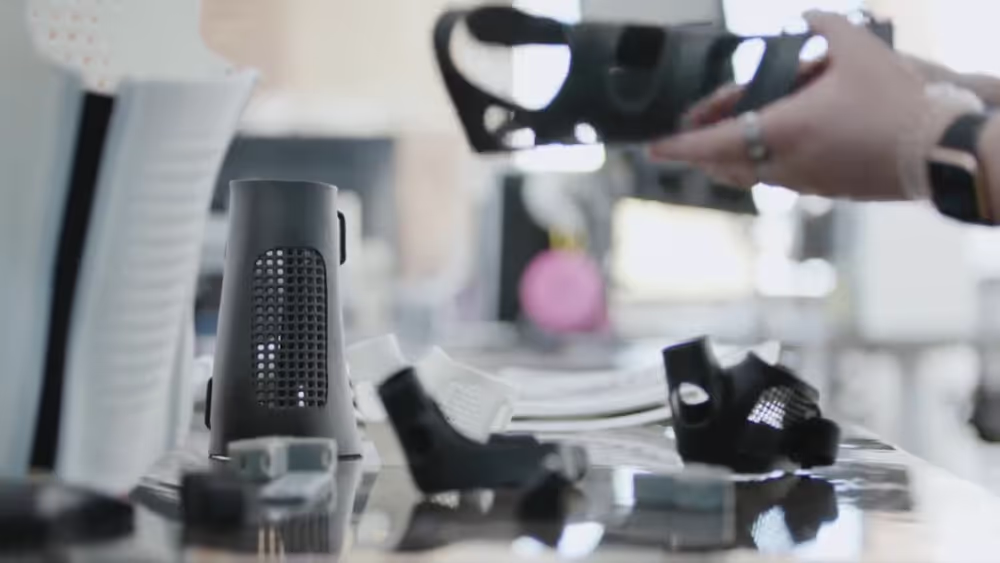
Image courtesy of Carbon[/caption][spacer height="50px"]While these technologies promise to usher in new possibilities for ultrafast 3D printing, what methods are currently available to manufacturers?Carbon is one such company looking to accelerate additive manufacturing having developed its own Carbon Digital Light Synthesis™ (Carbon DLS™) process. Carbon DLS™ offers a variety of benefits including robust and consistent parts, scalability and of course, faster production. One of the companies putting Carbon’s DLS printing into practice is mign, “a digital orthopedics company, creates custom orthopedic, spine, and sports medicine bracing.”According to Carbon, “Carbon Digital Light Synthesis™ allows mign to scan, design, and print a support device all in one day.” In fact, Mign’s Co-founder and Chief Executive Officer Lisa Tweardy cites the speed of printing as one of the reasons why mign chose a Carbon Printer.Elliott Dix, mign’s Director of Research and Development added, “Carbon allows us to make something now.”
Fancy footwear
[spacer height="50px"][caption id="attachment_41898" align="alignnone" width="1000"]

Image courtesy of Nexa3D 3[/caption]Nexa3D is another industrial additive manufacturing solution offering ultrafast SLS printing. According to the company, their QLS 820 thermoplastic 3D printer is the Industry’s “Fastest SLS 3D Printer.” The QLS 820 achieves this coveted title through, “mart automation, removing pain points in capacity utilization and downstream labor intensity. With 4x more power and throughput compared to competitor models, this thermoplastic 3D printer can print up to 8 liters per hour at 20% job density.”One company taking advantage of this faster additive manufacturing is footwear manufacturer Lalaland. Prior to implementing their Nexa3D, Dwayne Jeon explains the lengthy lead times involved in producing the midsoles, “Traditionally, we have developed midsoles using EVA injection molding processes. This technique takes around 26 hours to produce a typical midsole, and with a further eight processes to go through, the average turnaround time from design to production is around 18-24 weeks.”Now, Lalaland is able to produce these same midsoles in just 3 hours. According to Jeon, “That is such a huge time difference. It immediately revolutionized the prototype production process.”
HP Multi Jet Fusion
[spacer height="50px"][caption id="attachment_41907" align="alignnone" width="1000"]
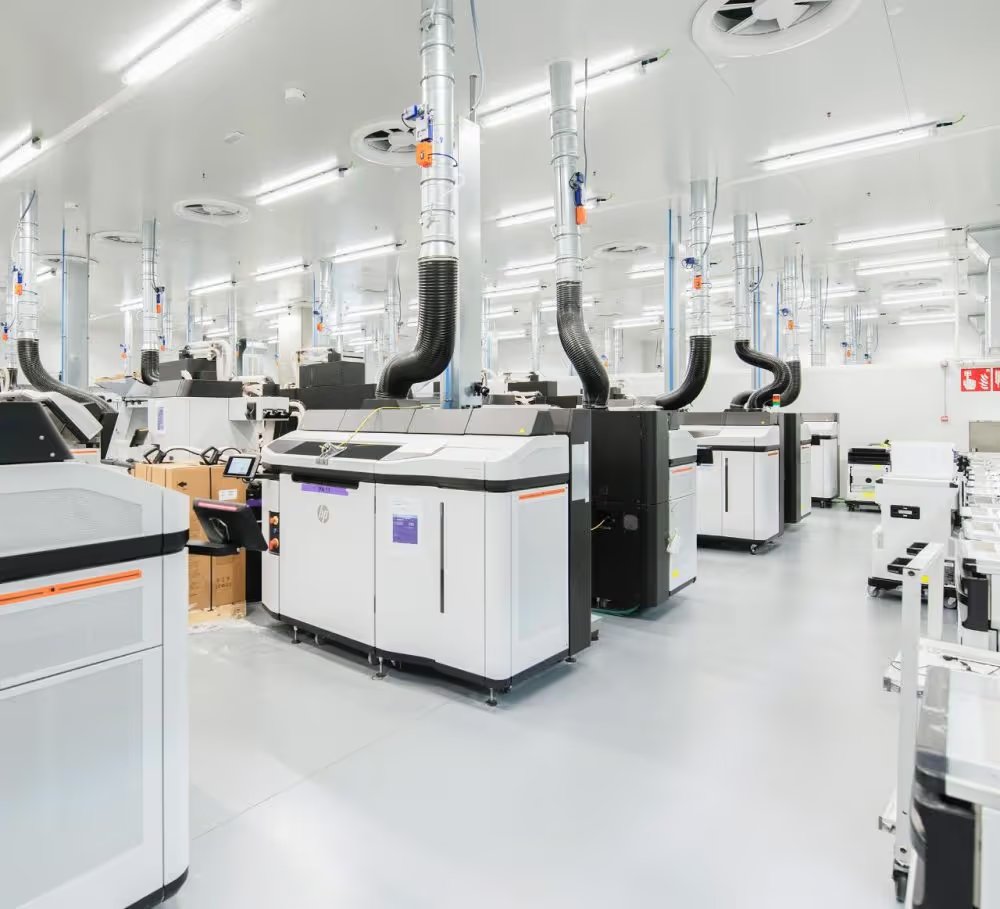
Data courtesy of HP 3[/caption][spacer height="50px"]Of course, HP is a major player in the world of additive manufacturing and their Multi Jet Fusion Technology marks another step forward for AM processes. As HP argued, “HP Multi Jet Fusion technology enables high build quality up to 10 times the faster and at the lowest cost relative to competitive 3D printing solutions in the marketplace today.”How do they do it?“A key innovation in HP Multi Jet Fusion technology is a high-speed, synchronous architecture that builds parts layer-by-layer. [... D]ual carriages scan across the Working area in perpendicular directions: one carriage recoats the working area with fresh material, and the other prints HP functional agents and fuses the printed areas. This separates the processes of recoating and printing/fusing so that each process can be separately optimized for performance, reliability, and productivity.”HP Multi Jet Fusion technology is proving to be a game changer for companies like the UK manufacturer of bearings Bowman. Bowman’s use of HP Multi Jet Fusion has seen the company make cuts to lead times. “Traditionally 3D printing bearings required a lead time of 12 to 14 weeks, but using HP MJF technology to 3D print these industrial parts resulted in a lead time of only one week.”
Desktop Solutions
[spacer height="50px"][caption id="attachment_41894" align="alignnone" width="1000"]
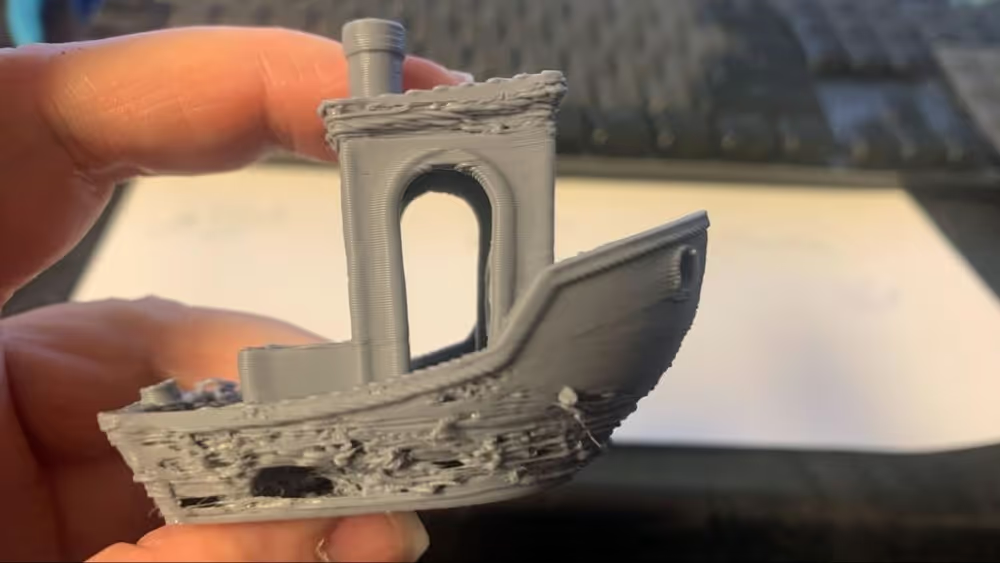
Image courtesy of Tom's Hardware[/caption][spacer height="50px"]Industrial additive manufacturing is one use case for additive manufacturing, but is there anything we can learn about fast printing from desktop printers? Tom’s Hardware might just have the answers. They ran a test to find out which FDM-style (filament) 3D printer offers the best combination of quickness and quality output using the industry benchmark part Benchy. The test compared the printing speed and quality of 22 printers using “a timed print test using standard settings, max acceleration and no restrictions on flow.”The results were mixed but showed print times ranging from 13 minutes to 41 minutes. Before you get too excited about those times, it’s worth pointing out that the quality varied massively.At the top of the list was the Creality K1C which managed to produce a Benchy in just 13 minutes and 39 seconds with a quality which was “a bit stringy and rough on the hull line, but exceptionally good by speed boat standards."Even the Sovol SV07 produced a boat in 19 minutes 17 seconds which may have taken longer than some of the other printers but managed to produce the Benchy to a high quality that, “that was not only amazingly fast but super clean. There’s no ringing, the edges are well-defined and the layers are very smooth.”
The Future of Fast Additive Manufacturing
[spacer height="50px"][caption id="attachment_41892" align="alignnone" width="1000"]
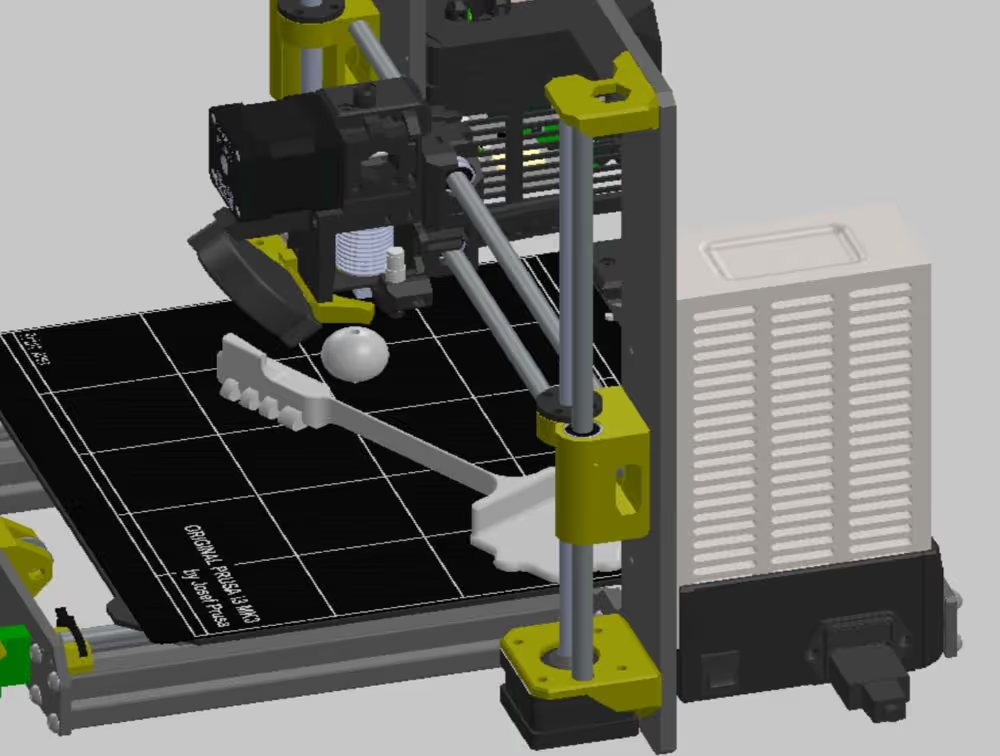
Image courtesy of NASA[/caption][spacer height="50px"]High-speed additive manufacturing is more than a pipe dream. With companies striving to improve printing speeds and processes, it seems like only a matter of time before this becomes a reality.The question remains, which technological advancements will be responsible for ushering in this new age of high-speed additive manufacturing? We may find one answer to this question in NASA’s announcement of fully automated high-throughput additive manufacturing. According to NASA, it “can significantly increase the speed of 3D printing by automating the removal of printed components from the build platform without the need for additional hardware, which increases printing throughput.”As well as increased throughput speed, NASA also claims that technology could be used for other use cases such as, “quality control, machine calibration, material origins, and counterfeit detection.”Similarly, in 2022, researchers at the Technical University of Denmark developed “a new 3D printer [which] combines the principles of a CT scanner with light modelling of materials to produce objects with unique property combinations in record time.”Put simply, the technology works like a “reverse scanner”, where traditional methods of additive manufacturing involve printing objects layer by layer, this method would involve printing all points simultaneously. According to Innovation Origins, “Since the new 3D printer uses an inverted CT image as a template and simply changes the polymeric material with light rays instead of printing point by point, objects can be produced almost instantly."As leader of the multi-departmental team, Assistant Professor Yi Yang at DTU Chemistry points out that this technology paves the way for applications such as the printing of artificial organs such as hearts. As he puts it, “The degree of detail and flexibility in our 3D printing will hopefully be so extensive that the technique can be used to produce fully vascularized constructs using biopolymers as ‘ink.’ This technology might be able to replicate the softness and unique build-up of blood vessels, capillaries, and muscles. There is a long way to go, but hopefully, the printer can bring us closer to the goal.”
Final Thoughts
[spacer height="50px"][caption id="attachment_41890" align="alignnone" width="1000"]

Image courtesy of 3D Natives[/caption][spacer height="50px"]Additive Manufacturing is a major player in advanced manufacturing technologies. From construction to medicine, automotive and defence, there are no shortages of industries that can be revolutionized by additive manufacturing. Nevertheless, the comparatively slow manufacturing time compared to other processes may hamper the scalability of the technology.The need to address and ramp up printing times led to major breakthroughs for companies such as Carbon, Nexa3D and HP, allowing companies to make the most of rapid prototyping. Moreover, there have been innovative developments such as NASA’s Fully Automated High-Throughput Additive Manufacturing, DTU’s Tomographic Vat Photopolymerization (TVP) or Liquid Metal Printing. Each of these technologies promises to be a game-changer when they move from the lab into the industry.Now, production lead times for additive manufacturing are impressive when they can cut lead times from days to hours. Will we get to a point in the future when we can slash these hours to minutes, or even seconds?


.avif)
.svg)