Trump's Tariffs: What Do They Mean for Additive Manufacturing?



It’s been a whirlwind start to Trump 2.0.
The tariffs announced by Donald Trump have truly roiled the North American economy, with the US slapping a hefty blanket 10% on China and 25% for Mexico and Canada (although this has been paused for 30 days). The three countries comprise the US’ biggest trading partners, with the trio supplying around 30% of imports.
The wielding of tariffs as a punitive measure is rooted in Trump’s America First trade policy, which plans to 'tax China to build up America’, employing a ‘pro-America system of universal baseline tariffs on most foreign products’.
The reasons the White House have cited as justification have been numerous, but among them has been the desire to transform the US into a ‘manufacturing powerhouse like the world has never seen before’.
In this article, we consider the positives and negatives for AM in light of the tariffs, and offer advice on how the US government and AM companies can build on an existing relationship to reap great benefits.
Positives for AM industry

1. Reshoring of defence
An America-first policy portends major wins for AM in aerospace and defence. In an interview with Forbes, Glynn Fletcher, CEO of EOS North America, asserted how the second Trump presidency could bring the most sensitive type of manufacturing back to the US.
Geopolitical tensions between Trump and China will necessitate reshoring technology and manufacturing for defence to the US or its allies in the interest of both jobs and national security (although given initial squabbles with Canada and Mexico, it’s clear how this may be problematic).
Furthermore, the aerospace market looks bullish. Elon Musk’s proximity to the Trump administration through his role in the Department of Government Efficiency is a positive signal for AM; Musk has been a continued supporter of 3D printing, to the extent that Velo3D machines have been implemented at SpaceX.
The White House is prioritising military superiority and commercial market leadership; AM is poised to achieve these goals.
2. AM can address supply chain issues
Although there are currently few end-use parts that have been additively manufactured, there is potential for the technology to replace the overseas supply chain in mold tooling, spare parts, and low-mid volume production needed for aerospace and medical applications. The Department of Defence has already recognised the paramount importance for supply chain resilience and on-demand lean manufacturing that AM shoulders.
A move towards onshoring plays into distributed manufacturing, the cornerstone of AM. Just-In-Time (JIT) manufacturing can truly be employed, decreasing the risk of supply chain collapse.Under Trump 2.0, we could see a move toward a surge in American-based micro-factories fabricating products for use in the US, and a cutback in imports from inordinately vast factories overseas.
3. Levels the playing field with China
China is an ever-growing powerhouse in the AM global market. They are set to reach $8 billion in 3D printer sales by 2032, and continued engagement with Chinese OEMs by American companies ensure that much of the extended supply chain lies in China. Bambu Lab have asserted themselves as giants in the personal-use market.
In an open letter to the Trump White House, 3DPrint.com identified the solar panel manufacturing industry as a case study of the US hesitating and losing out to China, and urged the President to heed the lessons learnt. China has (and is) moving aggressively in the AM market, with their printers and solutions being broadly applied both domestically and internationally.
Take Adidas. The sportswear giant employs a fleet of 3D printers fabricated by California-based company Carbon to produce midsoles on their 4DFWD running shoe. Although this process could be done on American soil, Adidas look to China. The tariffs may spur American companies to reshore comprehensively, including AM companies.
Negatives for AM industry
1. Filament sourcing worries
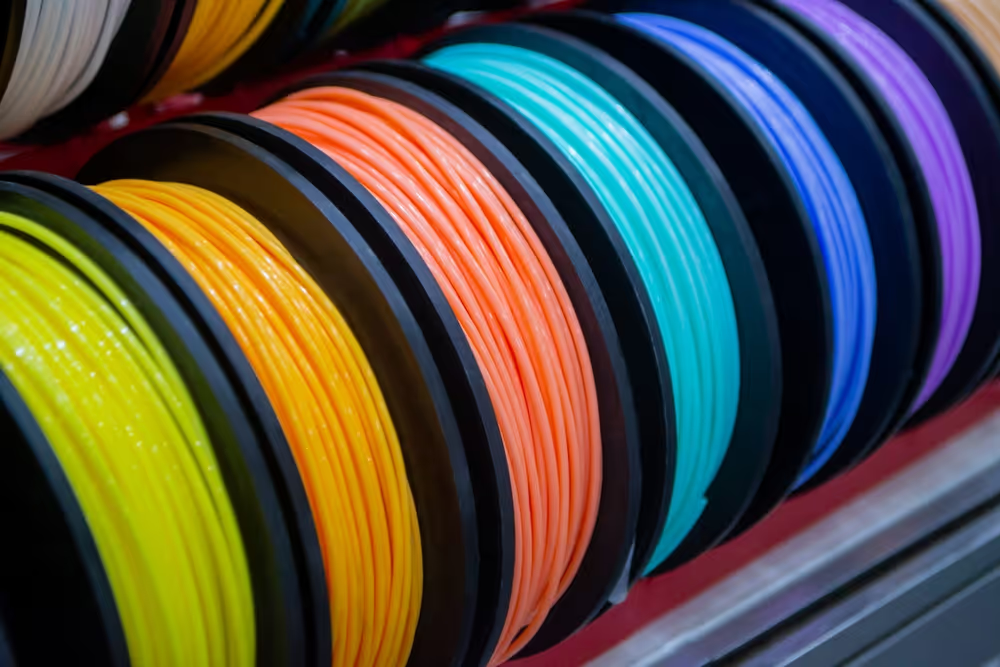
The recent downturn in the additive manufacturing industry (covered in our article looking back at 2024) has been tough. Many European filament operations have shut up shop in the past few years, forcing manufacturers across the world to revisit their sourcing strategies. The tariffs on China, along with Trump’s threats to implement fees for EU imports, is worrying for US manufacturers that depend on filament and material from overseas.
AM is able to skip steps in the traditional supply chain, but the technology itself exists nestled in a supply chain of its own.
Companies will need to secure alternative sources, a trend which manifested in US imports hitting a record high in December 2024 and the trade deficit reaching the highest level since March 2022.
We saw in Trump’s first presidency the negative effect of tariffs on the acquisition of filament, but this can be seen as an opportunity to focus on improving the quality of domestically produced filament.
2. Lack of industrial infrastructure
Although AM has the potential to revolutionise American manufacturing, failure is inevitable without robust industrial infrastructure. Investment must be focused and concentrated if the system is to be overhauled, and, as of today, this just isn’t the case.
In the open letter, 3Dprint.com enumerates 6 ways to ensure development, ranging from proactive investment, to innovative policies and cross-agency planning, to a unified national strategy that includes tax incentives and R&D grants.
Although imports has primarily been the focus of the America First trade policy and this article, the impact on exports from retaliatory tariffs and protectionism at large could have some negative effects on the AM industry.
Even as it stands, some 3D printed parts are manufactured in the US and then shipped to countries with lower labour costs for assembly.
Reshoring can only benefit AM and US manufacturing in general if the entire supply chain is repatriated. Parts are just parts without assembly, and given that there still remains a dearth of 3D printed end-use parts, the new president must take steps to reclaim every step in the supply chain.
3. Values of AM undermined
An emergent industry like AM necessarily relies on a sharing of goods and ideas. In most countries in which there is a developed market for it, there is a hesitancy to adopt, and a protectionist approach limits allies and ideas from which to draw.
There is a sentiment that a step forward for AM in a country is a step forward for AM as a whole, and that more printers and 3D-printed solutions on the market means more sales for everyone.
The America First trade policy may isolate the US from the global additive community, preventing smaller American additive manufacturers from breaking through and hindering adopting both globally and domestically.
How AM can capitalise

Trump’s protectionism affords AM a unique opportunity to capitalise on the challenges that the tariffs have engendered for other industries. Here are three ways of achieving this.
1. Ensure that they’re prepared to fix supply chain issues
Additive OEMs and service bureaus must use this chance to further AM adoption. Digital inventories can encourage production in local markets, reduce costs, and diminish risks to the supply chain, a key aspect in AM’s campaign to gain ground in the face of these tariffs.
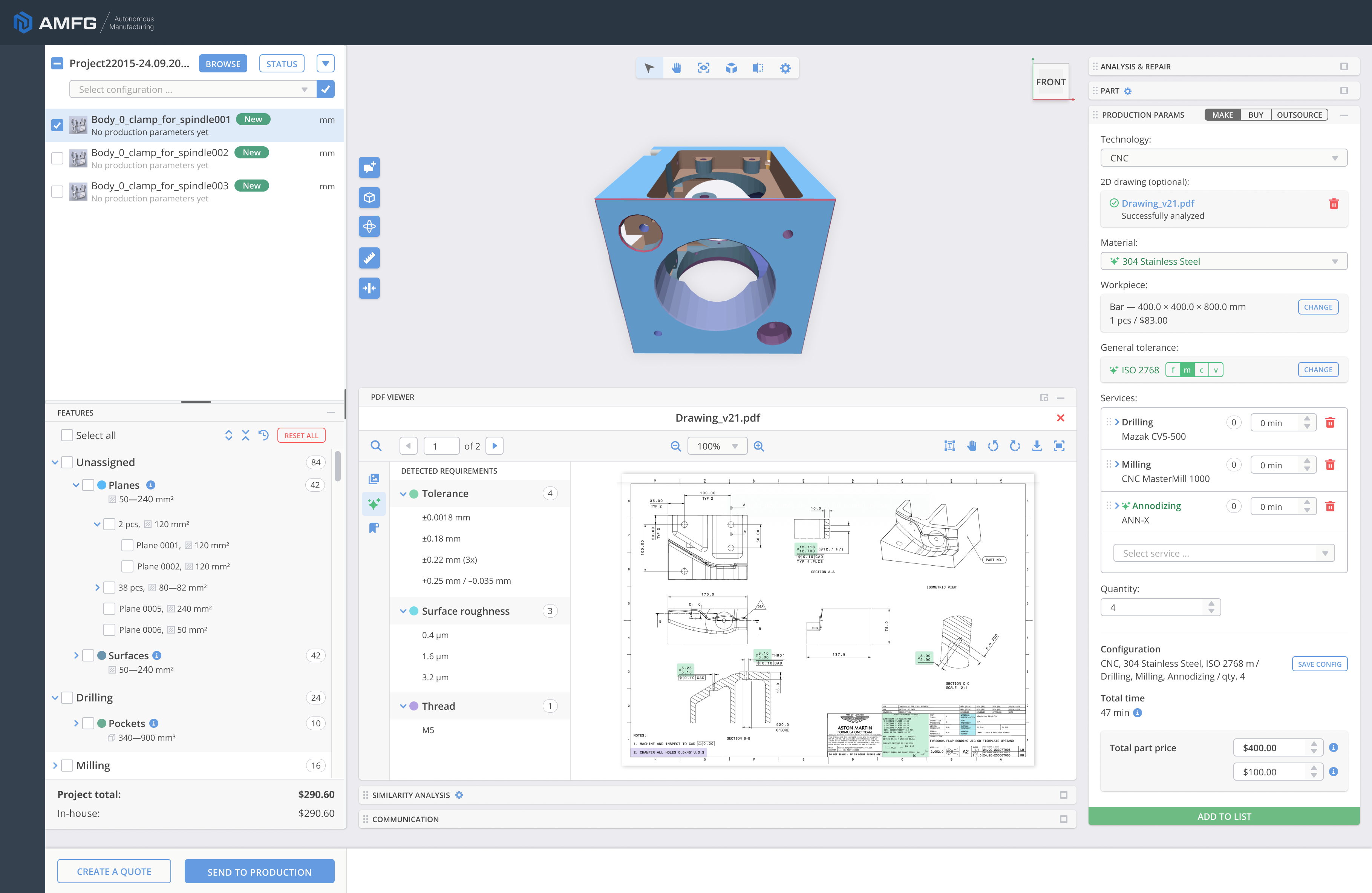
But digital inventories need as much care and attention as physical ones, and manufacturers must be prepared. AMFG allows manufacturers to manage digital inventory, streamline shipping processes, and directly connect with preferred suppliers and subcontractors and enable on-demand, distributed manufacturing- click here to find out more.
2. Government investment
China’s success in AM partly boils down to government investment. It is taken seriously, and this is reflected in policy.
The now permanent R&D tax credit is available for companies developing new products, process, or software, and AM falls into that category snugly. The Government should continue and expand this investment into new technologies, and companies should engage with AM not only for the benefits of the technology and its supply chain capabilities, but also as a financial incentive.
Similarly, there needs to be governmental encouragement that steers companies to truly reshoring operations, and not just relocating to additional countries for the sake of saving costs on labour and increasing efficiency. Trump’s first premiership saw companies looking to Vietnam and Malaysia, neglecting the US workforce in the process, and there are worries that this could repeat with this set of tariffs.
3. Work with companies to provide AM solutions
Companies who export from overseas will be faced with higher production costs, and these costs will have to be balanced somehow. Companies can choose to drive up prices for the consumer and let Americans assume the damage, or they can engage with AM solutions.
Target has already declared an unwillingness to assume price increases from suppliers due to tariffs, instructing partners to develop contingency plans to avoid passing on costs to customers. This plan is perhaps unsustainable, however; why not assist suppliers with 3D printing solutions, circumnavigating the issue entirely?
Increasing reliance on AM technology could bolster domestic manufacturing and offset rising costs, so American companies should seriously consider 3D printing as Trump 2.0 unfolds. Diversifying supply chains through the incorporation of AM and decreasing dependency on international vendors could reap benefits for both AM and the US alike.
Final thoughts
This is an opportunity for AM and should be treated as such. The rationale is quite simple: high tariffs mean products can’t be made overseas and imported with ease; thus facilities and technologies that can be used in the US will have to be prioritised; AM is one of those technologies set to benefit.
The president and his right-hand-man have indicated a willingness to consider increased adoption, and AM companies should be prepared and ready to snap up any investment and business.
Even if companies aren’t ready yet to commit to a 3D based future and implement in-house capabilities, a burgeoning market of 3D contract manufacturers are knocking at the door, ready to supply a manufacturing solution in a post-tariff landscape.
Want to know more about getting your AM company prepared? Click here to find out more: Book a demo


.avif)
.svg)