Vapour Smoothing in 3D Printing: An Introduction
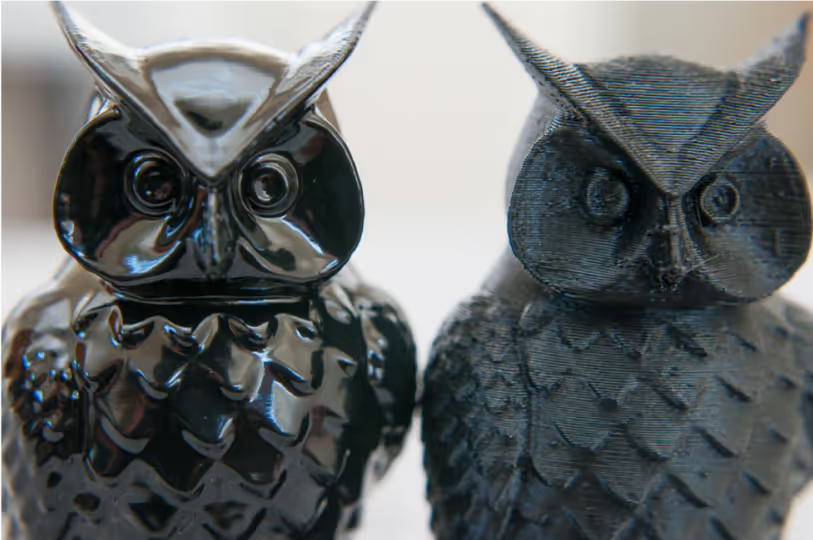


A frequent thorn in the side for 3D prints is a grainy finish, characterised by an appearance reminiscent of a sugar cube and layer lines.
But additive manufacturers should have no cause for alarm, as post-processing techniques like vapour smoothing are changing the game.
Vapour smoothing is capable of transforming the rough surfaces of thermoplastic printed parts into sleek, professional finishes.
The technique uses chemical vapours, which react with the material's surface and cause it to melt and partially dissolve, leaving a smoother, glossier finish with improved uniformity. Unlike subtractive processes, no material is removed, making it a more sustainable (and in some cases, a quicker) finishing process.
How does it work?
The science behind smoothing is quite simple: liquefy the top print layer under the effect of steam and chemicals in order to reorganise the surface molecules and thus improve its structure.
Maintaining control of temperature and pressure is key to achieve the desired outcome, so the process takes place in a hermetically sealed, heated chamber. The 3D printed parts are placed in, hanging, along with a finishing agent. (In some dedicated solutions, the smoothing chambers is already integrated.)
The agent is heated until it creates a vapour surrounding the part, clinging to its surface and creating a controlled chemical melt on the top layer of the part. This liquefies and redistributes material, smoothing out rough areas or pores and enhancing the lustre and shine of the material. The longer and more intensive the chemical treatment, the glossier and smoother the final part.
Finally, the chamber is heated to remove the vapour and finishing agent, drying the part and leaving it of residue. Then manufacturers are free to subject the part to additional dyeing, spray painting, etc.
Vapour smoothing is used across various AM technologies, primarily polymer and elastomer thermoplastics. As parts produced with SLS and MJF typically have a rough surface after printing, this finishing technique is ideal.
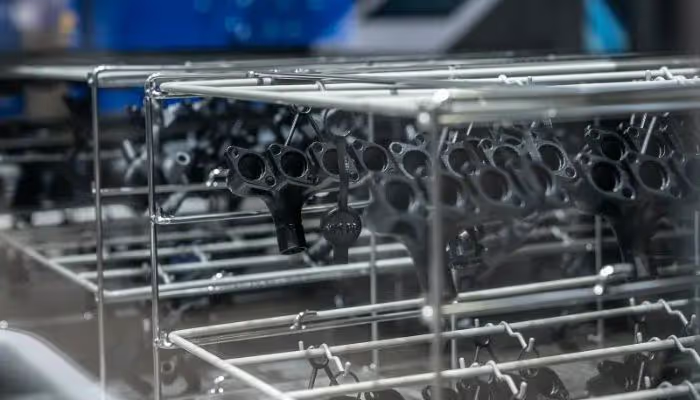
3D-printed parts hang in a chamber during vapour smoothing. Image courtesy of DyeMansion
Advantages of vapour smoothing
Improved surface finish
The main advantage of vapour smoothing is that it enables a surface and aesthetic quality rivalling those of injection-moulded parts.
Whereas standard SLS parts typically have a surface roughness greater than 8 μm Ra, parts finished with vapour smoothing boasting a surface finish below the 3 μm Ra threshold.
Vapour smoothing achieves this whilst maintaining dimensional accuracy, too. Traditional machining and sanding processes run the risk of deforming or modifying the part’s dimensions, but vapour smoothing is non-abrasive and retains the part’s original shape.
Enhanced performance
Surface roughness is nothing to be scoffed at– it can directly affect a part’s tensile strength, elongation at break, and flexural performance.
A part finished with vapour smoothing is more durable, and the risk of part degradation and premature failure.
Moisture resistance
The melting and resealing of the top layer makes parts water-repellent and resistant to chemicals; this is essential for watertight or liquid-conductive materials.
Even for other parts, sealing the surface prevents moisture absorption, protecting the part’s mechanical properties– particularly its durability.
Non-line-of-sight features
Vapour smoothing is able to reach deep recesses and internal cavities that cannot be accessed by traditional polishing or sanding methods. As a result, even parts with complex geometries can still have a uniform, high-quality surface finish.
Consequently, bacteria growth and moisture absorption is prevented- Formlabs and AMT found a 60% reduction in MRSA bacteria growth.
The easy cleaning of components and hygiene is facilitated, freeing up vapour-smoothed, meaning these parts can be used in a broad array of applications.
Cost and flexibility
Vapour smoothing delivers fast, inexpensive results when compared with other finishing methods. It is compatible with a wide range of thermoplastics, making it a jack of many trades– smoothed parts could be used in the same areas as injection-moulded parts, as both prototypes and final production parts.
Which industries use vapour smoothing?

Vapour smoothed coloured SLS and MJF parts. Image courtesy of Xometry
As AMFG has explored in previous articles, additive manufacturing is experiencing a boom in demand for applications across various verticals. While this represents a fantastic opportunity for 3D printing, manufacturers must ensure that parts have a high-quality surface finish, for both mechanical and aesthetic purposes.
Parts that have undergone vapour smoothing benefit from greater hygiene as they’re less conducive to bacterial accumulation, making them perfect for medical, dental, and even food applications– for example, the process increases resistance to sweat and general comfort.
Wearable technology is a market on the rise, and it requires lightweight, durable, and comfortable components– vapour smoothing 3D prints can provide high-quality aesthetics and wearability. For example, eyewear frames can be more comfortable for the wearer with this finishing technique.
Similarly, the process is used widely in automotive and aerospace; industries in which parts must be as smooth and perfect as possible for optimal function and aesthetics. Components such as valve covers and oil sumps must be leak-proof and corrosion-resistant, and a smooth surface can improve aesthetics and functionality alike.
Design applications work well with vapour smoothing as well– the process produces sleek, homogeneous surfaces with a glossy finish, leading to impressive visual parts.
Finishing up
Vapour smoothing is a reliable, cost-effective way of achieving sleek, professional-grade finishes for printed parts, and the tech is being employed by an ever-growing list of additive manufacturers across industries.
AMFG supports companies within verticals including O&P, automotive and aerospace, and consumer goods. We are a SaaS platform tailored for companies producing complex, high-value, low-volume products.
Our MES reimagines manufacturing operations– from configurable order intake to supporting multi-tech production, AMFG empowers organizations to orchestrate sophisticated manufacturing processes with flexibility and precision.
Interested? Find out more by booking a demo: Book a demo


.avif)
.svg)