Why We Need More Women in Manufacturing


By Ella Shaw
The first image that comes to mind when we talk about women in manufacturing tends to be of Rosie the Riveter. With the defiant look on her face, jacked bicep and headscarf, Rosie is one of the enduring images of WWII.
80 years later, you would expect that the role of women in manufacturing would be transformed. Unfortunately, a look at the female manufacturing workforce tells a different story.
Despite making up roughly 50% of the workforce, women only make up 29% of the manufacturing workforce. Across the pond in the UK, the picture is even more dismal with a report released by the Women in Manufacturing Initiative finding that women only make up 26.1% of the manufacturing workforce.
The past 80 years have seen major strides for women in the workplace but when it comes to manufacturing, there’s still a long way to go. Here, we explore what’s behind this underrepresentation and how employers can address it.
Moreover, despite these challenges, some of the fiercest champions of CNC are women. We look at how an innovative use of manufacturing and social media reveals what we can expect from the next generation of machining enthusiasts.
“Marching in Place”

Image courtesy of Britannica Encylopedia
A quick overview of women’s involvement in manufacturing might be summarised thus: compared to men in manufacturing there are fewer women, with less powerful positions getting paid less.
While these challenges are pretty clear, it’s a complex issue that starts in the classroom. Researchers point to explanatory factors such as stereotypes about science being viewed as a “masculine” subject or girls’ underperformance in maths which can be a barrier to entry for studying other STEM subjects. While there is no one obvious reason for girls’ lack of STEM representation, this issue has a ripple effect on higher education outcomes with women only accounting for 35% of STEM graduates.
For those who do pursue a career in STEM and more specifically manufacturing, workplace challenges prevent women from achieving the same career growth and salaries as men. One such challenge is the nature of manufacturing work demanding a predominantly on-site attendance as we explored in a recent AMFG article. A lack of flexible work options disproportionately affects women who take on the lion’s share of caring responsibilities in the family including childcare or looking after ageing relatives.
In July 2023, The Manufacturing Alliance released the report In Her Own Words: Breaking the Glass Ceiling Is Good for Business which outlines gender inequality in manufacturing. Here the issue of work is outlined by one woman manufacturer who comments, “There was a woman on my team that left after she came back from maternity leave because we wanted her to be in office full time. With the cost of daycare, it was not financially feasible for her to be in the office full time, and because we didn’t offer that flexibility, like a hybrid model, she left.”
Women may not leave but instead take on part-time work which only serves to widen the gap between men’s and women’s earnings as the Women in Manufacturing Initiative points outhttps://engage.ifm.eng.cam.ac.uk/wp-content/uploads/Women-in-Manufacturing-report-2024.pdf. “In December 2023, 26.2% of women in manufacturing worked part-time, compared to only 6% of men.”
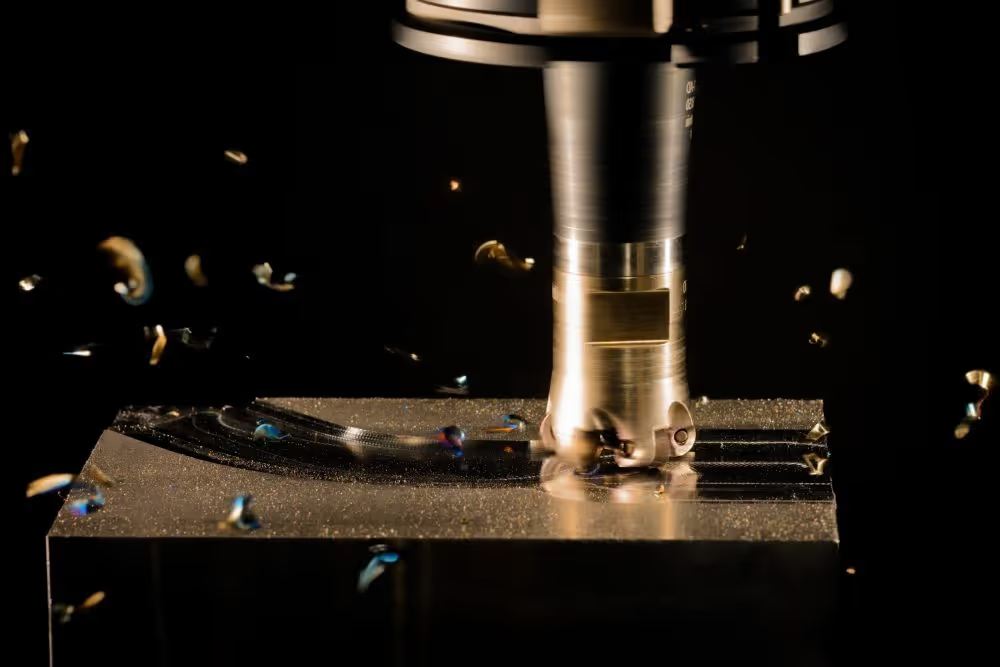
Image courtesy of The Job Shop Show
As family responsibilities take over, women’s careers in manufacturing are paused creating fewer opportunities for career progression. Unsurprisingly, this creates a “leaky” pipeline and it becomes even more difficult for women to reach the top of the career ladder in manufacturing.
For the few women in the industry who can excel in their education and minimise disruption to their career progression, the challenges remain. They may face other challenges which rely on complicated social interactions which are more difficult to measure than grades or salary brackets.
The Manufacturers Alliance Foundation highlights 8 ways in which women might be disadvantaged. Aside from lack of workplace flexibility and family leave, these factors include competency bias, being “The Only”, being heard, discrimination and challenges related to recruitment.
In a nutshell, respondents to the report’s survey identify that they feel as though their skills are more likely to be called into question. Moreover, they must battle with outdated ideas in the workplace. Solving these issues relies on addressing existing perceptions and stereotypes. As the Glass Ceiling report outlines women face common experiences of discrimination which range from subtle to downright antagonistic. This can be anything from being the only woman in a male-dominated team all the way to being told that it would be difficult to advance in the company because colleagues would expect her to leave and have children.
An Outcome that Benefits Everyone

Image courtesy of the Manufacturing Alliance
Of course, if we want to live in a society where everyone has the opportunity to do the job that they’re passionate about then it’s important that we encourage more women to join manufacturing.
However, there may be those who wonder that if the prospect of careers in manufacturing isn’t that interesting to women then why force the issue?
The truth is that the industry stands to benefit massively from the participation of women. Manufacturing is an industry that’s defined by innovation as we see with the introduction of AI-powered solutions or machining centres achieving increasingly higher levels of precision engineering. Gender diversity in the industry is key for driving that innovation. According to surveys by McKinsey and BCG gender diverse teams achieve 25% more profitability than the average and benefit from a 38% increase in innovation revenue.
Moreover, there’s evidence to suggest that including more women in high-level positions has a positive impact on workplace flexibility with studies showing that the more women are on a board of directors the more likely it is that that company will offer flexible work options.
Finally, it wouldn’t be an article about the manufacturing labour force if we didn’t mention the ongoing skills shortage facing the industry. At AMFG we’re excited by the possibilities of automation technologies to streamline operations and improve efficiency. However, with 4,000,000 jobs to fill, it’s vital to attract as many people as possible to these roles.
To put it plainly, encouraging women to join manufacturing benefits everyone in concrete ways beyond quotas and box ticking. Let’s face it, what are the good reasons against it?
What Can Be Done?
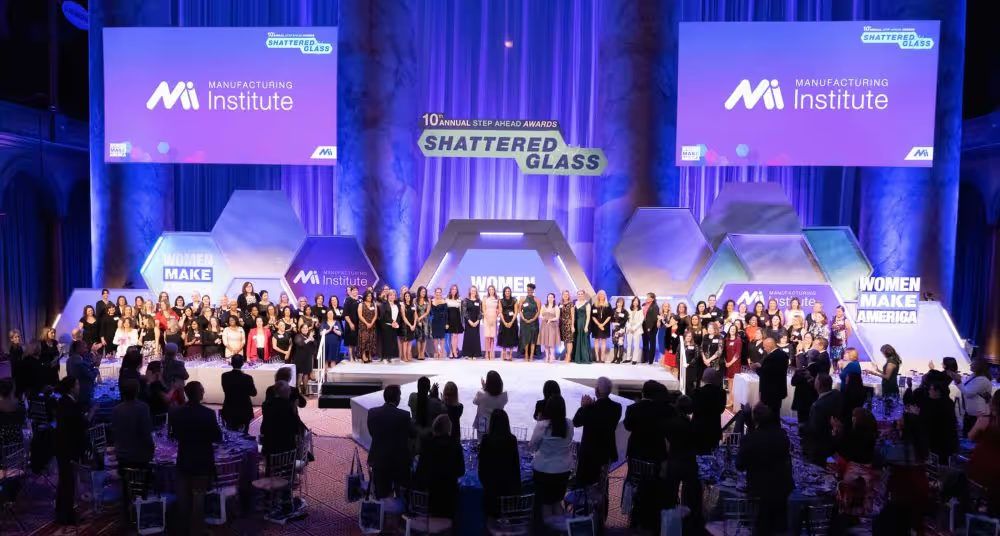
Image courtesy of the Manufacturing Institute
As the Women In Manufacturing Initiative highlights in their report, it’s crucial to encourage women’s participation in the manufacturing workforce in a way that fosters collaboration trust and respect across the workforce.
Nevertheless, as we highlighted previously in the article, it’s easier to remove some barriers of entry to women working in the workplace than others. For example, companies can introduce more flexibility options than hybrid with some employers offering solutions such as shift-splitting or “dynamic working” patterns.
Changing the workplace culture may be more difficult to measure and address but it is possible. There are a multitude of methods to foster a more welcoming workplace for women from using inclusive language in job advertisements, training, and mentorship opportunities or outreach programmes.
The sky is the limit when it comes to adopting these measures.
Meeting the Women of Machining

Image courtesy of Hallie Haupt via LinkedIn
Of all the initiatives that help to encourage women’s participation in the workplace, having a female role model is one that has the biggest impact. Experts consistently point out that having a role model encourages and empowers women to see the opportunities offered by manufacturing. In our article on the top manufacturing awards, we discussed the Women Make Awards which are designed to celebrate the hard work of women in the manufacturing industry.
As well as these talented women, the industry has also seen the growth of a new kind of manufacturing championing: the machining influencer. For those as glued to LinkedIn as I am might have seen them. As well as being knowledgeable and passionate about the industry, these women offer a fresh and glamorous face to CNC.
One example of these women is Rebecca Wolfinger who is something of a modern-day Rosie the Riveter herself. Rebecca runs the North Carolina job shop Mil-Spec Manufacturing with her veteran husband Kurtis Wolfinger. Frustrated by the rigid mindset and lack of veteran support available in other job shops, the Wolfingers set up their own business with a budget of just $40,000. After capturing the attention of Practical Machinist, Rebecca now has a highly successful video series on the site.
Similarly, when you think of Titans of CNC, the first thing that comes to mind might be the bombast of Titan Gilroy and the ALL-CAPS video titles of mega machining projects. However, one ace member of the team is Kylie Granno, Head of Strategic Partnerships and Division 1 Soccer Player.
These women are not alone, there is a community of online female machinists like Hallie Haupt who is the Director of Marketing for job shop IQ Manufacturing as well as the creative Lead for Skill Sister Apparel a clothing line designed to celebrate women in skilled trades. For any of my loved ones who might be reading, I’m particularly partial to the Hard Hats and High Heels shirt.
Finally, while all of these women are impressive, Shae Eichele single handedly kept me informed about the goings on at IMTS 2024. As the marketing coordinator for the HEH group and host of the Manufacturing Muscle podcast, Shae keeps her followers up to date with the latest in manufacturing news.
These women are only a handful of this new generation of manufacturing champions. They manage a dual role, both making more people aware of manufacturing while challenging the stereotypes of a traditional, old-fashioned industry where women struggle to see themselves thriving.
Final Thoughts
While Rosie the Riveter remains an iconic image of women in manufacturing, the progress since her time has been uneven. Women today still face significant barriers to fully participating and advancing in the manufacturing industry, from workplace biases and lack of flexibility to enduring gender stereotypes that affect recruitment and retention. Yet, despite these challenges, there is a growing cohort of women making waves in machining, using their expertise and visibility to inspire others and reshape the narrative.
By addressing systemic issues—like providing more flexible work options, tackling unconscious bias, and promoting STEM education for young women—the industry can not only attract more women but also benefit from the innovation and profitability that gender diversity brings. As the sector faces critical skills shortages, empowering women to step into manufacturing roles isn’t just about fairness, it's a strategic imperative for the future of the industry. By recognizing and supporting these trailblazing women, we can take concrete steps toward a more inclusive and prosperous future for manufacturing.

.avif)
.svg)