The Buyer's Guide to Machine Shop Quoting & Estimating Software


A Breakdown of Estimating & Quoting Software for Manufacturing
Just as there are many ways to estimate for custom part manufacturing, estimating software takes various approaches to calculate times and costs as well. There are four main estimation methods that quoting software for machine shops calculate, ranging from basically manual costing using ERPs, rule/feature based costing, geometry/process based estimation and AI assisted estimations.
Understanding how different machine shop costing software calculates will help with choosing a software that is ideal for your job shop’s processes.
Across AMFG, ERP (JobBOSS², Fulcrum, Proshop), Spanflug, Imnoo, Paperless Parts and Uptool, they each have a different approach to quoting.
How are Quotes Calculated?
Fundamentally, most quotes include the following components:
Quote Price = Setup Time + Programming Time + Run Time + Material + Secondary Finishes + Markup
How do the Different Software Calculate Quotes?
AMFG: Geometry Based Calculations Paired with AI
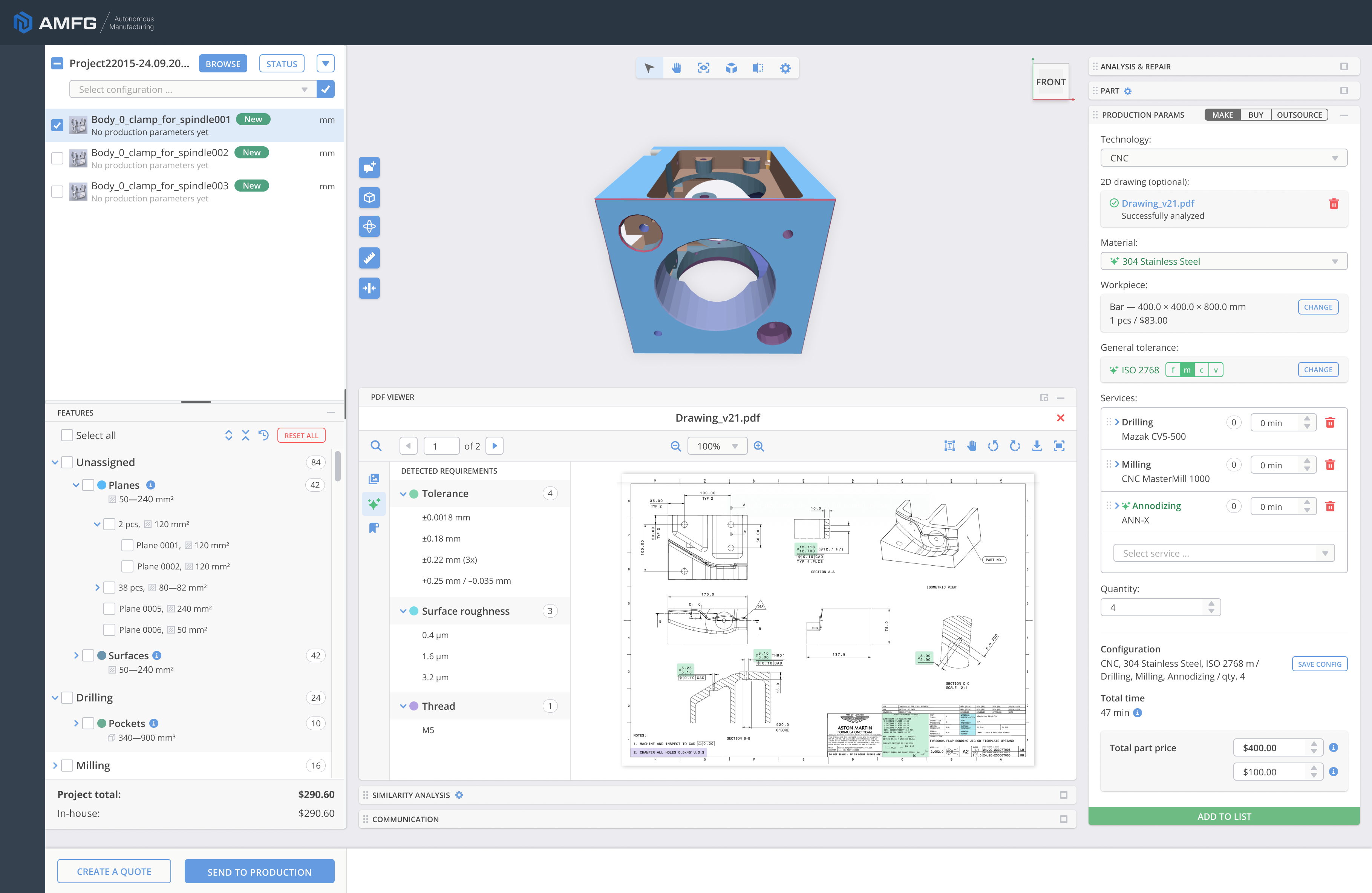
AMFG calculates fast, accurate cost estimates using its Geometric Estimating Engine, an automated calculation method that analyzes 3D CAD models’ features to model toolpaths, feeds, speeds and material removal rates similar to a CAM programmer’s workflow. To process complex CAD geometry, the system unifies data from both 2D drawings and 3D models. Sentinel AI automatically extracts key specifications, requirements, and GD&T callouts from the 2D PDF, then maps those tolerances and surface finishes directly onto the corresponding features of the 3D CAD model. Built by machinists for machinists, AMFG delivers up to 90% accurate quotes in under 90 seconds when calibrated to shop specific tooling and machine data.
Estimates are calculated by:
- AMFG reads 3D models, supporting STEP, STP, STL, .prt, .X_T, and SLDPRT to analyze 3D geometry to identify machinable features, dimensions and directions. (holes, pockets, slots, faces, etc.)
- Sentinel AI extracts tolerances, surface finish and GD&T from 2D drawings.
- Based on the machines your shop or business has, AMFG autoselects tools.
- Calculates cycle, set up and programming time from feature geometry, cutting paths, speeds and feeds assumptions based on material and tooling.
- Apply shop-specific rates and markups. AMFG’s costing logic is customized to match each shop’s requirements.
- A customer ready quote is generated.
AMFG is the best fit for you if you are looking for a quoting software for machine shops that are:
- Focused on high mix, low volume parts.
- Seeking exceptional accuracy as AMFG’s quotes are based on geometric algorithms.
- Looking for speed and reliability, achieved through calculation visibility.
- Seeking to increase traceability with a breakdown of how they got to the cost.
- Working through messy RFQs and email chaos.
- Requiring flexible software that adapts to your processes.
- Able to handle both 3D printing and CNC machining for quoting
However, AMFG may not be the best fit for those who seeking Estimating & Quoting software for:
- High volume parts with low complexity.
- Primarily focused on the ERP as the core system.
ERP Based, Manual Estimates (JobBOSS, Fulcrum, Proshop)
ERPs are glorified spreadsheets that can be used for estimating capabilities. Rather than an autonomous CAD processing software, it requires estimators to enter part numbers and pricing into a system to create a quote through the ERP. Their system helps shops respond faster with consistent, rate based estimates that can be used repeatedly, only accounting for known costs to build a starting point for the quote.
These quotes are defined by repeated operations which can include things like:
- Material purchasing or stock allocation
- Machining operations
- Set up time
- Run or cycle
These costs then need to incorporate estimates for time, such as cycle and set up time. ERPs are used to add up the costs for numbers that are already defined, but would require an estimator or CAM programmer to step in to determine the machining strategy and calculate the routing and cycle time.
ERPs are a strong fit for machine shops that:
- Makes repeated parts or has a standardized family of parts
- Has a standardized production process
- High volume shops that produce the same part repeatedly
ERPs may not be the best fit for machine shops that are:
- Mainly struggling with quoting
- High mix low volume shops
- Does not have standardized production processes or rates
Paperless Parts: Volumetric Based Calculation
Paperless Parts takes a volumetric approach that bases their quotes. It identifies how much metal needs to be cut away and multiplies it by a preset volume removal rate that is defined during onboarding. They consider geometries based on feature extraction from 3D models or PDFs such as set up count, holes and other features which will be used to calculate how much volume needs to be cut away.
They add in the secondary finishes, inspection and other costs like mark ups to produce a customer facing quote. However, Paperless Parts heavily leverages volumetric removal rates to calculate estimates, which makes it beneficial for sheet metal and general machining processes but it may face difficulty estimating complex toolpaths.
Paperless Parts would be a strong fit if you are seeking:
- To estimate and quote sheet metals
- Extract relevant specifications for the shop’s costing and pricing logic
- Visibility into the cost drivers and requirements
Paperless Parts may not be the best fit when you are seeking:
- Estimates that would align or support the CAM programmer
- Want visibility into how the estimate was calculated
- Estimating & Quoting software that can handle calculations for complex parts
- A solution for a small machine shop or business with lower historical RFQ sample volumes
- Would like the estimates to consider tools / machines used
Spanflug: Geometry Based Calculations
Spanflug is an estimating and quoting software focusing on CNC milling and turning that bases their calculations on geometry and uses parsing to map out the specifications to a feature. They take CAD models and 2D drawings to calculate machine time and costs and add additional costs like materials, secondary finishes and margin markups. Their strengths lie in automated, instant pricing for standardized milling and turning operations.
Spanflug is best suited for machine shops that are:
- Looking for an instant price generation software focused on standardized parts
- Specific to CNC milling and turning
An alternative should be considered if:
- They have hybrid processes
- Seeks to expand into shop floor tracking
Imnoo: AI Based Quoting
Imnoo is a data driven AI software that requires a high number of historical quotes to train an AI model that learns your shop’s specific capabilities. It identifies features and cost drivers like tight tolerances, holes and threads when you upload 2D PDFs or 3D CAD files. Based on the geometric analysis, it references your past quotes to generate runtimes based on how the machine behaved historically.
Imnoo would be best for machine shops that are:
- Working with high volume parts with minimal customization
- Seeking accuracy based on how your shop’s machines behaved historically
An alternative would be better when:
- The shop does not have a lot of historical quotes that can be used to train the AI
- The jobs are highly custom which cannot be calculated based on past estimates
Uptool: AI Assisted Workflow
Uptool is a BOM and document scraping AI tool that automates gathering information from RFQ files and then creates a quote based on workflows they pull from databases and a library of calculators built for fab shops. This is particularly useful for machine shops that are struggling with the hassle of information overload and pulling out relevant specifications from messy RFQs and email chains. While their sheet metal workflow is almost fully automated, for precision machining, Uptool requires a hands on approach requiring cycle time estimations.
Uptool would be the best fit when:
- The admin in your quoting process is the biggest bottleneck
- You receive complex RFQs with multiple files
- Seeking for Estimating & Quoting software for sheet metal and laser cutting
An alternative may be better if:
- You are seeking a turn key, fully automated solution with minimal input
- Seeking a software more catered to complex parts
- Requires a highly accurate estimate with complex parts and tight tolerances
What should I Consider when Selecting an Estimating & Quoting Software?
If your shop already has strong standard routings and wants tight integration with job costing, an ERP-style system like JobBOSS² may be the best fit. If you want instant, geometry-based quotes for high-volume RFQs, a configurable engine like DigiFabster or Paperless Parts may be more appropriate. If your main problem is handling complex RFQ packages and reducing administrative time, an AI-assisted workflow tool like Uptool could deliver the most immediate benefit. If you want a geometry-first, strategy-based estimate that mirrors CAM thinking, AMFG’s approach is the closest to that ideal.
The right choice depends less on which system is “most advanced” and more on which approach aligns with how your shop actually thinks about cost, capacity and risk.
FAQ
1. What are the essential cost components included in a custom manufacturing quote?
Manufacturing quotes calculate total job price adding direct and indirect operational costs. The formula includes setup time, programming time, run time, material, secondary finishes and markups to create the final customer-facing quote.
2. How do geometry-based and volumetric estimating methods differ for machine shops?
Geometry-based software (e.g., AMFG) mimics CAM programming by analyzing 3D CAD models feature-by-feature to model precise toolpaths, feeds, speeds, and surface finishes. Conversely, volumetric software (e.g., Paperless Parts) multiplies total material volume to be removed by a preset removal rate. While volumetric estimation works rapidly for sheet metal, geometry-based calculation provides superior accuracy for complex parts with intricate curves and tight tolerances.
3. Why might a machine shop choose ERP-based estimating over automated CAD processing software?
ERP-based estimating (e.g., JobBOSS², ProShop) relies on standardized rate tables and historical production data manually entered by estimators rather than autonomous CAD analysis. Machine shops choose ERPs when producing high-volume, repeat parts or family components with proven, standardized routings. ERPs excel at integrating quoting directly with job costing, inventory, and shop-floor management, though they require manual input for custom cycle time calculations.
4. How do AI-driven quoting tools like Imnoo and Uptool streamline manufacturing estimates?
AI-driven quoting software automates data extraction and historical modeling to reduce administrative bottlenecks. Tools like Imnoo analyze part geometry against thousands of past quotes to predict runtimes based on actual historical machine performance. Workflow AI tools like Uptool scrape data from complex RFQ documents, emails, and bill of materials (BOMs), automatically populating specification calculators to accelerate quote generation for fab shops.
5. How should a job shop select the best estimating and quoting software for its operations?
Machine shops should select estimating software based on part complexity, volume, and operational bottlenecks. High-mix, low-volume shops with complex geometry benefit most from geometry-first engines like AMFG. High-volume repeat manufacturers should utilize ERP-centric costing or Imnoo. Shops focusing on sheet metal operations thrive using volumetric solutions like Paperless Parts.


.svg)