5 Ways 3D Printing is Being Used in Formula One in 2025
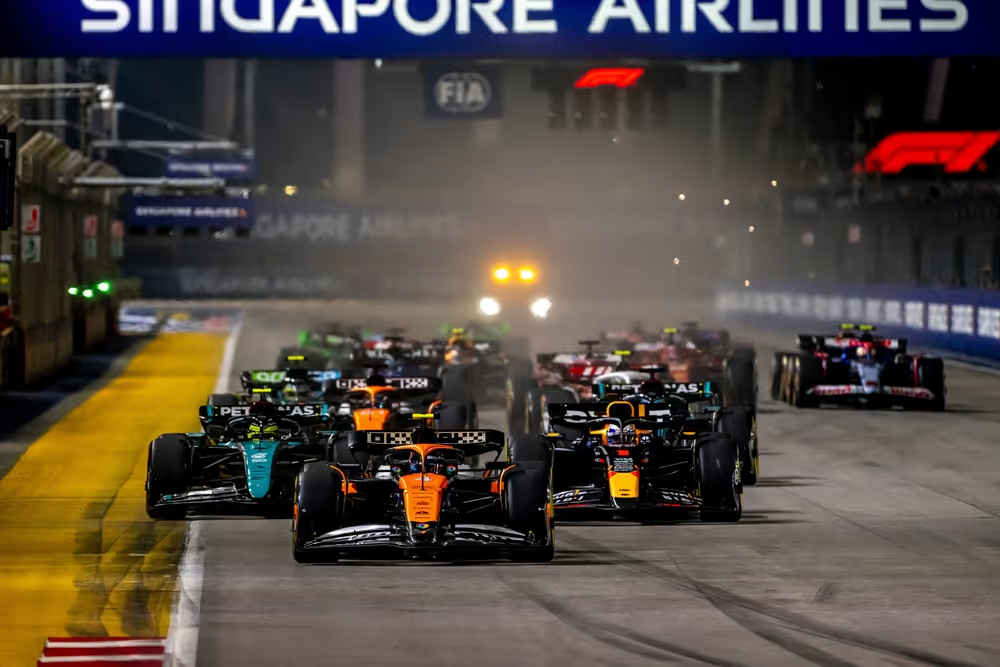


In a dynamic environment like Formula One, speed is key – both on and off the track. Since the difference between a win or loss could be a margin of mere seconds, perfecting the engineering of a racecar is a key imperative of any Formula One team.
But responding quickly to a world of ever-changing regulations whilst maintaining a competitive advantage requires a culture of innovation. F1 design and engineering teams must be able to develop new designs to improve car performance.
So where does 3D printing fit in?
Ideal for producing fast iterations and complex engineering solutions, AM technologies are a significant asset for designers and engineers looking to accelerate the product development cycle.
Today, AMFG examines 5 uses of AM in F1; from wind tunnels to wings, brake ducts to digital twins. Read on to discover how 3D printing’s ability to optimise design, minimise weight, and reduce lead times is being implemented across F1’s top constructors.
Ford and Red Bull's metal and polymer parts
F1 is all about super speed, so why not borrow from aerospace to achieve this?
Ford’s motorsport team has 3D printed more than 1000 parts in preparation for its F1 debut with Red Bull in 2026, using methods from the aerospace industry. As Top Gear describes, components including cold plates for batteries and cooling plates for other parts were printed and then put through X-ray and CT scanners by the Non-Destructive Evaluation (NDE) team.
F1 demands a lot of the parts it uses, so in order to ensure components have the required toughness, they are 3D scanned for mechanical strength, hardness, and geometric compliance. They are then scanned by the NDE team, sent to metrology to be tested for accuracy and precision, before they are finally sent to Red Bull F1.
Ford Performance Motorsports opted for additive manufacturing as the parts needed for F1 are complex metal and polymer parts that get tested to withstand 200 mph races.
McLaren and Stratasys' wings
[caption id="attachment_44794" align="alignnone" width="500"]

Composite layup tool for a McLaren MCL32 rear wing flap, produced on a Stratasys Fortus 900mc 3D Printer using ULTEM 1010 material.[/caption]
Design optimisation is not the only reason why F1 parts are 3D printed.
Production times rest on a knife edge, and budget restrictions require an innovative approach to designing and manufacturing, and AM provides this. McLaren Racing uses 20 Stratasys stereolithography printers to produce over 9000 parts a year across numerous front and rear wing programs, as well as large parts of the side bodywork and top-body.
Production time has been dramatically reduced, with certain large parts like scale model top-bodies being produced in as little as three days.
A few years ago, McLaren upgraded its rear-wing flap, using a 3D printed lay-up tool to mold the carbon-reinforced composites. The high temperature composite structure increased rear-wing downforce and helped the car shed a few tenths per lap.
McLaren also uses 3D printing for prototyping, but recently the technology has emerged as a legitimate method of production for the high-speed, high-demand environment of F1.
Red Bull and Hexagon's twin technology
For over 18 years, Oracle Red Bull Racing has partnered with Hexagon Manufacturing Intelligence to test and adopt innovative technologies while ensuring safety and reliability and gaining fractions of seconds on the racetrack.
Red Bull Racing uses digital twins and simulations to virtually design and test their cars before creating physical prototypes, a set-up that has enabled the racing team to climb to the top of the world’s most technologically advanced and complex sport.
With new sporting regulations requiring the complete redesigning of cars coming into effect in 2026, this partnership is more crucial than ever to support more “agile, competitive, safer, and more sustainable racing”.
Roboze and RB's brake cooling ducts
[caption id="attachment_44796" align="alignnone" width="600"]

3D printed brake cooling duct. Image courtesy of Roboze, VCARB team[/caption]
AM is the perfect technology for improving on the performance of existing parts, and the collaboration between Roboze and Visa Cash App RB (VCARB) F1 team is the perfect example of this.
Leveraging Carbon PEEK materials and Argo 500 Hyperspeed AM system, the VCARB system significantly reduces production costs and lead times for its brake cooling ducts, which brings in air to cool F1 car brakes and improve aerodynamic performance.
Traditional production of brake ducts made for long wait times and high costs, implying an astronomical amount of time and resources, as molds had to be sourced, produced individually, and then assembled. PEEK offers a cost-friendly, high-quality material that maintains performance reliability even under extreme conditions.
In March of this year, VCARB renewed their relationship with Roboze for 3 more years, aiming to create more parts capable of withstanding extreme conditions without compromising performance and lightweight properties.
Alpine and 3D System's wind tunnel
The story of 3D Systems and Alpine is one that traces the history of 3D printing.
The racing team was an early adopter of the tech, having used it since 1998, and has progressed from function and fit design verification and jigs and fixtures for accurate assembly. Nowadays, Alpine makes use of the wind tunnel facility, creating on-car parts through 3D printing for investment casting and explorations in direct metal printing.
The fleet of 3D Systems machines at Alpine currently include six stereolithography printers and three selective laser sintering machines.
Zooming in on Alpine’s wind tunnel capabilities, Patrick Warner, Advanced Digital Manufacturing Manager at the F1 team, describes how “the car model in the wind tunnel features a complex network of pressure sensors […] before SLA technologies were available, these were positioned by drilling pressure tappings into metal and carbon fiber components. The ability we now have to produce complex solids with intricate internal channels has revolutionized our ability to place these sensors and increase their numbers. It’s an aerodynamicist’s dream come true.”
Warner estimates that wind tunnel testing alone requires the production of 600 additive manufactured parts per week, all accomplished by a five-person engineering team.
Final thoughts
As motorsports companies continually strive to improve the performance of their cars whilst also complying with the ever-changing racing regulations, 3D printing presents a plethora of benefits for the sector.
The technology can help to reduce development time for new designs as well as produce end-use parts that could offer a significant performance advantage. As the technology is increasingly adopted, we’ll see even more innovative applications come into life, propelling teams towards victory.
Successful automotive companies are efficient and make use of a traceable workflow to ensure part production runs smoothly.
AMFG empowers high-mix, low volume manufacturers across industries, including aerospace, streamlining their operations with our cutting-edge software platform. Our scalable tools automate all stages of manufacturing operations, providing automatic quoting and order management, with 500+ integrations. Using our software, our clients can adapt to complex demand with efficiency and precision, securing their place at the forefront of the manufacturing industry.
Find out more here: Book a demo



.svg)