Expert Interview: Alex Cairns on Getting Manufacturing Moving



Alex Cairns has a message for manufacturers: it’s time to get moving.
Shaking up the status quo is at the heart of Move Marketing, an award-winning B2B marketing agency, based in Manchester and Cambridge, UK and New York, USA. Founded in 2017, the company offers a fresh yet sustainable B2B approach for companies working across science, technology and manufacturing.
We sat down with Managing Director Alex Cairns to explore why manufacturers must evolve their perspectives on marketing, what the UK can learn from the US and how AI is set to revolutionise the industry.
How did you get into manufacturing marketing?
My dad and my grandad before that worked at Leyland Motors so I guess I had manufacturing running through my veins from a young age even before I got into my career or founded Move.
In terms of industry specialisms, getting into manufacturing marketing happened by accident. I wanted to get into marketing but I didn’t know what sector or specialism. I came out of university and applied to all the big London ad agencies. However, everyone was trying to apply to those and I got nowhere with it.
I had to find another way into marketing and, one way or another, I ended up at Michelin. Back in the day, they had a graduate programme which sold you this dream of heading into marketing down the line. The truth is that it was more like a call centre for that first year and you had to prove yourself to get an opportunity.
When that opportunity came, I never looked back.
My first marketing role at Michelin was working on promoting aircraft tyres on a global basis. The market for aircraft tyres is relatively niche, but I think it’s where I quickly started to hone my specialism. I realised that I couldn’t think about the product like a piece of clothing or a can of Coke. I was selling to a really small group and there was a complex buying team behind that group who made those decisions. I had to think about things totally differently.
As I went through all the roles later in my career and then into agency life, the idea that industrial B2B marketing is a huge challenge has always rung true.
It’s the ultimate test of a marketer.
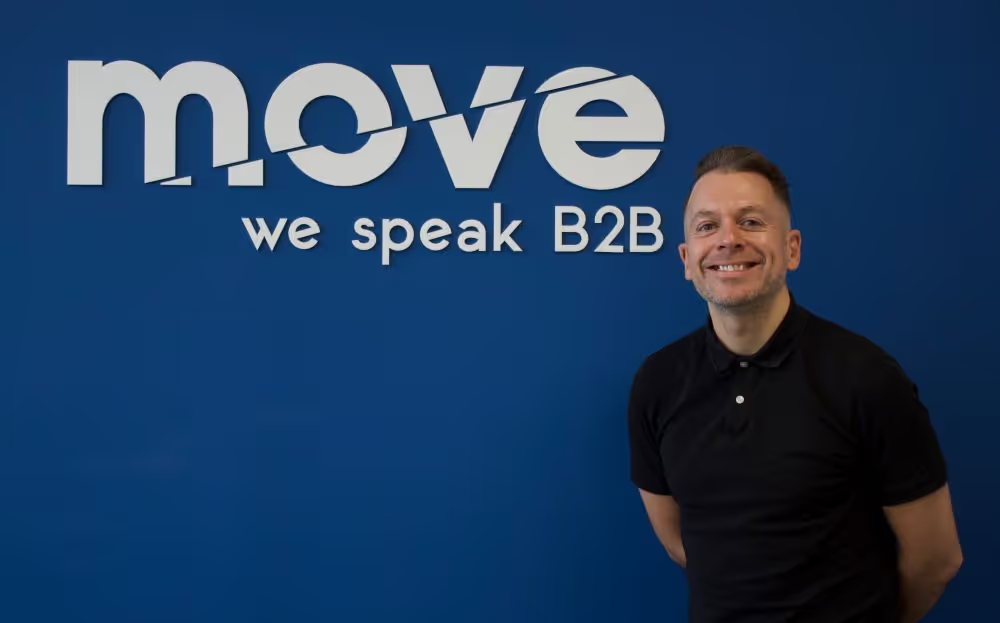
Image courtesy of Move Marketing
What makes marketing in the industrial/tech space so unique?
I’m biased because I’ve spent 23 years in it but I would say that industrial B2B marketing takes a lot more analysis and strategy; there’s a higher technical challenge. It takes a lot more skill to market something when you’ve only got hundreds of potential customers, not even thousands let alone millions or billions.
If you’ve only got a few hundred buyers to sell to, it takes a hell of a lot of skill to figure out how to pitch your product against product B,C & D which are all very similar and have very similar technical capabilities. You’re literally looking for half a per cent, one per cent little marginal gains.
Like I said, I never meant to get into industrial marketing deliberately but once I got into it I saw how it would be possible to build a specialism here because there are few specialists in this space. I still think that's still as true today as it was in many ways 23 years ago. There are more specialists but still not enough.
What keeps you working in industrial marketing? Do you find it rewarding to navigate the challenges you described?
Yeah, once I got into it, I found it would be challenging and intriguing to build a specialism in it. All the way through my career, there’s been this international flavour as well. Maybe that’s not always a given perhaps for a B2C agency in the UK so that aspect has kept me intrigued and interested as well.
Moreover, as we’ve built our specialism over the years, we’ve built a systemised and repeatable framework that could be just as applicable to companies outside of the UK too.
Yes, you’ve come up with your recipe for success with “The 8 Moves of B2B”. What made you set up Move Marketing?
The word “move” was meant as a rallying call to arms, to say “Do something, think about it, do something different.” For 10 years, whenever I was working client-side, I saw industrial companies and manufacturers not taking marketing seriously. They might spend their budget on print advertising or maybe exhibition stands.
I wanted to say to these companies, “No just stop, think about that, don’t just do the thing that you’ve been doing for the last 30 years”. Just because you’ve reached a certain point through contacts you already have, doesn’t mean that’s your future. You need to think more expansively, more dynamically, build strategy and be creative. Companies need to be experimental and try other channels to reach a new generation of buyers.
When I was thinking about words or names for the company, “move” was the one word that encapsulated everything I thought. I’m trying to shake up these traditional, many times old-fashioned, manufacturing companies and bring them into the twenty-first century.
We can help you grow but you won’t grow by doing things the same way you’ve always done them.

Image courtesy of Alex Cairns via LinkedIn
The idea that “we’ve always done it that way, so we always need to do it that way” is a theme when I talk to people about what challenges manufacturing needs to address. It can be a problematic mindset. What’s the most common challenge you face when you work with a new client?
It’s usually one of two situations. Some prospects or new clients come along and think they know what they want, typically, some channel support on one or two certain channels. Or it’s a case that they’re not sure about what they want and filling in those blanks is part of those processes.
8/10 times we’re in a position where a marketing strategy would answer a lot of these problems or questions. If you think you need just that one channel of support, we would question that and explore whether just one channel of support is the right way to go.
On the other hand, when clients aren’t sure what they need we can look at things from a more strategic approach.
Either way with those two streams, we use our 8 Moves of B2B. It’s a strategy that I came up with and refined over time while making it systemised and repeatable. It’s still bespoke to each particular client and to each particular industry sector but you start to see and build on the trends across a massive cross-section of manufacturing. It is a bit different from the approaches of traditional agencies which is again something that manufacturing prospects can be a little fearful of at the start.
There’s a lot of resistance to change and there’s a lot of resistance in general to marketing. When our clients first engage with us they would probably admit that they’re scared of marketing and think, “Well it’s intangible. What are we really getting out of it?”
We tell our clients that the way you get more out of that spend and reduce what you perceive to be “risk” is by doing more analysis. Developing more strategy will help us figure that out and piece it together collaboratively.
That’s where we start tackling most client problems and then things evolve over time from there and it can morph into geographic expansion or product launches or lots of other cool stuff.

Image courtesy of Alex Cairns via LinkedIn
Is there anything that you find that you’re telling clients until you’re blue in the face?
It’s strategy, I mean, it’s absolutely strategy. However, that takes a little bit more time and patience. We’ll often deal with anything from an SME manufacturer right up to blue chips and asking these companies to wait before getting into some tangible activity can be a challenge.
Manufacturers come to us in a crisis, usually, they’ve not got enough sales and they’ll say, “We need leads tomorrow”.
A lot of the time we’re effectively saying to them, “Okay, we know you need leads but you just need to pause for breath. Let’s work through this process and then we’ll give you a much longer-term take on how you can get those leads and actually consistently and sustainably build on that.”
That’s different to what some of them might do, or have been doing which is to chuck a load of money at social or pay-per-click or whatever the latest fad is. That’s the antithesis of the way we think and do things.Understanding that comes from my work with manufacturers and being client side. I’ve also built a team around me that gets those same challenges. Most of the team I’ve built have B2B backgrounds, they’ve been at other industrial or B2B agencies.
I saw that you were at IMTS recently. What conversations were coming up there?
We were there for different purposes than most of the exhibitors because we were ultimately trying to educate manufacturers on marketing and communicating their message better. So the chats we were having were down that route. Although, I would say that automation and AI were huge, anything in that whole robotic space was very front and centre. Software as a wider extension of that had a massive hall almost all to itself.
The big thing I noticed over there is this collaborative approach that you don’t see so much of in the UK or Europe. In the US you’ve got these manufacturing influencers now which is really interesting because it’s something that speaks to a change in demographics and generations that’s going on.That’s not being ageist or anything - I’m rushing through my mid-forties myself so I can’t exactly talk at all! Seeing these influencers create this forum for all manufacturers, whether it’s the younger or older generation, where people can connect and share ideas is really interesting and I actually think that we’re behind the US a little bit in that respect.

Image courtesy of Alex Cairns via LinkedIn
That was really interesting, I just spoke to Howard Sheldon from Precision Engineering. He’s got this big LinkedIn following and he was pointing out that the Americans have Titan Gilroy and we need something similar in the UK. Have you seen the rise of these influencers more over the past few years?
It’s not the only development in that area of communication but it’s the one that’s most relatable and that you see on your LinkedIn feed. It demonstrates what we’ve been trying to drive with Move Marketing, the idea that you need to be thinking more strategically about where your buyer spends time, how they find out information and where they educate themselves.
You can’t just get a sales guy to work the phones and get out on the road and see a hundred prospects anymore: the world has changed.
80% of this industrial buyer journey is happening digitally before buyers even want to speak to a salesperson. After my 23 years of industrial marketing, my take is that you’ve first got to have a strategic baseline and ask what you’re doing about that 80%. You can’t just rely on the sales guys to convert every single opportunity that gets into that last 20%, you need a marketing strategy. You need to line things up between sales and marketing.
The influencers on social media will help with some of that amplification of the company’s message. However, I think it’s a small piece of it because some of the traditional channels have still got some value and have a part to play in that as well.
How do you think that the US and the UK do things differently?
When it comes to attitudes about manufacturing, there’s a lot more bullishness and positivity on the whole in the US compared to the UK.
I’ve been over to the USA a few times now this year and it’s not something I’ve seen on one trip, I’ve seen it every single time.
I don’t mean that as a criticism of UK manufacturing but I do think there are some interesting lessons to take because we’re too down on manufacturing in this country.
In the US, a lot of the trade media around manufacturing is positive and pushes that narrative. It’s something that we could learn from in the UK because we’ve got loads to be positive about and yet we default back as a sector to nervousness and negativity. The way mainstream media in the UK perceives manufacturing is as this old-fashioned traditional thing.
Things are moving forward and the whole sector is digitalising in terms of production and marketing in some of the subdisciplines. We need to communicate that as well and get the next generation enthused about a career in manufacturing. I do see that in the US, they have a little bit of a headstart.
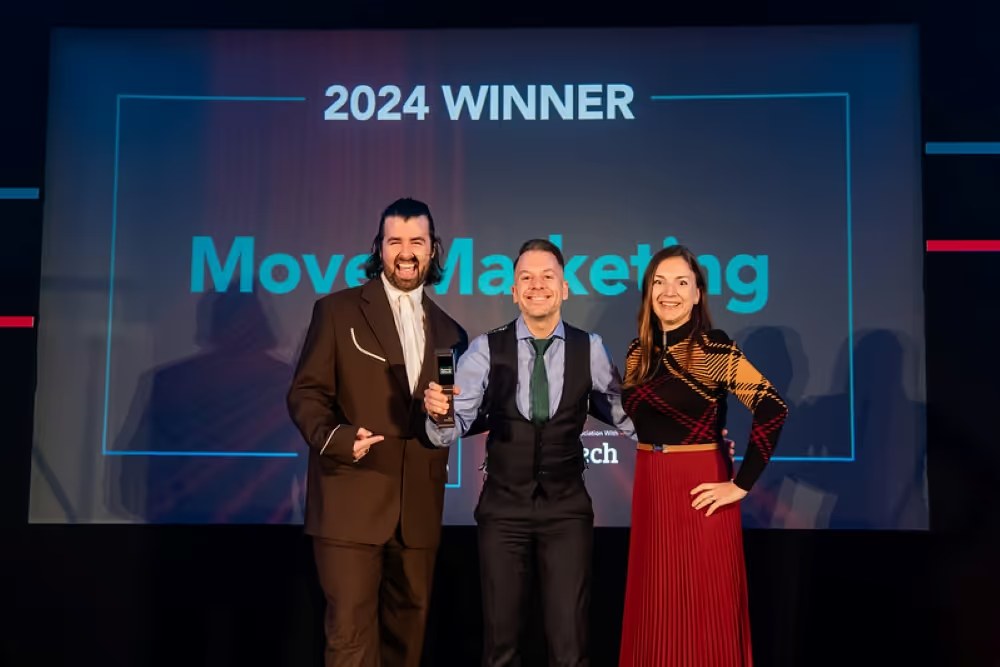
Image courtesy of Move Marketing
I’ve read about this negative perception of manufacturing as something that’s contributing to the skills shortage, does it have this image that’s stopping people from joining?
It’s not even the more mainstream negative attitude to it but if you think those influencers - let’s widen that term and call it “new marketing techniques” - that’s a lot less prevalent in the UK than in the US.
I’m less familiar with all the specifics of training schemes but I’m guessing that there will be a higher percentage of financial support for manufacturing careers in the US than in the UK.
Once you start to add up a few different aspects like that, then you see where we’re selling ourselves a bit short and not seizing an opportunity compared to other countries.
Image courtesy of Alex Cairns via LinkedIn
When you think about the future of manufacturing what’s one challenge that you think needs to be addressed?
One challenge is the alignment and integration of different departments and I say that with a little bit of bias from the marketing perspective. When I was client-side years ago, sales and marketing were almost butting heads. In latter years as I’ve run agencies and been on the other side of things, I see this resistance to change and companies not taking marketing that seriously.
The fact that 80% of the buyer journey is taking place online before they even want to speak to a salesperson has really taken a grip since COVID. Therefore, the challenge is at the very top of these manufacturing companies. CEOs, managing directors, and boards of directors need to take that integration of disciplines more seriously and I include marketing very much at the forefront of that.
There’s a cutthroat global market these days in manufacturing with increasing amounts of low-cost producers around the world. To stay ahead, you’re going to have to be better integrated and communicate why your company is better.
Is there anything you’re excited to see in manufacturing?
There’s a huge amount of innovation going on and we’re also at the dawn of this AI age as well. AI doesn’t just apply to making advancements in production or automation. It can also be applied to marketing as well as some of the other disciplines that are within a manufacturing organisation.
There’s also a new generation coming through perhaps with a bit more enthusiasm and passion for the sector off the back of things like our 8 Moves of B2B framework which is an educational tool as well. I hope that things like that bring more passion in the next generation to come into manufacturing and look at it as a viable career option.
There are a lot of tales of doom about the end of manufacturing in the UK. We’re amazing at that, we’re fantastic at portraying doom and that’s not just true of manufacturing. We need to be proud of the good stuff we have but if there are things that aren’t so good then we should talk about the positives and the ways that they could get better.

Image courtesy of Alex Cairns via LinkedIn
What would you say to encourage a young person to encourage them to join the industry?
It’s a massive growth area. It used to be a very niche specialism that didn’t have so many people practising it, but recently there’s been an explosion of B2B industrial agencies and specialists and that will only keep going because of the innovation that’s going on.
All of this innovation is driving growth in B2B industrial marketing. I’ve got to be honest, it’s not necessarily as sexy or as topical as B2C but that doesn’t mean that there’s any less enjoyment to be had. Actually, it’s more exhilarating when you get a result. When you achieve a good campaign or the growth of a B2B business, that challenge has been much harder so you end up with a higher level of specialism.
After ten or fifteen years in a B2B industrial marketing career, you can do whatever you want. You might not have had that level of skill building in an equivalent B2C role so that’s where the opportunity lies.


.avif)
.svg)