Lessons from Law Enforcement: an interview with Johnny Goode


"Do I want to continue to put myself at risk of death, being shot at or killed, and leave a family behind that now has to struggle to bring in income and survive?"
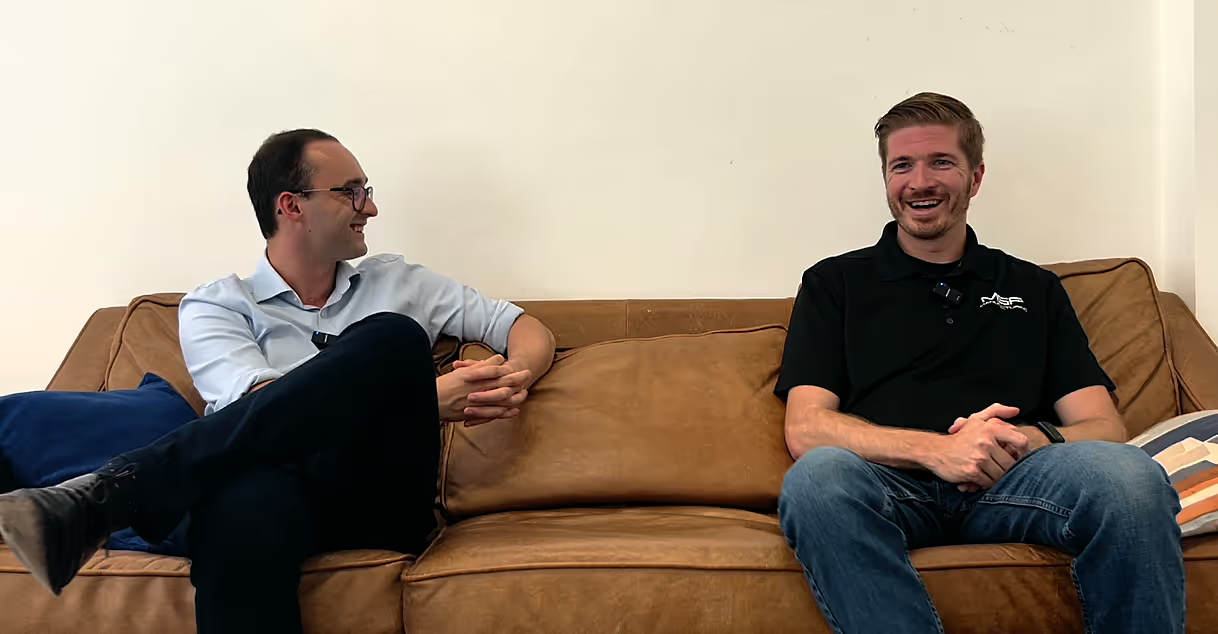
We interviewed the president of MSP Manufacturing, Johnny Goode. Having worked in law enforcement and served in the Army National Guard, Johnny started working at MSP in 2020, before becoming the company’s president in 2023. He steered the business through the covid pandemic, helped lead a company rebrand, and has built a culture of trust and dedication among his employees.
Our Head of Machine Shops, Henry Morris, sat down with Johnny to ask him about his interest in defense manufacturing, what he thinks about the reshoring efforts, and how being on a SWAT team can influence a successful leadership style.
September 11th, 15:00 BST
Henry: So Johnny, I'd love to hear how you got into manufacturing, it’s not a typical journey. I believe you spent a lot of time in law enforcement and served in the Army National Guard, how did that get you into manufacturing?
Johnny: So, going back a bit, I went to the Kelly School of Business in Indiana University to study entrepreneurship and innovation. Between my freshman and sophomore year, I applied to a cadet officer program, so I was a cadet for the local law enforcement agency. I went through the police academy in between my sophomore and junior year, and then I was a part time police officer for two years while I finished my degree, and in 2014 I got hired on full time. So I'd worked there already for four years and then I started working full time for the agency, really loved it, and thought I would stay in law enforcement forever.
But naturally, where you think you're going to be in 10 years is not always where you end up. I got to do a lot of really cool things; I worked undercover, worked on a SWAT team, but fast forward to 2020, and covid is happening. So I wasn’t able to do my narcotic buys because they didn't want hand-to-hand buys with the kind of targets I was going after, just to decrease my social contact. So I was in the FBI Special Agent process, it's very strenuous, my background check was coming and I had a potential start date with Quantico.
Now, during covid, a lot of the class dates were getting cancelled, offers were getting rescinded, and I was one of the people affected by that. I was a little distraught, but my fiancé was pregnant with my first son at the time, so I really started to think, where do I want to be in 20 years? Do I want to continue to put myself at risk of death, being shot at or killed, and leave a family behind that now has to struggle to bring in income and survive?
My dad has owned MSP since 2002, and while still working at the law enforcement agency, I worked part time in business development. Luckily, another buddy of mine who had left law enforcement had his own company, and was looking for a manufacturer. So I brought in that business when aviation manufacturing was pretty low, especially with Boeing who had, prior to the pandemic, the two 737 crashes which really negatively impacted production. So I started doing that and I fell in love with manufacturing much more than I would have ever imagined. I think a big part of it was our defense portfolio that was serving some projects that I knew about when I was in the army, and how we were continuing to support the warfighter, which is something I've become increasingly passionate about over the last couple of years. I also really liked the people. They were very supportive of me coming in, despite being the boss's son. I just really fell in love with manufacturing, and then continued to work my way up to the top, and then my dad later decided to hand me the reins and move to a different state. And that's where I'm at now, running that organization.
Brilliant, a great story about getting into manufacturing. And what would you say are some of the lessons you've learned from that experience that you had with SWAT teams and law enforcement? What lessons did you learn from that experience that you brought into manufacturing and MSP?
One of the best teams I've been a part of was a SWAT team I was on, just a ton of individuals that were always striving to be the best they could be, so that the team would be the best, with a huge level of trust and support in one another. So I've tried to ingrain that, but I think one of the basic lessons I learned was when I was working the street as a patrol officer. I learned to treat people with respect regardless of where they are in life, because often you're coming across people that are having mental breakdowns, they've committed violent crimes, but that does not give you the right to talk down to them, treat them badly, or take away their dignity. So I've always applied that lesson to pretty much everything, treat everyone equally whether you're the CEO or janitor. You know, everyone wants to be respected, they want their dignity, and so I've put that in place.
And I think the other thing is, I started at the bottom in law enforcement, and I always thought it would be nice if the Chiefs or people at the upper level got the lower level people's opinion, because sometimes the decisions they're making at the top are actively affecting those people, and often they're not the best decisions. So before I make major decisions, I talk to the guys on the floor. I talk to my managers, my directors, I get their insight. And now we're got a level of trust where sometimes I'll have a terrible idea, and they're more than welcome to let me know that it's a bad idea. But that gives me a perspective I don't have. I've run a machine, you know, I’ll press the start button, but I don't program. I don't know the technical ins and outs. So when I think I have an idea that looks great on paper, I love that they say “have you thought of this?” or “that's really good, I didn't think of that and that could help us”, or “that's terrible, because this will counteract”, so those lessons have been very useful. I think, to sum it up in a few words, I think leadership is about the way you treat people, and I have created a culture where I don't have anybody leaving MSP, I have people applying for jobs I don't have open. I look at manufacturers that surround me, and they can't retain people, and they ask, “What are you doing?” And I say, "I pay people a fair wage, I treat them as people, and I set them up for success."
That's really impressive Johnny, and it's clear that your experiences have led you to take an approach that’s a bit different to traditional manufacturers. MSP’s been going for 83 years, and must’ve seen a lot of changes, do you think your untraditional approach is part of a generational shift?
Yes, so we have been around, we were formed in 1943. I think a big generational difference, and maybe a personal difference is, I'm very service driven. That's what pushed me into law enforcement. I think a lot of CEOs and entrepreneurs are really dedicated, they want leadership, but sometimes they're a little bit more money focused than I am. My drive is I want to provide opportunities to myself, my family, but also my employees and their families. So I'm very passionate about my employees, I have met a lot of CEOs that are similar. But I think you look at the innovation that is happening in the world now, and it is way more rapid than it was 20 years ago. So when you have a CEO or president that is 60, or 70, they're probably not going to be looking at all the innovation. They're not going to spend the time travelling to see the early adapter technology. That's where I think I've differentiated myself from older generations, my team and I go to trade shows, not always to get customers or suppliers, I want to see what's new. I also sit on a couple of boards where I get a bit of exposure to that. We're constantly looking for ways to better our technology. In the last five years, we've increased our capabilities, capacity and efficiencies, and we’ve increased our bottom line as well.
Amazing to hear. Do you think new technologies will help you to navigate the skills gap that’s currently going on in the industry, or do you have a different approach to dealing with that?
So about four years ago we started a program with the local high school where we take in high school interns, and they can get school, or sometimes college, credit for the work they’re doing with MSP. That gives me a good insight into the student, does this person have a great work ethic, do they have the ability, and do they have a willingness to learn? And if they can check those three boxes, we are a little bit more motivated to invest in their education. So I've paid for employees to get their degrees, and then they come back and they have a time commitment, and the expectation is they're going to come back to a 1.5 ratio. So if we pay for them to go to school for two years, I want them to come back and work for me for three years. After that, if they decide to leave, they've got no student debt. I really think our culture is now recruiting more young people who want to work there. I think the pendulum is starting to shift. Manufacturing jobs were seen as less glamorous, and that pushed a lot of people out of the industry. But now people are saying, well, I can be a programmer and make a lot more money than I thought. And manufacturing isn't going away, AI is not going to replace those individuals. It might reduce administrative jobs, but blue collar trades still need the people to do the jobs.
Yeah, I completely agree. You went through the pandemic, you dealt with that. How do you see 2025? What are the key trends that you're looking for? I mean, we're nearly at the end of 2025, what do you see going forward into 2026?
Prior to 2020 we were largely tied to Boeing. I think at one point we had about between 60% and 70% of our business tied to Boeing, or our customers were supplying Boeing. I think we're closer to 35% now, so we've cut that in half. We're doing a lot more in defense, direct to the DoD, primarily Navy, and we’ve seen a lot more space requests for quotes. So I think we're going to have a much bigger percentage of space. Our defense is still growing, kind of organically. Our aviation is very legacy. So I would imagine that over time, unless we get more into aviation build to print, we might see a reduction in our aviation, but we're still seeing sales go up. I think MSP particularly will experience some astronomical growth in the next three to five years. And I think I have the labor and systems to support it without having to double my staff. You know, we talk about your technology and some of the other ones we've put in. I think they're really good force multipliers, where, you know, the older generation and people that aren't familiar with it look at this as “this is taking my job” and I’m like, “No, it’s just allowing you to do what three people would have to do without it.”
"I want to provide opportunities to myself, my family, but also my employees and their families."
How do you think AI will improve manufacturing, and have you integrated it into MSP yet?
So this is just my opinion, there's a lot of people way smarter than me with AI. I tend to find AI that’s easy to implement and that's not going to have a lot of resistance. So last year, I was at the Farnborough Air Show. Shout out to the Indiana Economic Development they gave us a grant that helps fund my travel to the UK. Anyway, I met with some people, I thought they had a really good programming AI and I got along really well with them. We cut a pretty sweet deal, and we were able to test that. I had a very quick buy in from my guys. We're starting to use more data analytics, so Power BI for example, and by doing so you can start implementing contract review. So I think AI will reduce a lot of the administrative, painful, repeatable processes in businesses.
And then, the type of technology that AMFG is offering, if you look at the estimating side rather than replacing these positions you guys are a tool that can really be a force multiplier. And I think that's what AI is. I think it may take some admin jobs, but the estimators, the programmers, for the people doing that work AI will be a huge asset. I think AI is just giving you data faster and in an easier to digest format so you can make better decisions.
You mentioned that you want to see some really impressive growth at MSP. With all the technology you're starting to use now, where do you see MSP in 10 years time?
I think I just want to see more revenue, more bottom line, but I want to see our baseline salary increase a lot more, so that every one of my employees is living very comfortably. I want to see us do cool projects. I want to put more parts in space and in the hands of our warfighters. But also, I want to keep my work life balance. I want to spend just as much time with my kids as I am now, and I also want all my employees to do so. So if I can add automation, I can decrease their work week, I can increase their salaries, I can give them better lives. That's really what's driving me for success, which might be a little bit different than some companies. I'd also like to see our machine shop look more state of the art and I'd like to increase our global footprint. I want people to see the MSP name and think, “That's a good company, run by good people.”
Fantastic. I think you're quite unique compared to a lot of the shops in the States, since you have such a good international footprint. You’re selling and supplying critical parts overseas. Can you talk me through how you got to that point, and how you see that developing?
Yes, so we have a lot of parts where we're the exclusive provider. So we'll get aircraft on the ground that need parts, and those can be in a plethora of different countries, depending on where their flights are. So that was a big driver. My dad bought product lines, so that gave us exclusivity, and then we worked out deals with companies that have now moved their operations out of the country, but they still source their stuff from us. So that's been another driving factor. And some of these good names, if they’re happy they’re not going to be looking elsewhere. We make sure high quality parts are delivered on time, with good customer service, and we don't really see a reduction in our orders even if the company’s moved overseas.
So more than anything, to be a successful shop, you really want to be getting the basics, the fundamentals, right. Would you say that's correct, is that the key thing?
Yeah, I always think that to grow as a machine shop, you need to have good customer service, on time delivery, and good quality, and if you can, make the parts look cool too. Where big companies struggle, I think, is they don't have that human connection. So, inevitably, something will go wrong. And I think that gives you a great opportunity to bend over backwards and show that you're willing to support your customer, and big companies struggle to do that sometimes. So I try to bring that support mechanism into manufacturing, I want to support my customers. Sometimes things happen, let’s say in shipping and if you look at the purchase order and it's on our customer, you know they take possession at the time of shipment we often go, “yes, this could legally be your fault. We're still willing to give you the extra parts, let’s expedite shipping, on us.” So we eat a lot of costs to make sure our customers are hitting their objectives too.
Fantastic. A big trend that we've been talking about at AMFG, considering customers who have moved abroad, is reshoring. How has that impacted MSP, and the US manufacturing industry as a whole?
I think it's got a much bigger impact on the US than what MSP is currently seeing, we've always been American made American sourced, so we source everything domestically. And, I didn't do this strategically it just worked out really well, I bought most of the material for our core product in November of 2024 so when all the tariffs hit, I had the material already in hand. So we've been largely unaffected by the tariff stuff. We have got a lot more quotes from people that are looking to push more things back into America, especially the ones that are working with the DoD. When I look at the state of Indiana, we're seeing a lot of companies move big operations into the States. We're seeing a lot of infrastructure being built for this, automation companies have a huge backlog. So that's where we've kind of seen a little bit of the heartache affect MSP, when we want to automate a solution, we have a longer response time from these companies. You know, you've got Toyota and other large companies that are bringing more things in house, and they pay a lot more than we do for automation. But I think it'll be great. I think definitely when you look at the defense side, it'll make it more secure, and especially when you look at the software, you don't want a foreign entity to have software in a US war machine.
Of course
I think it's going to create a lot more jobs. I think the onshoring, plus removing the stigma of manufacturing being a low level job, is really going to make the economy boom. However, these things don't happen overnight. There's pain in the process. But I don't think you can have growth, prosperity, all that stuff, without short term pain. I hope the US can come together as a people and push forward an economy that's beneficial for everybody.
"To grow as a machine shop, you need to have good customer service, on time delivery, and good quality, and if you can, make the parts look cool too. Where big companies struggle, I think, is they don't have that human connection."
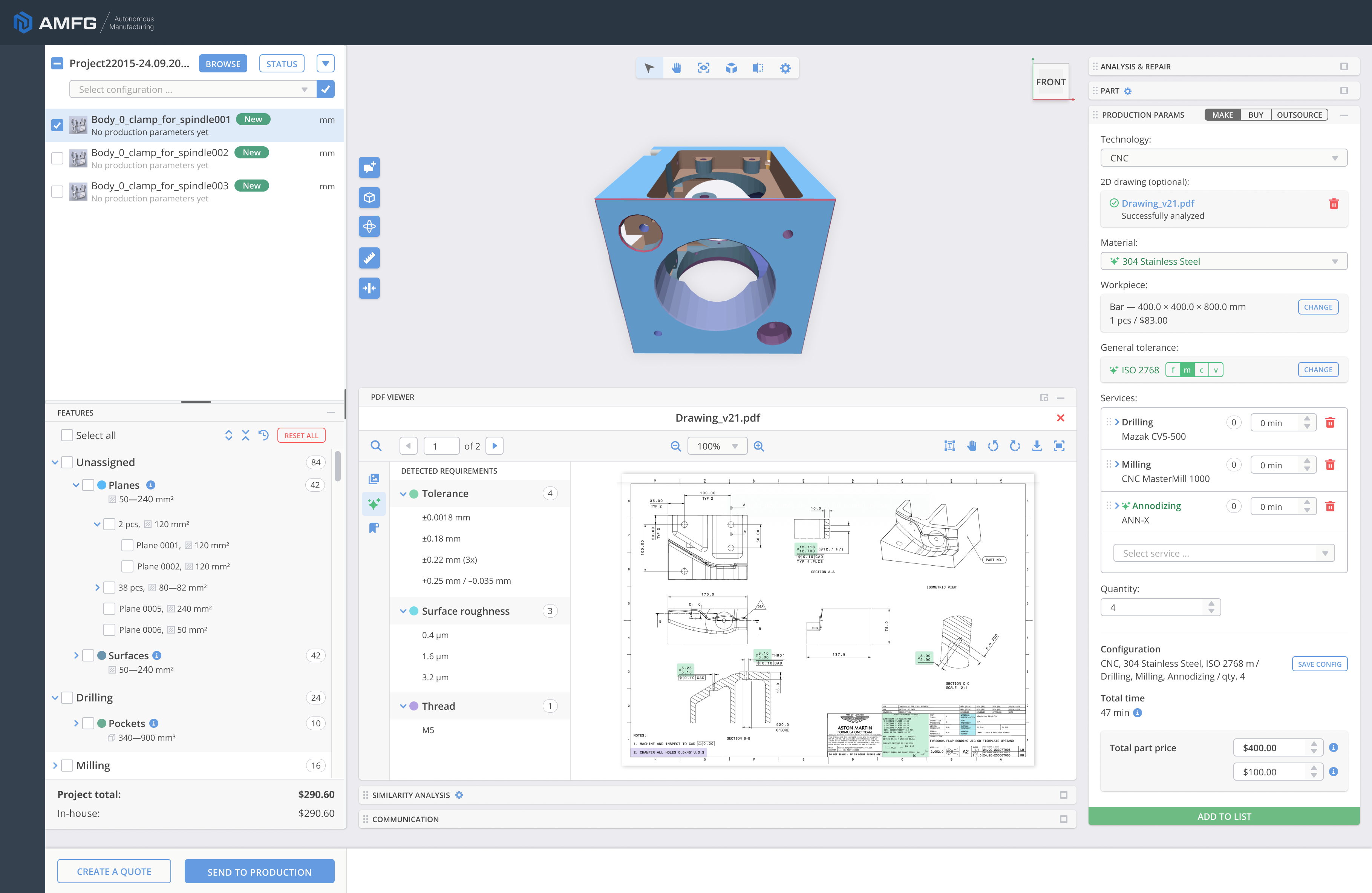
Definitely, I mean one thing we’ve seen at AMFG recently is a bit of an RFQ tidal wave as a result of the reshoring, which is reassuring, and has actually led to many shops being overwhelmed. How do you see quoting and estimating software like AMFG’s affecting shops and providing a competitive advantage?
Yes, I think reshoring is a big driver. I also think the space industry is going gangbuster. So I think you have both drivers flooding shops. And I think shops are going to have no choice but to implement something. I think where AMFG is a good solution is that it's not super hard to implement, and it's focused on assisting the estimator not replacing them. I've talked to other companies that have a super long implementation time, it’s quite painful. I think the companies that use software like AMFG will be able to win more business, and the companies that don't will struggle to see the same kind of growth. It’s not taking your job, it’s helping you do more. And yes, you may have the cost with AMFG, but if you've got estimators that are commission based this may make them more money because they're winning so much more work. So I view it as something that’s going to help you rather than hurt you. And I think shops are going to have no choice, honestly. This is one year into this reshoring push, if it continues at this pace for multiple years and you're not already looking at that solution, I think you will get left behind.
Interesting. Now, you’ve recently launched Goode Solutions, when did that happen?
January of this year (2025).
Oh amazing, and what’s the aim of Goode Solutions?
So, for lack of a better word, it's a big catch all. I started it because I have a disability rating from the army. I was super blessed because when I started at MSP, my dad had a great network. He introduced me to all the right people. They seemed to not hate me and they really helped me out, so without them, we probably wouldn't have been as innovative. We wouldn't have the state, federal, and local funding we got through grants and tax incentives. However, a lot of that information is niche, or it's not easily found. There aren't a lot of databases where you can search “what grant fits me?” So a lot of it is who you know, and I wanted to be that, ‘who you know’, for people that were struggling, or other small businesses, I wanted to give them free help.
And then also if there are grants that are available where I can be the vendor, I can give free consulting or discounted consulting to these other businesses on things that I've learned. Especially businesses that are similar to MSP, because I would say my manufacturing knowledge is very niche to MSP and maybe some other machine shops, but I think I could teach leadership and a few other things.
We've also partnered with a couple of different entities in Australia and other countries that have great solutions for the DoD, but they need a US partner to do that. So Goode Solutions does that but also, if we do a contract vehicle and it doesn't go amazing, I'm not risking 83 years of company history.
A clever strategy, so you’re quite an entrepreneur. You've got MSP, you've got Goode Solutions, and you've also got Mobile Mulligans Golf right?
Yeah, so today is September 11th and we have a booking with Adam Sandler who’s going to be in our truck today.
No way, fantastic!
So one of my buddies, we were cops together when I was a detective. We worked a little bit of patrol, and used to play football for Indiana University. He went into cyber security, but he was living in Tampa, and he said it was so hard to go play golf. The city's very urban, it’s a very long drive, and they didn’t have vehicles because they lived in an urban place. So he liked golf, but couldn't golf very often, so he thought of an idea of putting it in a box truck. But box trucks are small, so we made ours a transformable box truck. The ceiling goes up, the sides come out and we’ve got, I think, 250 square feet of space in there. We've had people that are 6”8 swing a golf club and not hit walls. So it's essentially a mobile golf simulator, patent pending. And it's just been really fun. We've had a couple of celebrities in there, and we've gone to some really cool events. I've met some amazing people, but it's also great that when we did all the fundraising, we kept all the equity. So it's my buddy and I, and then one of his other friends, we’re the owners. My one friend owns the vast majority but he brought me in early. I had won a pitch competition for a different idea, so I funded our early patent filings, and he gave me an equity share. It's been interesting to see the perspective of running a business that's been around for 83 years, and then running a business that's been around for two years that came from nothing. So that gives me a plethora of experience to be able to hopefully pass on to other people.
Well Johnny, I've really enjoyed our conversation today, thank you for coming and I appreciate you answering all my questions.
Oh, thank you, I appreciate getting to answer them.
This interview has been edited for length.
About AMFG
AMFG works with high-mix, low volume manufacturers across the globe, streamlining their operations with our cutting-edge software platform. Our scalable tools automate all stages of manufacturing operations, providing automatic quoting and order management. Using our software, our clients can adapt to complex demand with efficiency and precision, securing their place at the forefront of the manufacturing industry.
For more information, please visit www.amfg.ai or contact: press@amfg.ai

.avif)
.svg)