How Can 3D Printing Benefit Underdeveloped Countries?
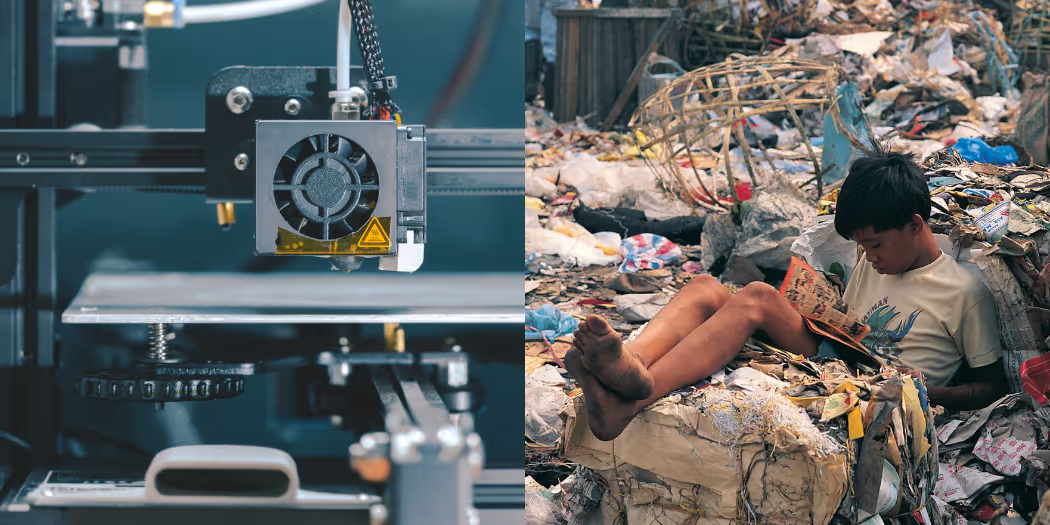


3D printing has established itself not only as an industry disruptor but as a viable alternative to traditional manufacturing processes. This allows manufacturers to build complex shapes easily, replacing the need for molds and dies–devices that are impossible to make without highly advanced techniques. Additionally, products created using 3D printing tend to have much shorter production times than traditional subtractive manufacturing methods3D printing, or Additive Manufacturing (AM), has found applications across various industries including; aerospace, medical, manufacturing and shipping. 3D printers have even been sent to the International Space Station (ISS) and on long-distance missions to Mars, to address resupply issues. However, what about the supply issues down on Earth? Additive Manufacturing can be applied to help solve the problems in areas of the planet that lack infrastructure and essentials. Here are ten ways 3D printing can help underdeveloped countries:

Image: Rephile Water
Clean Drinking Water
Access to clean drinking water remains one of the most significant challenges in underdeveloped countries. According to the World Health Organisation (WHO), approximately 2 billion people—equivalent to 1 in 3 individuals globally—lack basic access to clean water. Through 3D printing, water filters can be crafted using locally available materials at a fraction of the traditional cost. The design involves utilizing a plastic bottle and a tape-based filter capable of capturing various solids, including human hair and other contaminants. Depending on its origin and usage, such a water filter can provide up to four years of clean drinking water, making a substantial impact on improving access to this essential resource.

Image: Uta Scholl
Water Pumps
With a 3D printer and various components printed by local workshops, water pumps for wells can be constructed, guaranteeing the extraction of clean fresh water from the ground even during drought periods. This innovation could be a lifeline to numerous communities and has the potential to save lives.3D-printed wells installed in underdeveloped communities would not only address immediate water needs but also showcase the power of community collaboration. It illustrates that the benefits of 3D printing extend beyond just technicians or engineers, empowering entire communities to leverage this technology for sustainable solutions.
![An OXPEKK SLS 3D printed cranial implant [Image credit: Oxford Performance Materials]](https://cdn.prod.website-files.com/68ada093f042e50f43548e00/696bdcbd6c0d492fb0d892ed_OXPEKK-IG-e1502283993324-300x152.avif)
An OXPEKK SLS 3D printed cranial implant [Image: Oxford Performance Materials]
Healthcare
Additive manufacturing has already proven itself to be a huge benefit to the medical industry, with 3d printed prosthetics, implants, and even neurologically functional brains being produced for study and patient use. However, the splash these innovations have made in the headlines of scientific journals would be nothing compared to the impact they would make in underdeveloped countries. Healthcare stands as another critical service essential for every underdeveloped region, nearly on par with the necessity for food and clean drinking water. Leveraging 3D printing technology, essential medical devices such as hearing aids, dental implants, orthopedic devices, and even full prosthetic limbs can be fabricated. Custom prosthetics can be precisely modeled and printed at substantially reduced costs, quickly and consistently. This approach can mitigate the impact of high rates of birth defects or other health issues resulting from the absence of regular healthcare services in an area.

Image: The Construction Index
Housing
The housing crisis has hit developed countries hard in recent years, but has struck underdeveloped countries far harder. In 2015, homelessness charity Habitat reported that 1.6 billion people worldwide lacked adequate housing, with the World Economic Forum reporting in 2021 that 150 million of the world’s population were without homes.3D printing holds immense potential for widespread adoption as a swift alternative for constructing temporary homes for families displaced by natural disasters, disease outbreaks, or conflict. Furthermore, once the crisis has subsided, these homes can be easily disassembled and repurposed elsewhere within the country, offering a sustainable solution for addressing housing needs.

Image: FEWS NET
Weather Stations
Weather forecasting plays a crucial role in facilitating planning for farming and other outdoor activities vital for underdeveloped countries and communities. Utilizing 3D printers, inexpensive weather stations can be constructed, enabling local communities to monitor conditions and prepare accordingly. This includes suggesting crop adjustments to ensure survival during challenging periods. Moreover, these stations can aid in tracking and predicting storms, significantly mitigating the loss of life and property.

Image: Jay Heike
Farming Equipment
Just as with weather forecasting, farming equipment plays a crucial role in aiding underdeveloped nations during challenging times. With 3D printing, tractor components or other parts that are in short supply can be manufactured locally. This enables farmers to sustain their operations even when they cannot afford to purchase new equipment, ensuring continuity in agricultural activities despite financial constraints. For those in the world’s poorest communities, this could be the difference between starvation and survival.

Image: Jan Huber[/caption]
Livestock
In addition to other applications, 3D printers can be utilized to construct incubators for livestock, which serve as crucial sources of food during periods of drought or famine. This innovative approach ensures that farmers can sustainably provide for themselves and their families, even when lacking the extra income to purchase new animals.[caption id="attachment_39857" align="alignnone" width="1388"]

Image: Rachel Martin
Transportation
Transportation stands as a pressing priority for any underdeveloped nation striving to advance beyond subsistence levels. Leveraging 3D printing technology, bicycles can be relatively easily produced in regions where parts may be scarce, and the necessity for traveling long distances with heavy loads is significant. In certain African countries, motorcycles are frequently utilized as primary modes of transportation due to their ability to navigate a wide variety of terrains.3D printers could be deployed to additively manufacture component parts, or create the whole motorcycle, as shown by Sintratec’s Ethec City Project.Poor quality of transportation infrastructure including roads and bridges is another very real problem facing underdeveloped countries. If bridges are washed away by floods or collapse due to age and lack of repair, it can be months or even years before they are replaced, if at all. Additive manufacturing can be deployed to rapidly replace bridges, showcased by the new MX3D steel printed bridge in Amsterdam.

Image: Annie Spratt
Education
Education stands as perhaps the most crucial investment a country can undertake. Without it, any form of development and progress becomes unattainable. Utilizing 3D printed parts, which can be produced affordably, presents an opportunity to enhance student learning. Creating a visual learning environment improves comprehension of the world around them. Through hands-on interaction with their projects, students can explore and expand their imaginations, fostering innovation and growth.

Image: Tanvi Sharma
Plastic Waste
In underdeveloped communities, 3D printers offer a range of additional uses, including recycling plastic waste to create filament. Excess plastic is frequently found scattered across various parts of the world, part of the planet’s global plastic pollution crisis. Instead of being discarded, it can be melted down and fed into a 3D printer, addressing two problems simultaneously with a single action.
Summary
The potential for building with a 3D printer is vast, particularly when the effort is collaborative. A meticulously designed CAD model coupled with a reliable supply of high-quality parts can significantly aid individuals living in poverty. 3D printing facilitates the rapid and regular provision of supplies in an economical manner. Moreover, with these 3D-printed parts, local communities can also achieve self-sufficiency in the long term, fostering sustainable development.
Report by Danny Weller


.svg)