How to Improve Quote Win Rate (Hit Rate) in Manufacturing


Quote-Win Strategy: How Manufacturers Improve Their Quote Win Rate
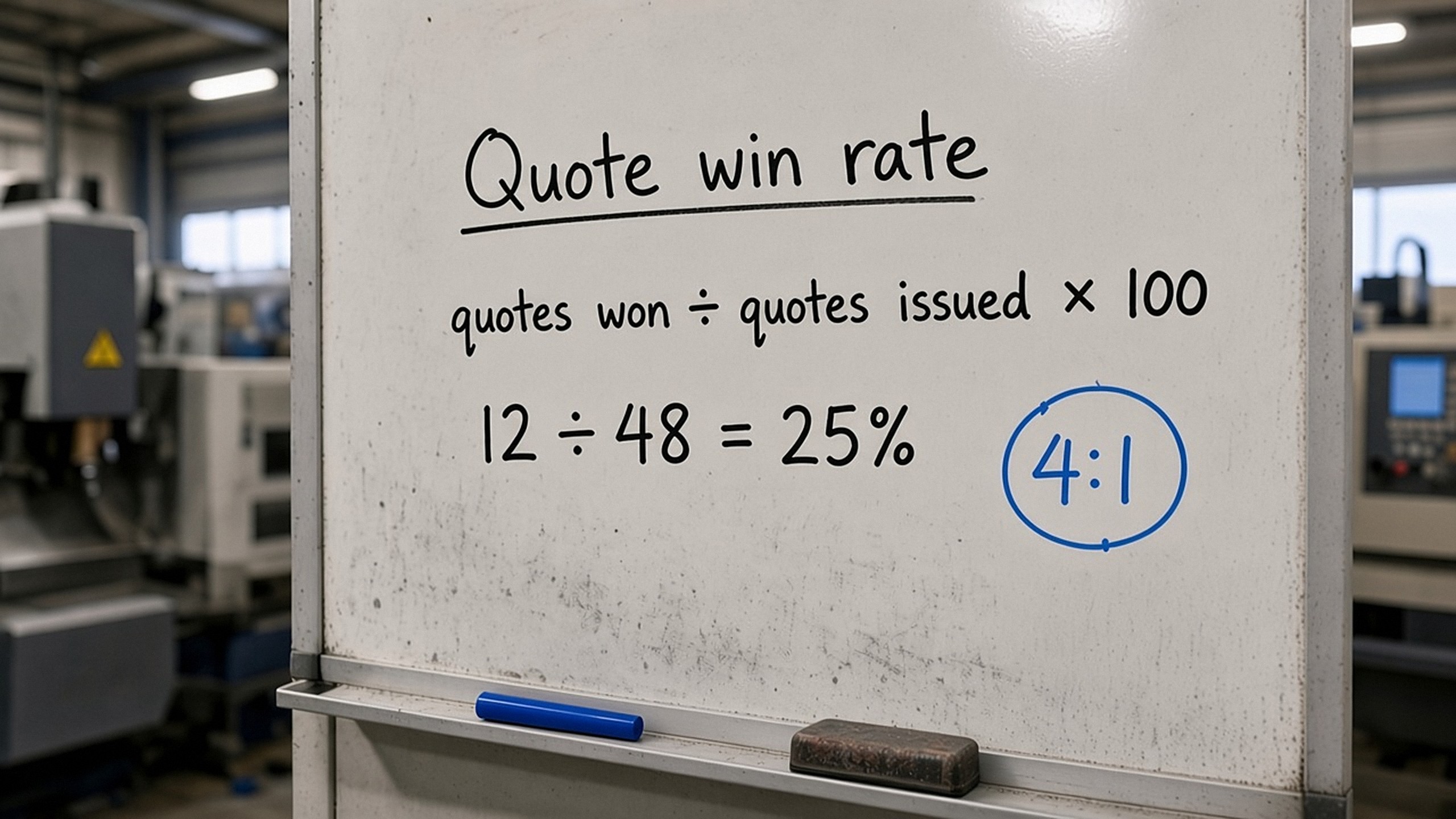
Quote win rate, also called hit rate or quote-to-win ratio, is the proportion of quotes a manufacturer issues that turn into orders. It can be measured by count or by value which tell us either the efficiency of quoting or profitability of the jobs you are winning. A quote-win strategy improves their quote win rate by quoting the right RFQs, responding faster, pricing accurately and consistently while learning from wins and losses.
How do you calculate quote win rate?
Rates that are based on count and value tells us different things. A high count-based win rate with a low value-based rate often means you are winning many small jobs and losing large ones.
What is a good win rate for a machine shop?
Just looking at win rates won't provide a full picture of how well your shop is doing. Context matters, as win rate depends on whether you quote mainly existing customers or new prospects, how selective your triage is, your market and the number of competitors per RFQ. The useful comparison is with your own history, segmented by customer, part type, material and quote size. Just because you have a rising win rate, if it has falling margins or lower win rates by value, it does not necessarily mean it is an improvement.
What are the main levers for improving win rate?
Quote selection with RFQ Triage
The fastest way to improve hit rate is to become more selective with the work you quote. RFQ triage is when manufacturers sort out incoming requests based on whether it is feasible with the machines and tools the shop has, or if it is worthwhile to respond to prevent estimators from spending time on unsuitable or low value RFQs.
Speed
Buyers tend to place orders with the first credible supplier to respond, especially for prototypes and urgent work. Improving quoting turnaround can be one step closer to enter negotiations earlier.
Accuracy and consistency
Quotes that are too high lose the job, and quotes that are too low win unprofitable work. Inconsistent pricing caused by different estimators producing different prices for the same part confuses customers and undermines trust. A standardized quoting process and traceable history of past quotes can address both issues.
Technical value
Clear, specific DFM feedback that highlights your shop's expertise like "a 3 mm internal radius instead of 1 mm would allow a standard tool and reduce cycle time," positions you as a reliable engineering partner.
Learn from your results
By tracking the quotes you send out and whether they were won, lost or expired, and comparing the estimate with actual costs provides a clear feedback loop to help identify what part families, customers and estimating assumptions may have impacted win rates along with profitability.
How do you run a win/loss review? A 6-step process
- Record every outcome. Won, lost, no decision, declined – with value and date.
- Capture loss reasons. Ask the customer. Use fixed categories (price, lead time, capability, relationship, specification change, slow RFQ turnaround) plus notes.
- Segment the data. By customer, industry, part type, material, quote value, response time and estimator.
- Look for patterns. For example losing on price only in one material, winning when quotes go out within a day, losing most large multi-part RFQs.
- Act on one or two findings. Adjust rates, change triage rules or improve quoting processes to respond faster.
- Review regularly. Monthly or quarterly, comparing the next period with the last.
Which quoting mistakes most often lose work?
- Slow responses to urgent, simple RFQs.
- Missing a drawing requirement, then re-quoting at a higher price.
- Inconsistent prices for repeat or similar parts.
- Quotes without stated assumptions, revisions or lead times.
- No follow-up, or follow-up after the customer has already decided.
- Pricing every job at the same margin regardless of risk, capacity or relationship.
AMFG's article on fixing common quoting mistakes covers several of these in more detail.
Key takeaways
- Quote win rate (hit rate) is quotes won divided by quotes issued. It can be based on count (the number of quotes won) or by value (the profitability of the quote).
- Compare against your own segmented history rather than a universal benchmark.
- Other than pricing, main levers are quote selection, speed, accuracy, consistency and DFM feedback.
- Run a regular win/loss review with fixed loss-reason categories and act on one or two findings at a time.
- Track margin on won work alongside win rate; a very high win rate can signal under-pricing.
How AMFG supports quote-win strategy
- Speed through automation. Auto-quoting converts RFQs from emails or CAD uploads into auto-drafted quotes using the shop's costing strategy, including markups, surcharges and variable machine rates, and the instant quoting portal provides quotes on the shop's website.
- Consistency. The Geometric Estimating Engine produces a logic-based baseline from part geometry that estimators adjust, and AMFG states that historical quote data is captured centrally for traceability (AMFG vs manual quoting).
- Win-rate and pricing insight. AMFG’s proprietary Sentinel AI, helps predict win rate profitability and generates dynamically adjusted pricing based on your shop's capacity.
- Traceability for estimators. AMFG's estimators page describes managing RFQs, collaborating on jobs and storing historical quotes on one platform.
- Return on investment. The ROI calculator lets shops model the effect of faster quoting.
FAQ
What is quote win rate?
Quote win rate, or hit rate, is the percentage of issued quotes that become orders. It can be measured by number of quotes or by value.
What is the quote-to-win ratio?
The quote-to-win ratio expresses how many quotes are needed to win one order, for example 4:1. It is the inverse view of win rate and helps size estimating effort.
How can a machine shop increase its win rate?
Quote the right RFQs, respond within the buyer's decision window, price accurately and consistently, give useful DFM feedback, follow up before decisions and learn from every loss.
Does quoting faster increase win rate?
Speed is often a significant factor, particularly for urgent and prototype work but it must be combined with accuracy. A fast quote that misses a requirement can lose money if it wins.
What should a win/loss analysis include?
Every outcome with value and date, categorised loss reasons, and segmentation by customer, part type, material, quote value, response time and estimator, reviewed regularly with specific actions.
Is a higher win rate always better?
No. A very high win rate can indicate under-pricing. Track margin on won work alongside win rate.