Design with Cost and DFM Clarity: Why We're Launching Kurf.
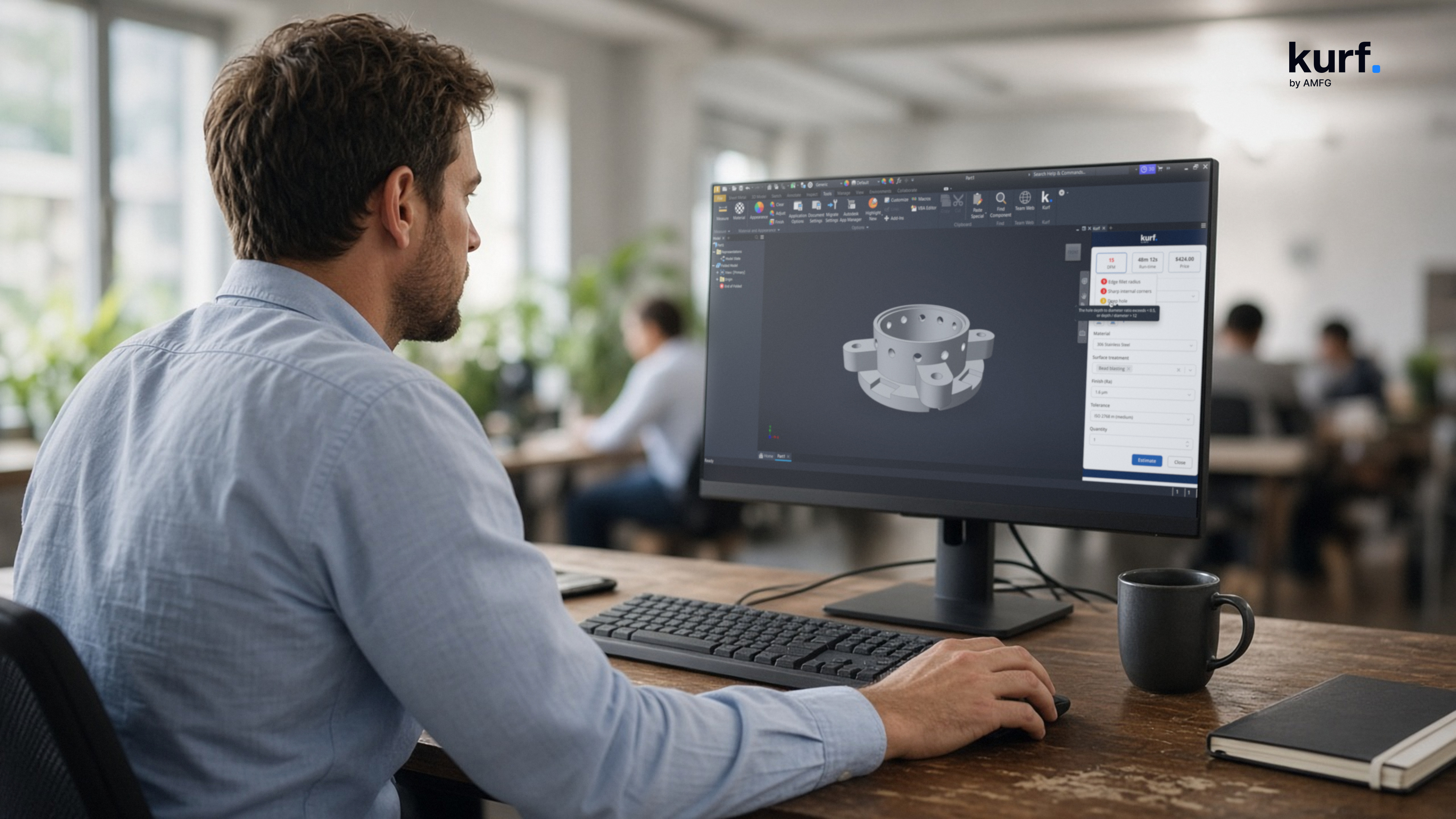


You’re designing a part that can actually be manufactured while balancing budget and design requirements, but you don’t know how your design decisions affect either of these things. Imagine the speed you can proceed with your designs if you knew it can be machined and roughly how much it would cost. Designing parts you know are optimized for cost, before you even send out your first RFQ. That’s the confidence we want every design engineer to have by delivering clarity on cost and DFM issues, and it's why we're launching Kurf. on November 10, 2026.
Designing parts comes with its fair share of challenges. If you’ve been through any of this, you’ll know why a different approach matters.
Designing in the dark: When every design decision feels like a costly guess.
If you're a design engineer at an OEM, you know the brief. The part has to meet the spec, fit the assembly and come in under the internal budget. But you’re expected to design without any feedback or checks about how much it would cost or whether it can be manufactured until the design is pretty much finalized enough for it to be sent to an RFQ.
As engineering researchers at RWTH Aachen University put it in a 2025 peer-reviewed paper, "70% of the product cost is determined by development and design." Yet at the design stage, most of the time you don't know if the part can be made as drawn, or if it's in budget. Even if you send an RFQ mid way through the design, you receive the quote back days later after the design had gone through multiple revisions and reiterations, making its feedback irrelevant.
Timing matters as much as the decision itself. As McKinsey noted in a 2023 article on medtech innovation, "The cost of change dramatically increases toward the end of development." The earlier you know whether a part works, the less it costs to act on it.
Chasing and waiting for answers instead of design engineering.
To validate your design, you send the part to an estimator or an external vendor as an RFQ. Then you wait, often for days or weeks, while the design keeps moving.
All that waiting and chasing eats into the time you have for actual engineering. In a 2022 analysis of leading aerospace and defense businesses, Bain & Company found that engineers at those companies spend about only half their time on active engineering work.
Backtracking instead of moving forward.
Design doesn't stop while you wait. By the time the cost estimate or DFM feedback comes back, the part has often changed so much that the response to the RFQ is no longer relevant. So you revise, resubmit and wait again with every loop adding time and cost.
What the delay costs.
Rework isn’t free and it adds up. The same Bain analysis found that of the time engineers do spend on active engineering work, 30% or more goes on rework and more than 40% goes on tasks engineers themselves rate as lower value.
Late design work can also quickly turn into delay and cost. In a 2024 report on the U.S. Navy's new frigate, the Government Accountability Office found that building began before the design was complete and that "delays in completing the ship design have created mounting construction delays," with the first ship forecast to be delivered 36 months late. GAO also noted that starting with an incomplete design "increases the risk of design changes and the subsequent costly rework.
None of this is anyone's fault. Estimators and suppliers are busy, RFQ packages are complex, and good design is iterative. But it leaves engineers making cost-critical decisions with the least amount of information, waiting on others for answers and losing control over their design process.
Why we built Kurf.
AMFG delivers Estimating & Quoting software for high mix, low volume CNC machining and 3D printing custom part manufacturers, built on our geometric estimating engine. We’ve heard first hand from machine shop’s time lost turning around an RFQ.
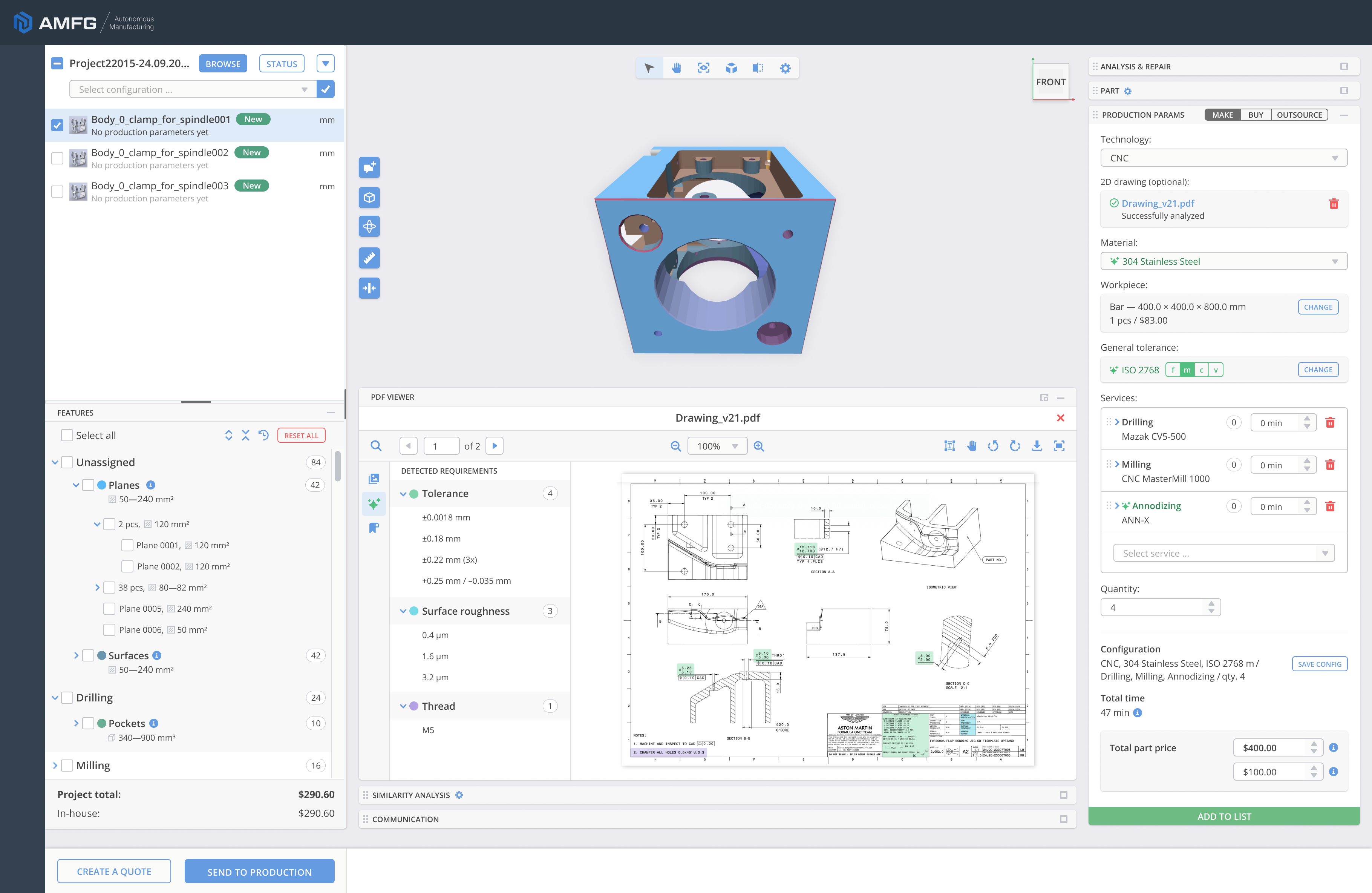
Kurf. is built for the other side of the table: the design engineers who send those RFQs. We wanted to give you the answers to DFM checks like "Can this be made?" and cost visibility like "Is it in budget?" while designing.
See it before launch
Kurf. launches on November 10, 2026, and it will have a free tier. Whether you're designing your first CNC machined part or managing a team that sends out RFQs every week, we'd like to show you what it can do on the kind of parts you design.
Book a demo at amfg.ai/kurf.