Interviewing a Maven of Manufacturing: with Meaghan Ziemba
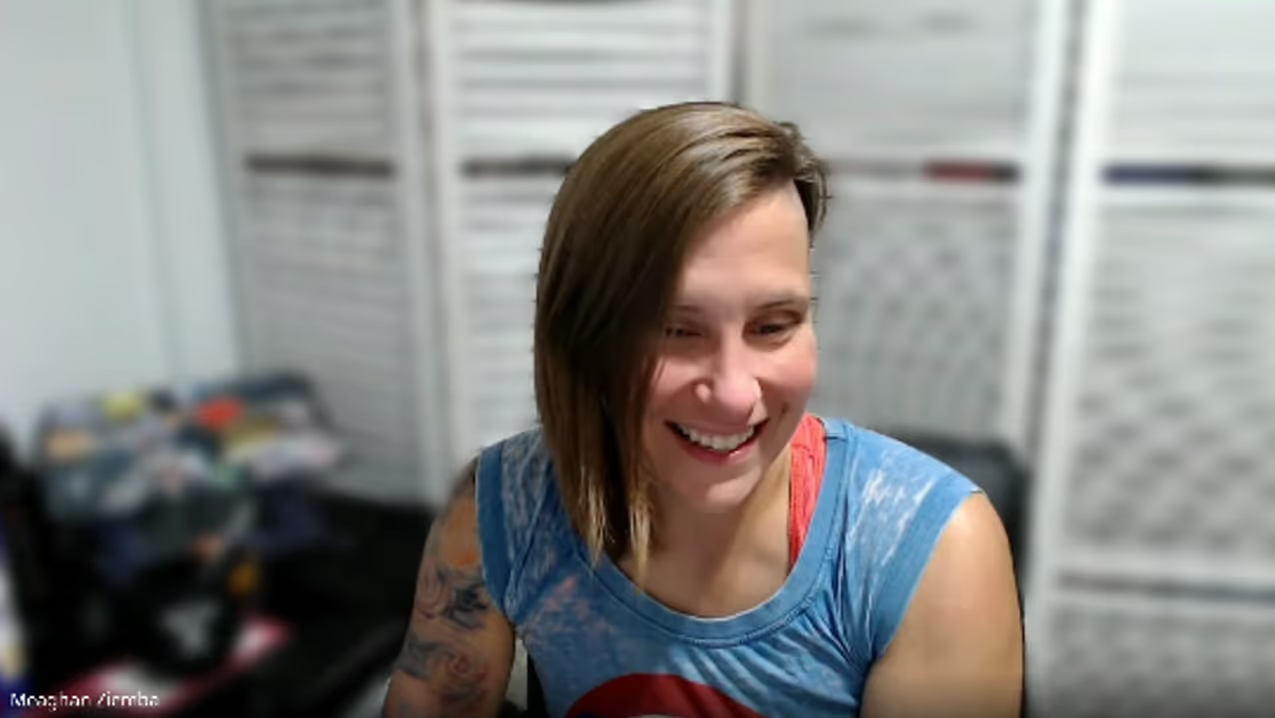


"I didn't want to be another ‘women empowering’ group ... I wanted to do something that sounded almost rebel-like"
I sat down with Meaghan Ziemba, founder of Mavens of Manufacturing, to discuss her entry into manufacturing, how women are the key to closing the skills gap, and whether the industry has changed for the better.
An experienced technical writer, Meaghan has been working in the manufacturing industry for years. Her determination to dismantle gendered stereotypes and shine a light on the hard-working women of the industry has won her widespread admiration and earned her a well-deserved reputation for, as she might say, ‘badassary.’
August 5th, 14:00pm BST
Rosie Manford: First of all, thank you for joining me. As I've mentioned, I am a bit of a fan, so this is very cool. For those who don't know as much about you, would you mind just talking me through how you came into manufacturing and how you got to this point?
Meaghan Ziemba: Yeah of course. So, not in the traditional way by any sense, it was completely by accident. I've always been free-spirited, very curious about a lot of things. I wasn't one of those individuals who wanted to go to college right away, but my mom was a stay-at-home mom, my dad was in manufacturing, and their idea of success was focused around that four-year college degree. And when I started college, I almost flunked out twice; I was on academic probation for my first two years. And then after my second year, I found out I was pregnant with my daughter.
So I ended up moving back to Wisconsin and transferred to the University of Wisconsin-Milwaukee, and that's where I found out about technical writing. One of my former classmates, she was also a single mom, and she was studying that course, and she said there were better opportunities that were high-paying within that field. I decided to take a look at it, and one of our first assignments was to write an instruction list on how to make a peanut butter and jelly sandwich. Out of all the students that were taking that class, none of us were successful! So it was really fascinating to see how different people interpreted information based off of their life experiences, where they grew up, what sort of cultural background they had.
And I was fascinated by how important that was in a tech background because if you don't have clear and concise communication, it can be catastrophic in our industry. After I graduated I got a job at a trade publication that focused on design engineering. It was really fascinating to interview all the engineers, break through their hard shell, and get a peek inside their brains and have a better understanding of how they were able to develop ideas and create solutions that made all of our lives easier. I tried leaving manufacturing, I went a liberal arts college for marketing and got bored out of my mind. So I started pursuing jobs in different manufacturing companies within their marketing departments and really helped establish their brand voice. Did product releases, press releases, community building, and also helped manage some of their trade show events. So that was a lot of fun.
And then right before the pandemic hit, I was married at the time. I had two more kids, and I asked my former husband if it was okay if I did my own thing as a freelance writer, so I could stay at home with the kids more, and he said that was fine. And then the pandemic hit, he lost his job, so I got a marketing manager position at a chemical etching company. And at the same time, while everybody was flocking to social media to keep their sanity, I noticed that there were a lot of conversations happening on LinkedIn, but it was a lot of guys in the space and there weren't really any women sharing their experiences of how they got involved, what projects they were working on, what struggles they were going through. I made an announcement that I was thinking about starting a podcast that focused on women, and a bunch of women reached out to me wanting to share their story. So, I launched Mavens of Manufacturing towards the end of 2020 and it's been going strong ever since. Every Friday, I have a live interview with a few pre-recordings. It's really interesting to hear the perspectives of women in all areas of manufacturing. I interview everyone: marketing, sales, CEOs, apprentices, interns, even high school students are reaching out to me wanting to share their story about why they're excited to pursue this sector.
What made you pick the word ‘mavens’? Am I right in thinking that's a kind of expert, but it's not a gendered thing?
Yeah. So, there are a lot of women's groups out there, and I didn't want to be another ‘women empowering’ group on purpose. I wanted to do something that sounded almost rebel-like, because I'm a huge fan of underdogs and rebels. Mavens is a gender neutral word that means connoisseur and expert because there are a lot of women who say “I don't like being called a woman engineer. I'm an engineer” or “I don't like being a woman in manufacturing. I'm just a person in manufacturing” because sometimes they feel like “woman” can set them up for a disadvantage and limit them. There's traditional stereotypes around the word “woman” and they didn't want those stereotypes to follow their skill set. It was interesting to consider that and I noticed a lot of women were using Mavens in some of their hashtags and titles on LinkedIn. So, I just decided to swipe it and use it for Mavens of Manufacturing. This way, it still opens up the conversation for men to be involved as well, because you can have male mavens and they can be experts in their field. I have interviewed a few guys on the podcast, but they came in as allies for women and they talked about some of the things that they were doing to support more women or attract more women in this sector. And it sounds really cool, “Maven's of Manufacturing” laughs. So, it was a lot of fun with the word play and figuring that out.
It seems like a lot of women talk about falling into the industry by accident rather than through a deliberate choice, do you think that's accurate?
Yeah, I've heard that as a common theme across some of the older generations as well. I think anyone who’s part of the baby boomers, even some of the millennials, they weren't really encouraged to join STEM fields. There are instances where they have been and it's because they had a mentor or someone who saw their potential either in science or math and encouraged them to pursue it, but it wasn't a lot. I think it's changing. I think there are more women who are pursuing some of the trades, and even construction, more purposefully because they're seeing other women in the field now and they like what they see. I'm a strong believer in representation matters so if you can't see it, you don't believe you can be that thing. But if you can see it, it's easier for you to believe that you can also pursue that same path.
Do you think a more trades friendly approach in schools and universities would encourage more women to join, or do you think visibility and mentoring is more important?
I think it's a combination. Even the high school that I graduated from, for some of the tech curriculums I've visited the classes and there were only a handful of girls compared to the amount of guys. And some of them were very outgoing, very opinionated, very outspoken, really believed in themselves, and had a high level of security and confidence. Not everybody is like that. So if you're more shy, and standoffish, and introverted, and you don't have the right mentor or support system, you might not pursue that opportunity if you're uncomfortable being one of few [women] or the only one in certain situations. I think it's really important to connect with like-minded people. You know, you need that validation and you need that support system and affirmations. And with that, I think people's confidence and self-security grows a little bit more. But I think we need a combination because as a sector, I don't think we're doing a very good job of sharing the stories and the opportunities that are available, especially with advancements in technologies.
The high school I graduated from, in the CNC class there some of the kids thought CNC meant additive manufacturing, so they weren't really aware of what CNC meant. And because it's such a scaled down version of what is available in the actual industry, they didn't realize how big those machines could get. They weren't aware that five-axis existed, and it's the same with robotics. Some were so used to the desktop robot arms, they didn't understand that things could get as big as the FANUC yellow cobot that gets highlighted at a lot of trade shows. They didn't understand it could scale up that big so we definitely need to do a better job at exposing them to what the possibilities are, and we can only do that through the stories that we share and tell.
"Manufacturing provides the foundation for not just economic stability but also national security and I think any country outside of the United States can agree to the same thing."
Did you have a mentor that helped you at any point? Was there a specific person or specific people that guided you?
I don't think I really grasped what a mentor was until I figured out what technical writing was, and I really appreciated my professor. He was very encouraging to all of us and he allowed us to make mistakes and always challenged us to do better. And then when I worked at the chemical etching company, my manager would ask “why did you pick this over this?” and “what could you do differently to make it better?” So she challenged my thought processes in a constructive way, and really helped build up my confidence and my critical thinking and problem-solving. So, I really appreciate her.
I do have specific mentors like Jim Mayer. He is a part of the Culture of Manufacturing podcast. He talks about how we need to change the culture to make it more diverse in engineering and manufacturing. Toni Neary of SME, she's really fantastic. She's helped with my confidence and being able to be comfortable telling people no and setting up healthy boundaries. And then Charli K. Matthews of Empowering Women in Industry, she's just a fantastic individual and she challenges me as well. So, I really look to those individuals who are extroverted, they're rebellish, very confident, they go against the grain and they're not afraid to challenge things. So I really like connecting with rebels and outspoken individuals. I always make the joke that if I was alive during the Salem Witch Trials I would probably be one of those women that got burned at the stake! laughs
There's a tendency for women to worry about how we'll be perceived if we say no or admit we can’t do something. Manufacturing is still quite a male-dominated industry, I think it's fair to say. In addition to mentoring and visibility, what else do you think we could do to shift the industry away from these negative stereotypes and attitudes, and towards a more inclusive environment where people can say “actually, no” without being seen as “the difficult woman”?
Yeah, well I mentioned Charli, who's the founder of the Empowering Women in Industry Organization, and then there's Allison Grealis who founded the Women in Manufacturing (WiM) Organization. WiM has chapters in other countries, and each of those organizations develops programs specifically around leadership skills. I think those opportunities are essential for women because they're connecting with other women and hearing stories of women in leadership roles and the struggles they went through. Hearing those stories can really help women assess what they're doing currently and give them some ideas or suggestions on how they can improve their own skill set towards leadership.
I also think companies in manufacturing really need to be proactive in inviting women to some of those business conversations. So that they can learn about the business, how things run, what happens when an order comes in the door, how it's designed and processed, manufactured and then distributed. I think knowing the ins and outs of a business can help a woman feel more confident about discussing it and pitching ideas and even talking about it with others. And then just setting up healthy boundaries. The more that you do it, the better you become at it. I think traditional stereotypes have molded us to pursue perfection and have set us up to care about what other people think about us. And we just need to stop doing that, we should be able to be confident in our skin and be who we are and not apologize for it, and women are known to apologize for everything, right?
Yeah laughs
I think Gen Z is really refreshing because I'm seeing a lot of younger women embrace their authentic selves and not be afraid to say no and set up boundaries. Like my daughter, she's 21 she'll be 22 soon, and I admire her so much because she's been able to set healthy boundaries and say, "No, I'm not doing that. I don't like how that sounds and that's not something I want to do. So, I'm going to do this instead because this makes me feel good." And I think that it's starting to change and shift. We're going to see a lot more young women step into who they are unapologetically and pursue the things that they love and enjoy, which is really refreshing to see.
I mean, with your daughter specifically, it's cuz she's got kind of a badass mom. So, speaking of examples, she's probably learned from the best.
Well I try to set that up, but the other thing is I admit to my mistakes, I apologize when I've done something wrong, and I do that with my children too. I'm trying to set an example for them, it's okay to be wrong and it's okay to take accountability, it’s actually a step towards growth. And I think for so long, especially in manufacturing, the traditional way was leadership couldn't be wrong, they were always right. But now you're starting to see this new group of leadership saying “no, I'm going to take accountability, I'm actually hiring people who are smarter than myself” and I think that's really beneficial for a company's success, keeping humans top of mind and not just seeing people as another number in the company. They're bringing that human aspect back into it.
I think sometimes it can be easy if you have really expensive machines to view that as the primary resource, but I think actually it's the people behind the machines, they’re just as important.
Yeah, it's definitely the people because if you don't have people buying into your company and they're not happy and they don't feel like part of the process, you're going to lose them and turnover is going to be high and right now, we can't really afford that because we don't have a lot of people filling the seats.
The skills gap is a really big issue that a lot of people are trying to solve in lots of different ways, but with the new technologies we're seeing like AI, ChatGPT, automation software, how do you think that's going to change the skills gap?
I think it depends on how companies are talking about it and showcasing it. There's this big misconception that Robots and AI are going to take people's jobs away, and the conversations that I've had with a lot of experts within the sector, they're just other tools to put inside your tool belt and help humans advance in their positions. So I've seen a lot of examples where a company has automated a process and it actually freed up their employees to do something more meaningful and more purposeful that took a lot of critical thinking and problem-solving. Right now, machines can't really adapt on the fly, and artificial intelligence is the first step to do that, but they really haven't fine-tuned it to adapt like a human can. So I think if we can talk about it more and actually share the good, the bad, and the ugly, the younger generation will get more interested and want to pursue those types of opportunities, but again, I think it depends on where you're at. There's communities that do a better job than others because they have the backing and support of not just their manufacturing leaders, but also their community leaders. And you can see that with the way that they're talking about manufacturing at the educational level. And it's not just at the high school level, it's younger kids, too. But the United States is just so big, it's not something we can have one giant template for and apply it to everybody, you really need to look at the community level and figure out what the main issues are in each community.
I, for example, mentor a robotics team where I'm from, and I actually brought them to IMTS and they took what they learned from the conversations that they had at that trade show, and applied it to their robot build and it actually got them an award and got them to participate in another event. So, I requested that they come to this Empowering Women 2025 event. They have three girls on the team, so they’re going to come to that event in October and I'm hoping that they can get information, make really good connections, and then apply that to what they're doing with the robotics team.
We do need to educate the general public more though. We had a bunch of strikes that happened on our docks, because those employees thought automation was going to take away their jobs. People were mad at the dock workers but we're not doing anything to educate them about how these options are going to help make their jobs easier and even more productive. So I definitely think there needs to be a shift. When companies and businesses want to bring in those newer advanced technologies, they need to involve everybody in the company in those types of conversations so that they don't feel left out or threatened.
You’ve spoken previously about your experience at your first trade show, what it was like being one of the only women there and some of the things you had to deal with. Would you say things have changed for the better?
I think they are changing for the better. I think it's slower than a lot of us want it to be. There are still a lot of negative things among certain groups of people, there’s still misogyny. I don't think you can completely get rid of it, but I think we can do a better job to prevent it from happening. And that's going to take everybody involved in this sector to call it out, to prevent it, to stop it, and address it when it comes up. Recently, I feel like a lot of people are afraid to have those uncomfortable conversations because they don't want to offend anyone. And we have to get back to this sense of agree to disagree, having respectful conversations even though they might be uncomfortable.
I participated in a panel discussion a few years back and someone made a really good point. Not all societies are pushing towards equality among women and men, there are a lot of societies that have strong patriarchy and they don't want to get rid of that. So I think that's something we all need to think about, consider, and address, because there are some places that really don't want women to progress forward or advance, and how as a sector do we do we address that? Do we sweep it under the rug? I don't know, but I'm hoping it gets better. I'm going to continue speaking out and if I end up getting tied to a stake later on, so be it again.
It's worth it in the long run, hopefully.
Yeah it will be.
I noticed that you planned a Manufacturing Ally Rally last year?
I tried to plan it and it didn't work out, it fell through. I still have that up on my LinkedIn because I still believe that one day it will happen. The goal was to bring people from all kinds of backgrounds together in one conversation. Depending on what community you're from, manufacturing can be thriving or it can be struggling. I really wanted to provide a template that communities could use to bring people together and educate the general public about the opportunities that are happening in manufacturing. It's important that they understand those opportunities because manufacturing provides the foundation for not just economic stability but also national security and I think any country outside of the United States can agree to the same thing. So I really wanted to bring voices together so that it’s not just kids who are learning about these opportunities, but their parents are learning about it too, other community leaders are learning about it. There is a stat out there that says in the United States, each dollar’s worth of manufactured goods creates another $1.30 elsewhere.
Wow, that's insane.
Yeah, so it's good to have a strong manufacturing base within your community because then everybody wins and is successful. I'm hoping I can get this rolling. But I need financial backing for it and I just haven't been able to find sponsors. If it ends up being a thing, I will definitely let you know and give you the details on it. But right now, there’s not anything happening with it.
Well if it does, if someone sees this and feels like sponsoring it, they know where to find you.
Yeah. Initially I was going to have Drew Crowe, Tony Neary, and Chris Luecke as hosts and we were going to do presentations and demos. I wanted to make it a big party, but I think it was too short notice. And I tried doing it during a major trade show year, so not everybody had the budget to support it. So we'll see.
I mean, it'll be great to see it eventually. I'm sure in a couple of years I'll see posts about it and I'll go, "Oh, it finally happened yes!"
Laughs Yeah!
"What adult drinking beer wouldn't get excited at a small robotic arm or 3D printer at Oktoberfest?"
Each state has its own history and community, but what makes a community more manufacturing centered and centric than others?
I think it's the message that's being delivered by the leaders in manufacturing within that community. So I come from a small town called Beloit, and back in the late 90s, early 2000s, our manufacturing sector took a really big hit. A lot of kids that were in my grade who were going to the same facilities that their parents worked at for 20, 30, 40 plus years, no longer had that plan. So a lot of people moved out to go find work, or they did other things that really didn't help their situation, and it put a bad taste in everybody's mouth about the stability of manufacturing. The big misconception still, I think to this day for some families, is that it's this dirty, dark, dangerous place. The work is mundane and very repetitive, there's really no purpose behind it, and that's just not the case anymore.
I went to McHenry County in Illinois for a job fair, and I was talking to one of the organizers and she said, "Yeah, we have an underwater robotics team, and this young girl came over and was asking all these questions, but her mom had a weird look on her face." Apparently the mom asked “This is for real? This is a real thing?" And the organizer explained it was real, and mom said she thought her daughter had been making the whole thing up, so she didn’t take her seriously. There's this disconnect of what we're seeing on TV, what we're seeing in our own communities, and what is actually happening in the industry. I think leaders need to be more vocal about their “why” and the purpose behind their solutions, they need to highlight the importance of manufacturing. If we weren't making these components then this, this, this, and this, wouldn't happen. It's just connecting that story with the people. Back in the 40s a lot of women were entering manufacturing because the men were fighting in the war, and I think around that time we had a 40% representation of women in the sector. All of the propaganda that was surrounding the war, it really instilled this sense of patriotic pride in our citizens. You have to do that in your communities as well, you have to make people excited about why this matters for the community. I think it's the way we're telling stories and how we're sharing information.
As a parent yourself, what do you think as an industry we could be doing to kind of make moms take their little girls seriously when they're talking about underwater robotics teams, what can we do to get the moms and dads going, "Yeah that sounds great, let's go for it”?
I think manufacturers need to be more creative in how they're inviting the general public into their facilities. I don't think a lot of the general public know they can go into facilities and look at the manufacturing that's being done within their communities. Each city, each state, has its own calendar of events; some of them have a 5K marathon, or a barbecue, one of the events in my town is a taco contest, and we have Oktoberfest. I think manufacturers need to start sponsoring those events and setting up tables and booths, even though they're not manufacturing-related, they can still set up booths, put on a demo, and have a conversation. What adult drinking beer wouldn't get excited at a small robotic arm or 3D printer at Oktoberfest? Because I would, that would gravitate me towards that table. I think they need to do a better job at saying, “hey, we're opening up our doors, come in, bring the family and we'll show you what we're making.” I think they need to start including that kind of thing in their budget and do more open houses, make it a public event, and broadcast it all over their community. I think that would help parents get a better understanding, too because they're seeing it for themselves. So then when their kids come by and say, "I want to do this" they'll be more supportive in their request. I don't know if you know Nush Ahmed, but she's amazing. And initially her parents didn't support what she was doing because they couldn't visualize the success or opportunities available. And once they started seeing the things that she was doing, she just did an interview with her dad and her dad said, “I'm very proud of her.” So it's just bringing everybody together, making it fun, making it memorable, and then calming the nerves about whether all these things are sustainable or about robotics, automation, and AI taking everybody’s jobs. You might get some of that older generation to apply too because I know a lot of women who, in their late 30s, early 40s decided to make a career change and it ended up being in manufacturing. So don't limit yourselves on who you can attract.
That's a really interesting point. A lot of the conversations at the moment about the skills gap are really focused on the younger generations, going into schools, apprenticeships, universities, but no one really thinks, well, how can we get a 45 year-old mom into a shop, how can we get her on a machine?
Right! I think companies need to start being more creative that way.
I think we're coming to the end of all my endless questions, but I just wanted to say thank you for this interview. It’s been very inspiring and it's been really great to pick your brain about some of the problems that we're facing and get some new perspectives on everything. So, thank you for that.
Oh, you're welcome. Thank you for the opportunity and if there's anything else I can do to help, just let me know. I'm hoping to make it across the pond one of these years. I have a bunch of friends who are in England and Denmark and all that and I need to get out of the States more. So, I'm hoping to cross over there. So, if I do, I'll make sure to connect with you.
Yeah, definitely. If you're in London, I will take you to a pub and buy you a drink and pick your brains some more, but this time off camera!
Sounds good!
This interview has been edited for length.
About AMFG
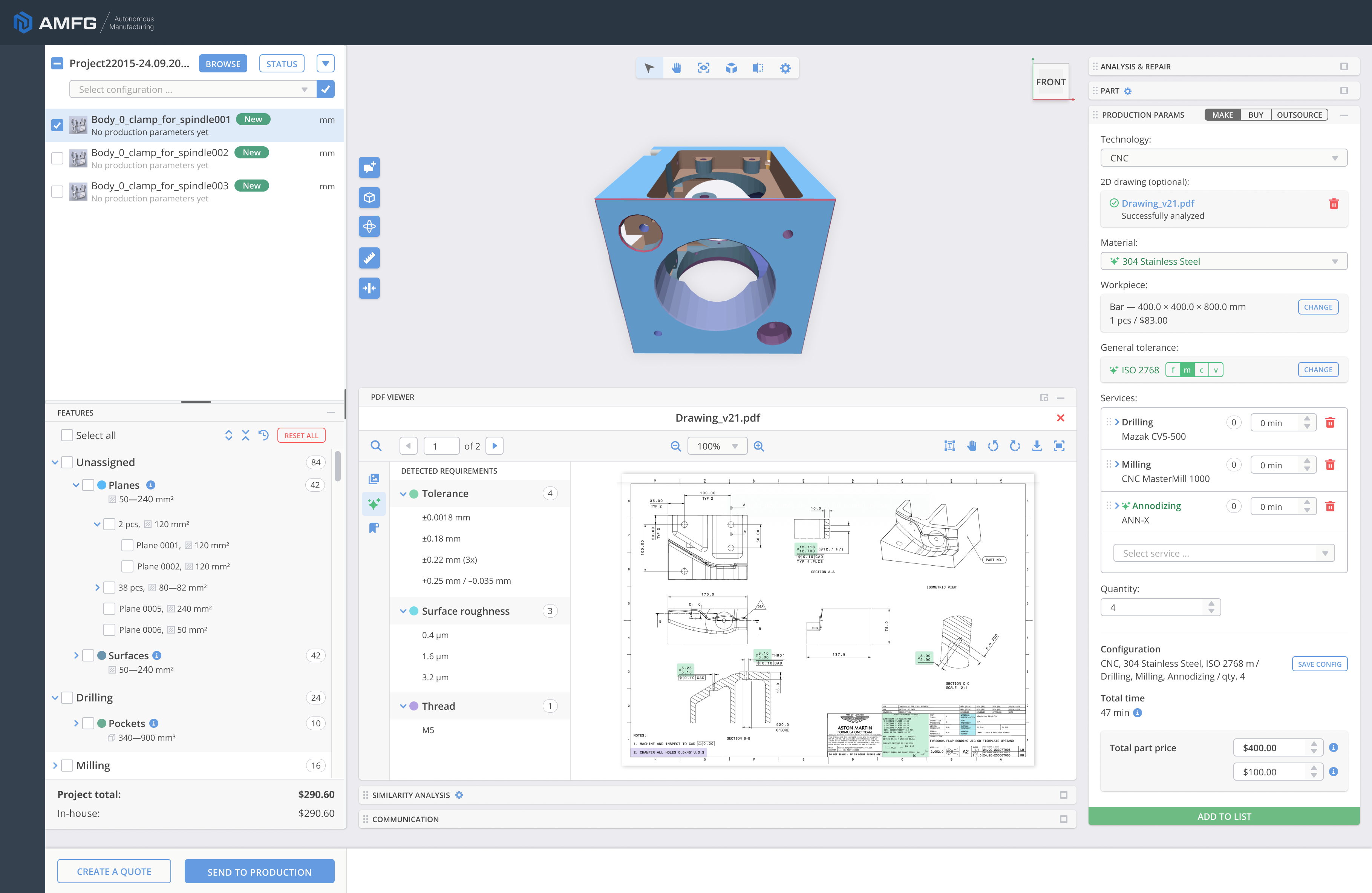
AMFG works with high-mix, low volume manufacturers across the globe, streamlining their operations with our cutting-edge software platform. Our scalable tools automate all stages of manufacturing operations, providing automatic quoting and order management. Using our software, our clients can adapt to complex demand with efficiency and precision, securing their place at the forefront of the manufacturing industry.
For more information, please visit www.amfg.ai or contact: press@amfg.ai

.avif)
.svg)