Latest Developments in Additive Manufacturing: June 2025


Another month, another round-up of all things AM. This June, we're taking an industry-specific look at all things 3D printing. From growing markets like footwear and construction, to established areas for AM, such as healthcare and energy, here are 5 developments in additive manufacturing in June 2025.
Construction
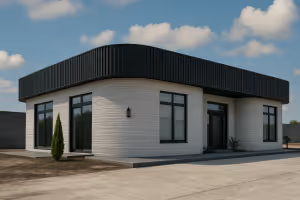
KNUBA’s project that seeks to create concrete mixtures using construction debris and other waste. Image courtesy of KNUBA
Recently, AMFG sketched an outline of additive construction, a rapidly blossoming industry in manufacturing over the past few years. This month, construction giant COBOD installed its BODXL, the world’s largest construction 3D printer, in Doha.
The machine, which measures a staggering 50x30x12m, will be deployed to print two two-story schools on a 100x100m plot. A construction team formed of architects, civil engineers, material scientists, and printer technicians have spent the past eight months training on the massive 3D printer, making more than 100 full-scale test prints at a trial site in Doha.
The schools, inspired by the dune-like desert formations of Qatar, are expected to be completed by the end of the year.
Elsewhere in construction, Kyiv National University has launched a concrete project to rebuild Ukraine with 3D printing and recycled materials, including construction debris and other waste materials. This project promises much both for the rebuilding of the country’s damaged infrastructure, and also for the future of post-crisis infrastructure development.
In Canada, Horizon Legacy and Two Row Architect have collaborated to address housing challenges affecting Indigenous communities by using onsite robotic technology to produce buildings that correspond with Indigenous architecture.
Consumer goods

Philips Fixables. Image courtesy of Philips
Philips are ensuring that their customers suffer no close shaves with a new initiative designed to encourage 3D printed self-repair. Philips Fixables will offer official 3D printable replacement components for free on Printables, a 3D file-sharing platform from Prusa Research.
Currently only a single part is available, a 3mm comb for its OneBlade shaver, and is currently being piloted in the Czech Republic, but the project will aim to signal a change in how tech companies support product longevity.
The move is a positive one for the Right to Repair movement, which advocates for the renewal of the general public’s ability to mend old or faulty products they own. With the rapid development of technology, many have found themselves falling behind, but 3D printing is a technology user-friendly enough to be universally accessible, whilst still being technical enough to properly repair consumers’ products.
The additive consumer goods market is an industry on the rise– find out how to manage complex workflows and ensure efficiency here.
Healthcare

June has seen a host of groundbreaking innovations in 3D printing and healthcare. We offer a couple from across the globe.
In Vietnam, the Vinmec Healthcare System has successfully performed a total femoral replacement in an eight-year-old osteosarcoma patient using a fully 3D‑printed, patient-specific titanium implant. Designed domestically by VinUniversity engineers from MRI/CT scans, the modular implant accommodates future growth.
The procedure, completed in May 2025 after an initial tumor-removal surgery in January 2024, preserved both the limb and life of the child, marking the world’s youngest known use of such an implant. The two-stage surgery highlights Vietnam’s emerging capabilities in precision medical manufacturing, offering a cost-effective alternative to amputation or infection-prone grafting.
Over in the UK, Bristol 3D Medical Centre is leveraging 3D printing for trauma recovery. With 3D imaging, scanning, and printing in a single facility, they are leading the path forward for a new standard in personalised medical reconstruction.
A patient of the centre, after suffering various facial injuries when hit by a drunk driver, has received tailored prosthetic components, including a large orbital prosthesis and scar splints. Given that the technology has the ability to digitally capture the contours of patients’ faces, this development in AM healthcare holds significant promise for the future of the industry.
Footwear
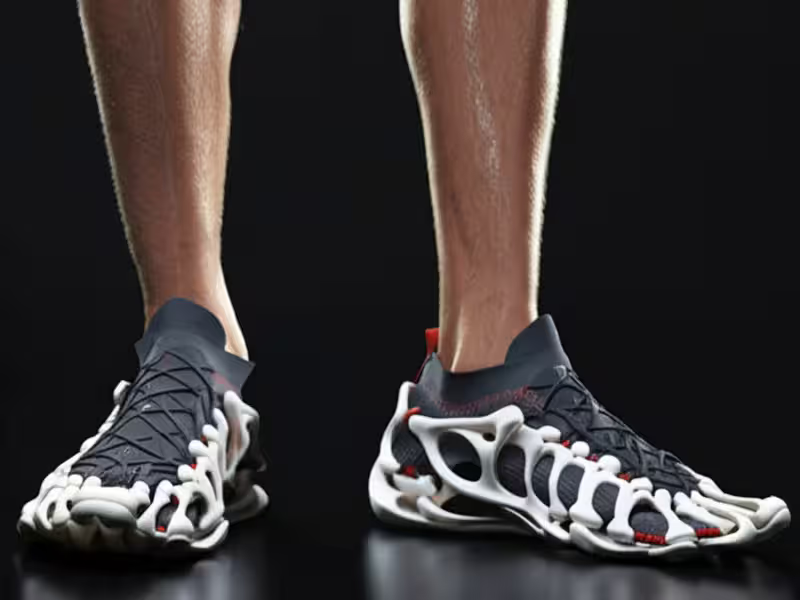
EXOSKYN, a 3D printed sneaker inspired by human anatomy. Image courtesy of TrendHunter
As we covered in a recent article about additive manufacturing success stories, 3D printed footwear is making big strides forward. This month, Lyon-based industrial designer Mahdi Naim and Korux have collaborated on Exoskyn, a 3D printed sneaker inspired by human anatomy.
The shoe uses a bio-inspired structure of the human foot, printed as a flexible monoblock, and, most interestingly, produced exclusively on demand, demonstrating the potential unique use case for AM in footwear in the future.
It draws inspiration from the anatomy of the human foot, featuring a lattice-like framework with ribbed patterns and continuous lines that bring to mind the bones and connective tissue of the foot.
Also in AM shoewear, Nike is preparing to release the Air Max 1000 Oatmeal, its first fully 3D printed shoe, in summer 2025, between June and August. The colourway, a neutral blend of beige tones, has attracted attention on social media, garnering the nickname ‘Foamy Oat’. The shoe represents a collaboration with Zellerfeld, a 3D printing startup, who has also launched a fully 3D printed sneaker and mule with Sean Double U this month.
Energy

First batch of low-carbon foundations for National Grid delivered to University of Sheffield. Image courtesy of National Grid
National Grid has launched the UK’s first trial of 3D‑printed concrete foundations for electricity substations, partnering with Finland’s Hyperion Robotics and the University of Sheffield. These prefab foundations aim to reduce concrete use by 70%, soil displacement by 80%, embodied carbon emissions by 65%, weight by 70%, and on-site labour hours by 50%. They’ll be printed in Finland, tested at Sheffield’s ICAIR facilities, and later field‑trialled at the Deeside Innovation Centre in North Wales.
If scaled across the grid, the initiative could save up to 705 tonnes of concrete, 323 tonnes of CO₂, and around £1.7 million in consumer costs over ten years. Backed by Ofgem’s funding, the project reflects a major stride towards sustainable energy infrastructure.
Also in AM and energy, Italian energy agency ENEA, in collaboration with Vilnius University, has demonstrated how 3D-printed micro-architected foams respond to high-intensity laser pulses, using both experiments and full 3D simulations to validate erosion behavior critical for inertial confinement fusion (ICF) target design. Their findings confirm that additive manufacturing and advanced modeling can produce and predict complex materials for high-energy applications, marking a significant step toward precision-engineered fusion targets.
About AMFG
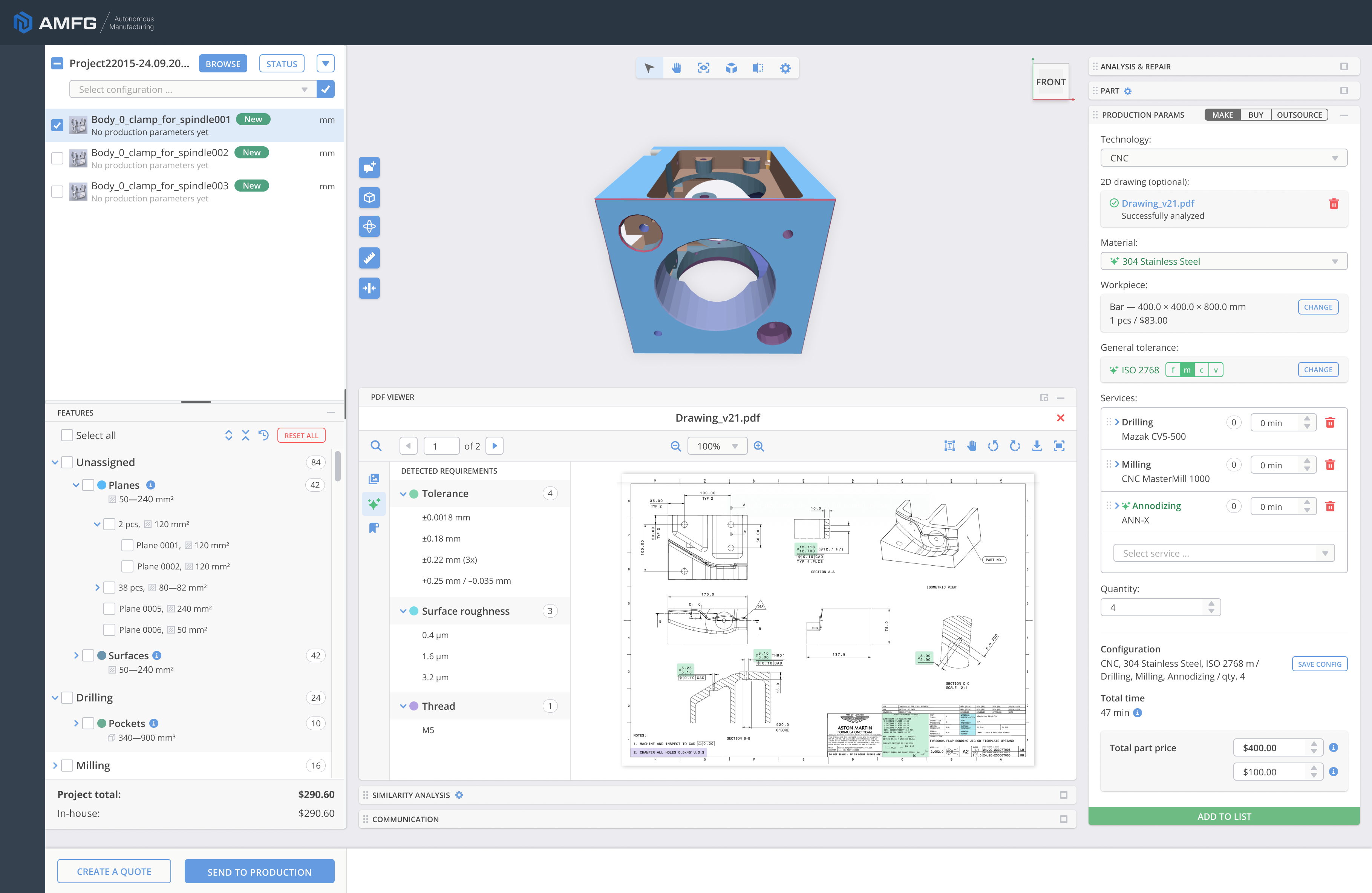
AMFG empowers high-mix, low volume manufacturers across industries, including aerospace, streamlining their operations with our cutting-edge software platform. Our scalable tools automate all stages of manufacturing operations, providing automatic quoting and order management, with 500+ integrations.
Using our software, our clients can adapt to complex demand with efficiency and precision, securing their place at the forefront of the manufacturing industry. Find out more by speaking to one of our team here: Book a demo



.svg)