The Risks of Not Modernizing Your Machine Shop


Most machine shops don't decide to stay behind. They stick with business as usual, because nothing feels broken. The spreadsheet still works and the estimator is managing to turn around RFQs. There's always another RFQ to get out before anyone has time to look at how quotes get made. For shop owners, estimators and planners at high-mix, low-volume shops, that's exactly where the risk sits, because the cost of manual quoting rarely shows up as one big loss. It shows up as jobs you never hear back on and margins that shrink a little with every guessed estimate.
Slow quotes and RFQ piles deciding the jobs you win
In a high-mix shop, every RFQ is a new part with its own drawing and its own questions. Complex parts with multiple features and set ups as well as secondary finishes can quickly eat up your estimators’ time as they pull out different details from the print and model. While that quote sits in your shop’s queue, the buyer is receiving quotes from other shops with faster turnaround.
It’s no secret buyers are rewarding the shops with the fastest shop turnaround times. They shortlist suitable shops in their area and select those who got back to them the fastest. Speed is a key criteria alongside quality and lead time.
The pressure is also growing as more RFQs land on the same desk. We've covered why in the RFQ tidal wave coming for manufacturers.
A single estimator holding up the quoting process
In many shops, the person who can quote is also the owner or the lead programmer. RFQs pile up on their desk and quoting is handled when they manage to make some time in the evenings or between jobs on the floor. When quotes stall, it creates a capacity issue. Even if a shop is equipped with the right machines and has spare hours, they can’t win more work if quotes don’t go out in time. When the flow of new jobs is dependent on one person and they are tied up on the shop floor, it puts the shop’s longevity at risk.
These roles are hard to hire for. In Deloitte's 2025 Smart Manufacturing and Operations Survey of 600 executives at large US manufacturers, 46% reported moderate to significant challenges filling planning and scheduling roles.
Retirements: when the quoting method walks out the door
Ask how a shop quotes and the answer is often a person's name. Their feel for setup times and the customers who always add a second op live in their head or in a spreadsheet only they understand.
In the UK, Make UK's Industrial Strategy Skills Commission points to increased early retirement and an ageing workforce as part of the pressure on manufacturers.
When your most experienced estimator leaves, the reasons behind years of quotes can leave with them. The cost of tribal knowledge can take years to recover as shops try to train or hire for estimators.
Guessed estimates and missed features
With so many variables in a CNC job, mistakes are bound to happen. Someone misses a machined feature or guesses an optimistic cycle time.
The estimate is what the job will cost you to make. The price is what you charge the customer. When the estimate is a guess, the price built on it is a guess too. Quote too low and you win work that loses money. Quote too high to cover the uncertainty and you lose the job entirely.
Consistency matters as much as accuracy. On Practical Machinist's Machine Shop Talk, the host admitted that even two people who think alike about quoting get different numbers, "or even sometimes when we quote something on a Monday versus a Friday" (YouTube).
Customers notice when similar parts come back at a different price. If you want to see where the time and errors go in a manual process, take a look at our comparison of manual and software-assisted quoting.
The manufacturing skills gap makes every one of these harder
The manufacturing skills gap isn't going away soon. In the National Association of Manufacturers' Q4 2025 Manufacturers' Outlook Survey, 72.1% of respondents said they needed to fill skilled production roles such as technicians, welders and machinists. Deloitte and The Manufacturing Institute estimate that 1.9 million US manufacturing jobs could go unfilled by 2033 if the skills and applicant gaps aren't addressed (2024 study).
The skills gap is also widening in the UK. Make UK's Skills Commission report counts 55,000 unfilled long-term vacancies in UK manufacturing and puts the cost of the skills gap at £6bn in lost output each year.
For estimating and quoting at machine shops, this means you can't count on hiring your way out of a backlog. Training a new estimator to quote complex parts takes years, and the people who could train them are the ones retiring. Shops need to start preparing to address the skills gap in CNC machining to lower the quoting skills barrier.
Falling behind shops that have already changed how they quote
Many manufacturers are already moving. In NAM's Q2 2025 survey, 84.7% of manufacturers said they plan to put some emphasis on digital transformation in their operations over the next 12 months, and 21.8% plan a significant emphasis. Among the large manufacturers in Deloitte's 2025 survey, 92% said they believe smart manufacturing will be the main driver of competitiveness over the next three years.
For smaller shops, digital transformation in manufacturing doesn't have to mean a factory-wide overhaul. Often it starts with quoting. BensonsCNC, a two-man, family-owned shop in Iowa, used to spend two to three hours quoting five parts using spreadsheets and educated guesses. With AMFG, the same five parts take 20 to 30 minutes. "I definitely win more jobs because of AMFG," co-owner Trevor Benson said.
Solmeto, which manages aerospace component orders across a European manufacturing network, cut its standard RFQ turnaround from three days to about two hours without adding headcount. As its co-founder put it, "When any other standard manufacturer quotes for two, three, or five days, we quote them within a couple of hours."
If your competitors quote in hours and you quote in days, the gap shows up in your win rate long before it shows up anywhere else.
A low-risk way to start modernising your machine shop
Whether you're just getting started or have already started modernising parts of the shop, you don't need to replace everything at once.
- Start by measuring your quoting. For a month, log how many RFQs come in, how long each quote takes, how many go out and how many you win to identify where the bottlenecks are.
- Write down how you price a part. Put your machine rates, typical setup times, outside processes and markups in one place. It protects the shop if a key person leaves, and any software will need these inputs.
- Start your digital transformation with machine shop quoting software. Quoting is where every job starts and where delays cost you work. It's a smaller change than replacing your ERP or scheduling system.
- Test parts you've already quoted. Run recent jobs through a new tool and compare its estimates with your own quotes and the actual job times to see its accuracy.
- Estimators should have the final say. Software should give the estimator a fast, checkable first pass. The estimator still reviews it and sets the final price.
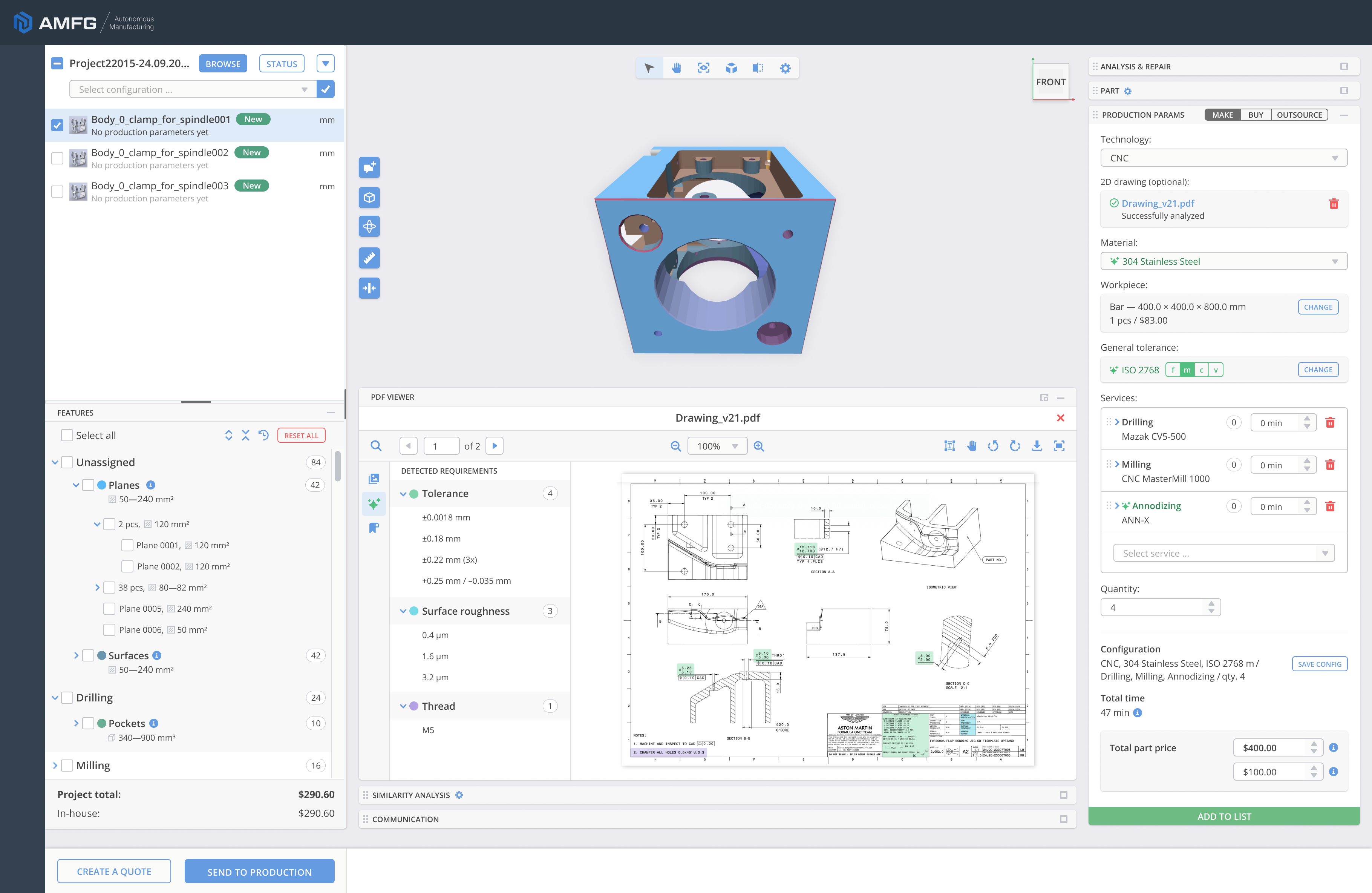
This is where AMFG fits. AMFG builds Estimating & Quoting software for high-mix, low-volume CNC machining and 3D printing manufacturers. The Geometric Estimating Engine analyses the features of a 3D CAD model to model toolpaths, feeds, speeds and material removal rates, similar to a CAM programmer's workflow. Sentinel AI extracts tolerances, surface finishes and GD&T callouts from the 2D drawing and maps them onto the matching features of the 3D model.
AMFG then applies your shop's own machines, tooling, rates and markups, and every estimate comes with a breakdown of how the cost was reached, so your estimator can check it line by line before the quote goes out. See how it works for estimators and for job shops.
FAQs
What does digital transformation in manufacturing mean for a small machine shop?
For a small shop, it usually means moving one process at a time from spreadsheets and memory into connected software. Many shops start with quoting, because that's where delays cost them work. Scheduling and production tracking can follow once quoting is under control.
Is quoting software a good fit for every machine shop?
No. AMFG is built for high-mix, low-volume shops quoting complex custom parts, including shops that quote both CNC machining and 3D printing. Shops making high volumes of simple parts may find a different setup suits them better.
Will quoting software replace my estimator?
No. It takes over the slow parts of building an estimate, like reading the drawing and working out cycle and setup times. The estimator still plays a role in reviewing the breakdown, applying their judgement and deciding the final price.