How to Calculate Price Part with CNC Machining


Pricing a part correctly is the first step to ensuring the long term profitability of your machine shop. To calculate the price of a CNC machined part, estimators need to add the cost of the material including stock allowance and scrap, the one-off batch costs like programming, setup, first-article inspection, dedicated tooling, and the secondary costs per-part including machine time at a fully burdened hourly rate, tooling wear, secondary operations, finishing, inspection and packaging. Divide the batch costs by the quantity, add them to the per-part costs and then apply your margin to arrive at a price.
With so many variables, getting each input right requires meticulous attention. Costing errors are bound to happen as people miss considering an operation, guesstimate an optimistic cycle time or an out-of-date hourly rate or even miss count things. This guide walks through each cost component.
The formula for CNC machining estimates
Cost per part = Material per part + (Batch costs ÷ Quantity) + Machine time cost per part + Per-part secondary costs
Price per part = Cost per part ÷ (1 − Target margin)
Where:
- Material per part is the cost of the blank you buy or cut for each part, including machining allowance, offcuts and scrap.
- Batch costs are incurred once per order or release: CAM programming, setup, dedicated tooling, first-article inspection, minimum lot charges from subcontractors and carriage.
- Quantity is the number of parts in the order or release that shares those batch costs.
- Machine time cost per part is cycle time multiplied by a burdened hourly rate.
- Per-part secondary costs include deburring, finishing, in-process inspection, tooling wear, packaging and any additional costs for traceability.
- Target margin is the share of the price per part you want to keep after costs.
Keeping batch costs and per-part costs separate is a useful habit in CNC estimating and quoting. If a customer ever asks for a repeat order, it prevents double counting time required for first time parts.
The main CNC machining cost components
1. Material per part
Formula term: Material per part, added once for every part.
Material cost isn’t just the cost of the finished part’s volume multiplied by price per kilogram. You need to cost the blank you actually buy or cut, which includes:
- Machining allowance – extra stock on each face. A few millimetres per side is common for sawn plate or bar, but your allowance depends on stock tolerance, flatness and how you hold the part.
- Saw kerf and offcuts – each cut consumes material, and bar ends or plate remnants that cannot be reused are scrapped.
- Standard stock sizes – if the nearest bar stock is 40 mm diameter and the part needs 33 mm, you still pay for 40 mm.
- Setup and scrap allowance – an extra blank or two per batch for first-off proving, or a percentage scrap rate based on your history for the material and part type.
Material grade also affects machine time, not just purchase price. Aluminium or brass will usually cut far faster than a tougher material like stainless steel or titanium alloy, so material choice impacts cycle time calculation. AMFG's guide to strategic material selection for cost-effective CNC machining covers this trade-off in more detail.
2. Batch costs
Formula term: Batch costs, paid once per order or release and then divided by the quantity.
CAM programming
Programming time covers importing the model, choosing the setups and workholding, creating and simulating toolpaths, posting code and producing setup sheets. This is only accounted for once as a new part may need hours of programming, while a repeat won’t. Many shops charge programming as a separate non-recurring line on first orders so it does not distort the repeat price.
Setup
Setup time is time set aside to prepare a machine for the next production, including loading tools, measuring tool lengths, fitting and indicating vices or fixtures, setting work offsets and proving out the first part. It is charged at the machine or shop rate because the machine is not earning while it happens. Every additional operation, for example flipping the part for a second side, adds its own setup.
Dedicated tooling
If dedicated tooling is bought for a specific job, like special form cutters, a reamer for an unusual fit or soft jaws. It is a batch cost. General tool wear is a per-part cost and is covered under per-part secondary costs.
First-article inspection and subcontract minimums
First-article inspection is done once per batch. Subcontract minimum lot charges are accounted for once a batch as well.
3. Impact of Batch size
Formula term: Quantity.
Because programming, setup and inspection are fixed per batch, cost per part falls steeply as quantity rises, then flattens out once machine time dominates.
4. Machine time cost per part
Formula term: Machine time cost per part = cycle time × burdened hourly rate. The burdened hourly rate includes the machine hourly rate, labour and overheads, so labour and overheads are not separate terms in the formula.
Machine hourly rate
The machine hourly rate is how much it costs you to run your CNC machine for an hour including the annual cost of owning and running the machine, divided by the hours you can realistically sell. Typical inputs are:
- Depreciation – purchase price less expected residual value, spread over the period you expect to use the machine.
- Finance cost – interest on loans or leases, or the opportunity cost of capital.
- Maintenance and service contracts – planned servicing, spindle rebuilds, way covers, probing and software updates.
- Floor space – a share of rent or building cost based on the machine's footprint.
- Power and compressed air – often costed per running hour.
- Productive hours – the number that most shops overestimate. Use available shift hours multiplied by a realistic utilisation figure taken from your own records.
Usually, shops include this in a single shop rate, which also includes operator labour and overhead recovery. That shop rate is the burdened hourly rate in the formula.
Labour
Labour cost is the total cost of an employee: wages plus employer on-costs such as National Insurance or payroll taxes, pension contributions, holiday pay and training. To get the labour cost per machine hour, divide it by the number of machines they run in that hour. If one operator runs two machines, the labour cost per machine hour roughly halves.
Overheads
Overheads are costs not tied to a specific machine, including items like back office staff, office rent, software licences, insurance, accreditation audits and general consumables. They are usually recovered through a per-hour allocation in the burdened hourly rate, or a percentage uplift on cost. Check periodically that your rates actually recovered last year's overheads.
Cycle time
Cycle time is the in-machine time per part: cutting time, rapid moves, tool changes and, in most quoting models, load and unload. Multiply it by the burdened hourly rate to get the machine time cost per part. It is usually the largest cost driver for production quantities, and it is also where estimates vary most between estimators.
5. Per-part secondary costs
Formula term: Per-part secondary costs, added once for every part.
These are frequently the items that get missed:
- Tool wear – allocated per part or per machine hour, with higher rates on hard or abrasive materials.
- Deburring and edge breaking – manual bench time should be accounted per part.
- Heat treatment, anodising, plating, painting or passivation – usually subcontracted and priced per part, with the minimum lot charge and carriage both ways counted in batch costs.
- Inspection – in-process checks at a defined frequency, CMM time and any documentation such as inspection reports or certificates of conformity, plus any additional costs for traceability.
- Marking, cleaning and packaging – any laser marking, part-specific packaging or protective wrapping.
Drawing notes such as surface finish, thread class, coating specification and inspection requirements drive many of these costs, which is why the drawing must be read alongside the 3D model.
6. Target margin
Formula term: Target margin is what turns a cost per part into a price per part: price per part = cost per part ÷ (1 − target margin).
Margin is a commercial decision rather than a cost, but the maths matters. A markup is applied to cost; a margin is a share of the selling price. A 25% markup on £100 cost gives £125, which is a 20% margin. To achieve a 25% margin, divide cost by 0.75 (giving £133.33). Mixing the two terms is a common source of under-pricing.
Common mistakes when calculating CNC machining costs
- Using an outdated hourly rate. Energy, wages and finance costs change; recalculate at least annually.
- Forgetting the second (or third) operation. Each flip, re-clamp or additional machine adds setup and handling time.
- Ignoring minimum lot charges. Subcontract finishing and heat treatment minimums can hike up the prices.
- Treating margin and markup as the same thing. Decide which one your business targets and use it consistently.
- Never comparing estimate to actual. Without feeding real job times back into your model, errors repeat.
How software helps with CNC cost calculation
Spreadsheets can handle the arithmetic above, but they rely on an estimator to interpret every model and drawing, choose the operations and estimate times by hand. That is where most of the effort, errors and most of the variation between estimators occur.
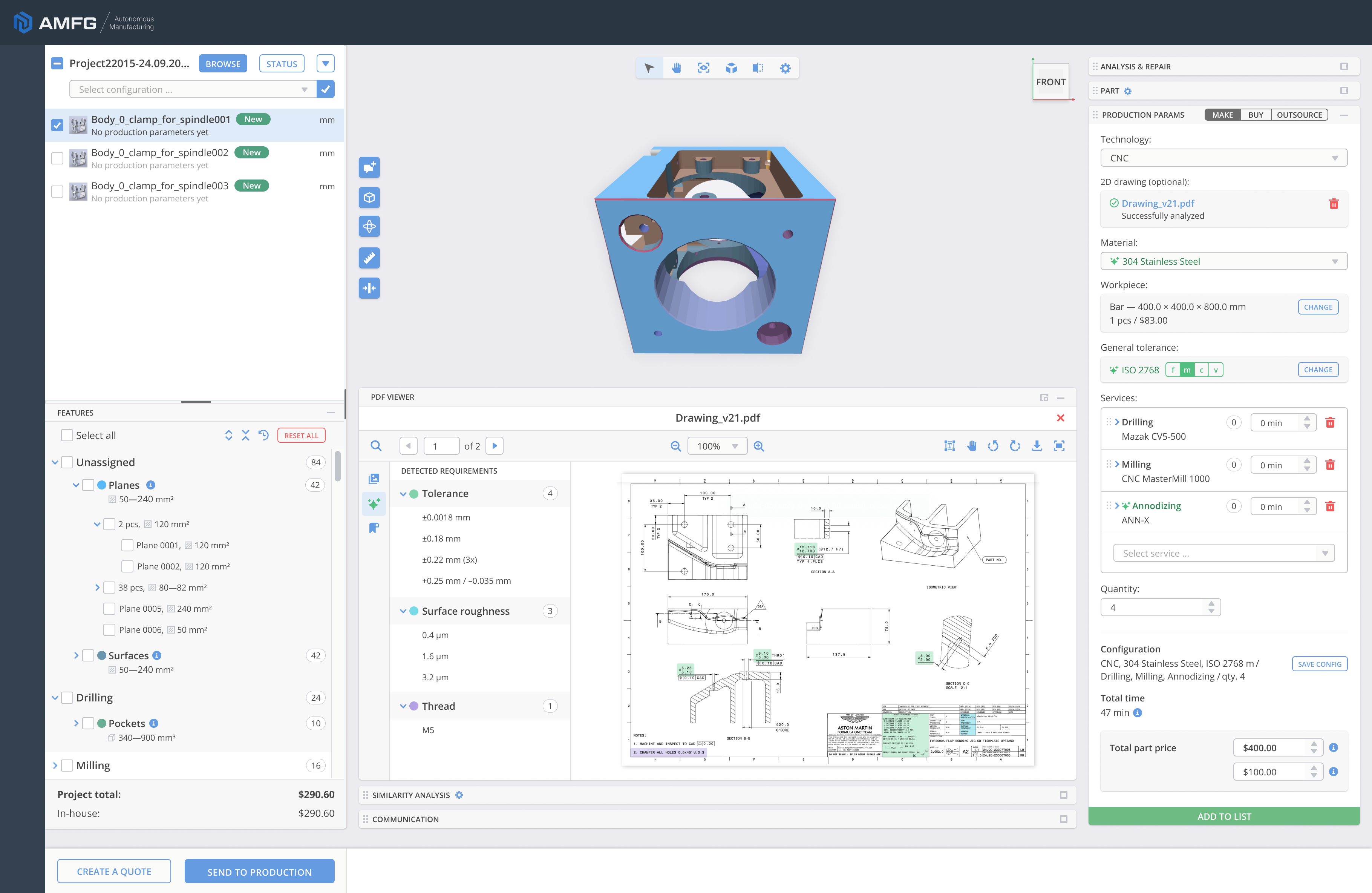
AMFG's CNC estimating and quoting software is designed to take on that groundwork. The Geometric Estimating Engine analyses 3D CAD files to calculate cycle, setup and programming time estimates, taking into account machinable features, material hardness, automatic tool assignment and tolerancing factors from their 2D files. That baseline is combined with each shop's own data and costing logic including cutting speeds, hourly rates and post-processing costs can all be modified, with the final checks done by the estimator to adjust it if necessary. AMFG's auto-quoting tools can then apply shop-specific markups, surcharges and variable machine rates.
The principles in this guide still apply: software is only as good as the rates, materials and rules you configure. If you are considering moving from spreadsheets, check our comparison between manual and software-assisted quoting.
FAQ
How do you calculate CNC machining cost per hour?
Add up the annual cost of owning and running the machine (depreciation, finance, maintenance, floor space) and divide by realistic productive hours, then add running costs such as power. If you quote a single shop rate, add fully loaded operator labour and an overhead allocation.
What is the biggest cost driver in CNC machining?
For production quantities it is usually cycle time multiplied by the hourly rate. For prototypes and small batches, fixed costs such as programming, setup, inspection and subcontract minimum charges often outweigh machine time.
Is a CNC cost calculator accurate?
A calculator is only as accurate as its inputs. Generic online calculators use generic rates; an accurate cost model uses your own machine rates, material prices, cycle times and finishing costs and is checked against actual job data over time.